
@ London Coliseum. Conducted by Yoel Gamzou. Marina Abramović, Director, actor, set designer and scenography (Maria Callas).\r(Opening Night 03-11-2023)\r©Tristram Kenton 10-23\r(3 Raveley Street, LONDON NW5 2HX TEL 0207 267 5550 Mob 07973 617 355)email: tristram@tristramkenton.com\r
This is an important year for Maria Callas fans – this being the centenary year of her birth.
Artistic tributes to La Divina, (Callas’s nickname), kicked off with Serbian performance artist, Marina Abramović, who used the English National Opera to explore her obsession with Callas. 7 Deaths of Maria Callas is no ordinary opera as you would expect from this provocative artist .
A large screen with dreamy, cloudy visuals gave way to lurid death scenes. Abramović dramatised seven operatic deaths inspired by operas by Bellini (Norma), Bizet (Carmen), Donizetti (Lucia di Lameermoor), Puccini (Tosca) and Verdi (La Traviata). The key arias from these operas were sung by a starry line-up of sopranos.
Abramović’s videos invited much blood, fantasy, madness and where there was beauty, it was always shocking! Abramović played on extremes, where beauty of the aria vied with darkness and danger on screen.
A scene with a yellow boa was probably the most striking image. Actor, Willem Dafoe, wrapped a live one around Abramovic’s head to reference Desdemona’s smothering in Verdi’s Otello. As this was happening, Nadine Benjamin sang a most moving and quiet rendition of ‘Ave Maria’!
Some people may have found, as I did, these imaginings distracting, especially as part of the attraction of 7 Deaths of Mara Callas was to hear these marvellous arias sung.
Abramović however, impressed in the final act. The act was original and really rather brilliant. The curtain lifted and there was Maria Callas’s Parisian apartment in Avenue George Mandel, where the diva lived in the late 1960s, with its empire furniture, oil paintings, velvet soft furnishings and glass doors which opened out onto a balcony. In bed lay Abramović, or was it Callas, the resemblance was uncanny from certain angles.
An invisible Onassis droned out orders in the room. Callas stood up slowly and followed his demands blindly, measuring her steps as she navigated her bedroom. Choreographed maids came and went, played by the sopranos we had heard earlier. Other new music by Marko Nikodijecić – which had opened the ‘opera’ beautifully, now filled the space. There were surprise vocal interludes, several choirs of beautiful low voices issued from two boxes either side of the stage.
Abramović finally appeared on stage in a gold lamé dress, hair pulled back from her face, Callas incarnate.
It was a sort of theatre of the absurd – very French – very European even, a neat dramatisation of Onassis’s continuing hold over Callas, even after he was no longer part of her life. And in amongst Callas’s subjugation, there was also the suggestion that she too exerted her power over the maids, who were indistinguishable from each other in uniform. Willing slaves perhaps but still catering to her every whim.
An interesting artistic exploration of power.
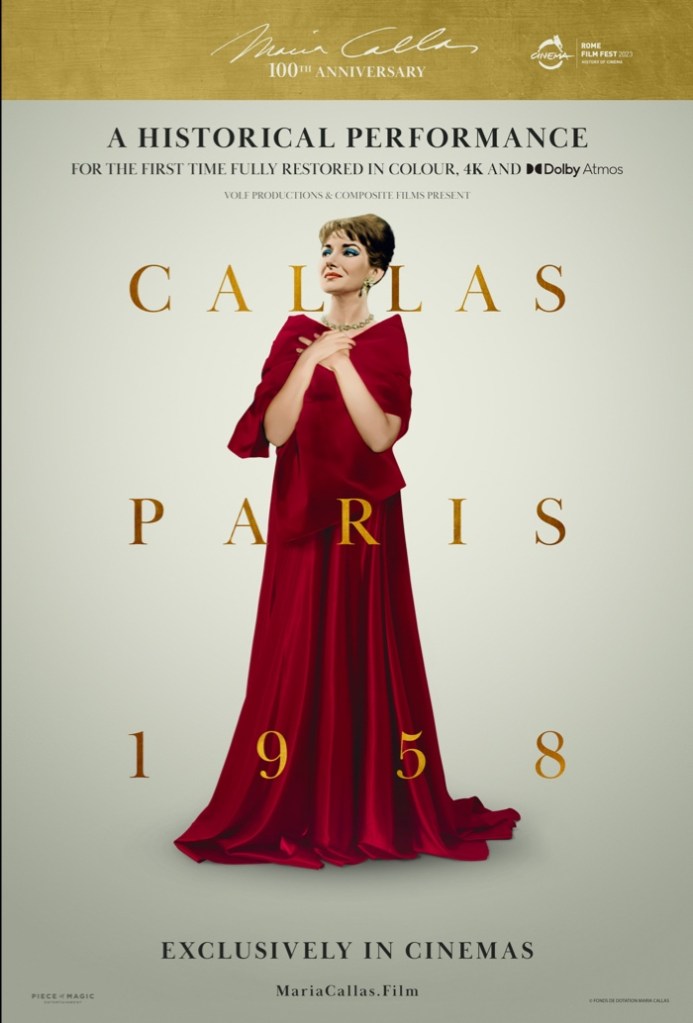
In the same week Callas-Paris, 1958 a rare historical film of Callas singing at the Palais Garnier opera house was released in cinemas in the UK and Ireland. The original Black and White 16mm film had been remastered – coloured, edited.
Colour is a magnificent thing as it brings into sharp relief the fashion of the time, hairdos, heavy jewellery, makeup and slingback shoes.
With colour – you are projected to that night in 1958 when Callas nervously faced tout Paris. Politicians, film stars, a young Brigitte Bardot with a beau who bears a great resemblance to Sacha Distel (a French popstar), enter the famous opera house where Callas is to give a gala performance of her most famous arias and perform Tosca.
Callas faces her audience, painfully thin with her piled up hair accentuating the thinness of her neck. Her shimmering blue eyeshadow is thickly applied. Her long velvet red dress matches the stage curtains! She appears a little drawn.
Before Paris, she had had to endure a disastrous performance of Norma at the Rome Opera, Italy, where she had sung well below par. She had had to bow out at the interval, leaving the Italian President and audience high and dry. The police had had to be called in to quieten the rumpus caused by disappointed, outraged fans.
The ninety-minute film has been judiciously edited down by Tom Volf from the original three hours. In her solo performances Callas displays her remarkable vocal versatility (she was an allrounder soprano at her peak), but on this film we also hear the odd reedy high note!
The stage is set for Tosca. Callas appears transformed into a Grecian goddess, in dress and in voice. Her eyes sparkle with excitement then narrow to the task. She is the proud, trapped Tosca, mentally tortured by her captor Scarpia. I expect her to overact – instead Callas delivers an awe-inspiring performance. Scarpia is masterful, seductive. Tito Gobbi I discover. The male cast is incidentally superb.
This is a unique record of Callas still singing at the top of her game. There is relatively little footage of Callas singing in performance so this film is to be treasured and also seen!
A must for Callas fans!
KH
- Soprano line-up for 7 Deaths of Maria Callas at English National Opera 2023– Eri Nakamura (Traviata), Elbenita Kajtazi (Tosca), Nadine Benjamin (Otello), Karah Son (Madame Butterfly), Aigul Akhmetshina (Carmen), Sarah Tynan (Lucia di Lammermoor), Sophie Bevan (Norma)
Callas, Paris 1958 has a limited release in UK and Irish cinemas on 11, 12th and 22nd November
Discover more from ARTMUSELONDON
Subscribe to get the latest posts sent to your email.
 ARTMUSELONDON