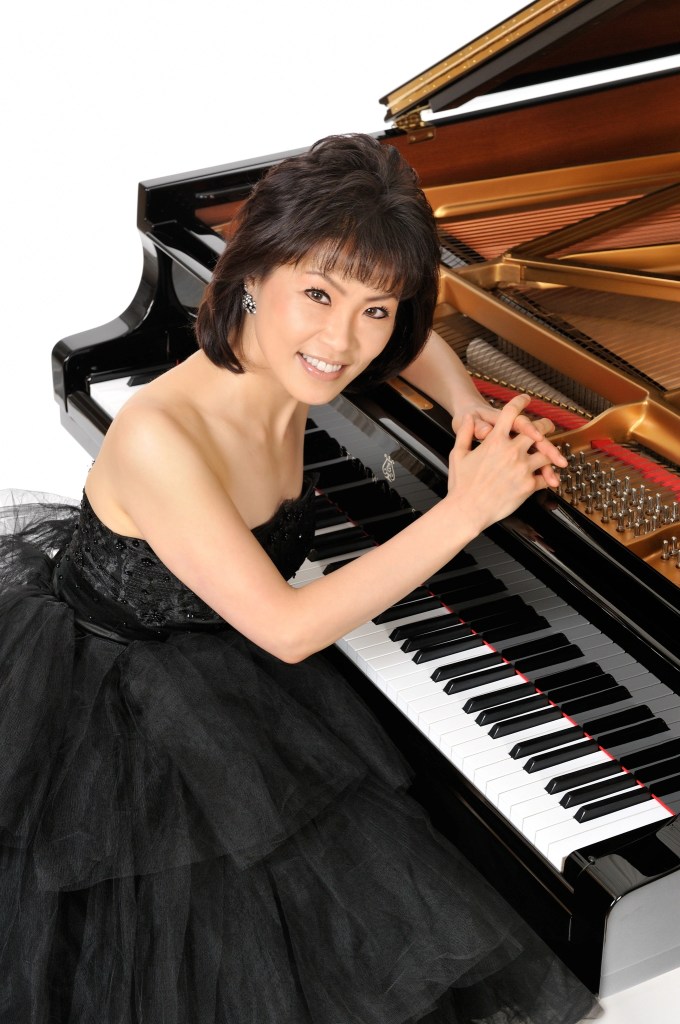
Pianist Noriko Ogawa is an internationally respected pianist and recording artist. She is one of the judges of the Hamamatsu International Piano Competition and is soon to play at King’s Place with the current winner of the 2023 Hamamatsu International Piano Competition, pianist, Can Çakmur,
On 19th January 2024 you will be playing with Can at King’s Place.
What is so special about Çan’s play? Was it hard for the judges to agree on the winner of the Hamamatsu International Piano Competition?
At the Hamamatsu International Piano Competition, there is no conferring between the jury members for the whole three weeks – it can be quite lonely as a result. I remember that after the jury had cast their votes, Can was a clear winner. Six months later, I sat next to the vice-chair of the competition at the Prize Winners Concert in Tokyo, and we finally exchanged a few words about Can’s play. Can’s performances were beautiful and musical all the way through, but the most memorable moment came during the chamber music semi-final round. His Schubert Sonata and Mozart Piano Quartet were simply outstanding. Every detail of every phrase just followed naturally and sounded like the pieces were conceived to be played in that way.
You will be playing a 4-hand arrangement of a Beethoven quartet with Can. What are the challenges and the joys of performing this duet and duets in general?
Playing four-hand piano duets is one of the most fun and challenging forms of chamber music. With one piano, only one person playing the lower part, can control the pedals. This means that we have to be extremely precise in every detail and it can be quite spectacular.
Rehearsing with Can has been a joy. He analyses the piece as we go along and points out all the significant corners of the work. The Grosse Fuge is considered one of the most complex works for string quartet, let alone for 4 hands!
You are the holder of prestigious piano awards yourself and have a long and very varied list of recordings to your name.
Which recording projects are you most proud of ?
Debussy (BIS1955/6). BIS, my recording company, was so doubtful and unkeen when I first suggested Debussy. Robert von Bahr looked at me and said ‘really?’, I said ‘really’. He nodded and ‘OK, if YOU really want to.’
Satie (BIS2215). Erik Satie is a little bit underrated as a composer. His music is raw but after having played all Debussy, I can hear that his fellow composers got ideas from Satie’s raw materials. This recording is played on the 1890 Erard, a charming and chic-sounding French piano.
DUBUGNON (BIS2229) – The concerto was originally written for my great friend Kathryn Stott but she had to cancel for ill health at that time. As a result, I stepped in to give the premiere, which led to this recording. It is a dramatic piece with a huge cadenza. I like this little history of the concerto as well.
You also have had music written for you…
Yes – Joseph Phibbs is writing a new piece for me right now! Joe will be giving me the work in early January 2024 – 19th to be precise. We are good friends – he knows me more than just as a pianist, so he is writing it very much with me in mind. It will be called ‘Sonatine‘. The World Premiere will happen at Muza Kawasaki Symphony Hall in Japan in Feb, the UK Premiere at Stoller Hall, and then Manchester in August.
What advice do you give young pianists who are starting out on a professional musical career?
Nowadays, young musicians have wonderful ideas about how to ‘produce’ themselves. They are very philosophical about their lives. I find them so much more mature than I was as a teenager or in my twenties, so there are very few things I can give as advice. Just one thing I should say is being a musician is a very physical thing as well as an intellectual and emotional thing. I would like everyone to take great care of their health. If you are healthy, you can travel, perform, sleep in strange beds, stay active in career for a long time.
Do you have a special daily routine to keep you mentally and physically fit for piano performances and recordings?
Apart from practicing the piano, I exercise every morning. I use a rubber band (a Dynaband!) to stretch my arms and back. I also do lots of stepping exercises and walk as much as I can. This way, I can clear my mind and physically I feel well even during jetlagged days. I cannot join a gym because of my busy lifestyle, so I exercise at home and in hotel rooms. I use this hour for multi-tasking to watch or listen to my favourite BBC programmes on the computer, read emails which arrive overnight (Japan is 8-9 hours ahead), and sometimes do some internet-shopping!
KH
Programme for 19th January King’s Place, London.
Fazil Say New Life SonataUK PREMIERE
Beethoven Grosse Fuge Op. 134 for Piano 4 Hands
Mozart Piano Quartet No. 1 in G minor K.478
Interval
Schubert Piano Sonata in B flat major D 960
(Encore: Sasaki Sacrifice)
Can Çakmur piano
Noriko Ogawa piano
Benjamin Gilmore violin
Rosalind Ventris viola
Tim Posner cello
Discover more from ARTMUSELONDON
Subscribe to get the latest posts sent to your email.
 ARTMUSELONDON