Pictures at an Exhibition marks its 140th anniversary this year (2026), famous for being one of the most frequently performed, distorted, and some say “butchered” masterpieces of 19th-century Russian music. The late Sviatoslav Richter saw it otherwise. He called Pictures the “best Russian work for piano, amen.” At least, he might have added, when performed as Modest Mussorgsky wrote it.
Lesser performers and composers have never ceased tinkering with it, much to the detriment of the original ten short pieces linked by a recurring motif.
Modest Mussorgsky (1839-1881) wanted to depict a ramble through an art exhibit in Tsarist St. Petersburg. No piano writing of the period quite measured up to its oh-so-Russian sonorities, harmonies, and jolting changes of mood. Among the hundreds of recordings available, Richter’s 1958 recital in Sofia, Bulgaria, is regarded as the gold standard. “The piece has incredible pianistic colour,” William Grant Naboré, director of the International Piano Academy on Lake Como, Italy, tells me in a study of Pictures, “and does it have Russian soul!” Here is the Richter interpretation:
Pictures was slow to settle into the music scene after it was first published in 1886 – 12 years after it was completed and five years after Mussorgsky died. Even the initial published version was distorted. Nikolai Rimsky-Korsakov, a former college roommate, was the first to massage it. “With the best of intentions, Rimsky emended some of Mussorgsky’s more daring touches,” wrote German musicologist Manfred Schandert in his commentary on the urtext manuscript. It nevertheless remained little known for decades, rarely performed in recitals and too difficult for amateurs to play at home.
Writing Pictures was almost frightening in its intensity for Mussorgsky. Musical ideas inspired by the art exhibit flooded his mind over three weeks as he structured what he was hearing in his head. “I can hardly manage to scribble it down fast enough,” he wrote in mid-composition; “I think it is working.”
On the page, images came to life as the music evoked Russian bells, children on a playground, women quarrelling at an open market, two Jews in conversation and a peasant singing as he drives a rumbling wooden cart, among other scenes.
Today, modern audiences love it for its charm and accessibility. “Pictures is a truly Russian work in its directness of expression, its form arising from content, and the sum of its parts rather than “organic growth,” wrote Dr. Michael Russ in an extended Cambridge monograph on the piece. “Mussorgsky prefers to depict real life rather than the spiritual, romantic, sensuous or erotic.”
The suite becomes more poignant considering its genesis: Mussorgsky wrote it shortly after his friend, the architect-artist Viktor Hartmann, died at the age of 39 from sudden heart failure. The two men had similar views on the arts in 19thcentury Russia and were crusading against too much Western European influence on Russian composers.
A temperamental genius with a lively comic streak, Mussorgsky began as a pianist and popular composer of songs. Voice gradually became his special interest. Other lasting contributions are his great operas – Boris Godunov and Khovanshchina. As a music innovator, he was a charter member of the Moscow group variously known as “The Five,” “The Mighty Handful,” and “The Mighty Coterie,” consisting of himself, Rimsky-Korsakov, Mili Balakirev, Alexander Borodin and César Cui. As the late Harold Schonberg wrote, Mussorgsky joined the group at age 18 after training as a regimental officer. Schonberg wrote that he brought with him his regimental habits – “ how to drink, how to wench, how to gamble, how to flog a serf. He found drinking the most congenial.”
His friend Viktor Hartmann worked tirelessly and left a voluminous legacy. For one of his architectural projects he produced a pile of some 700 sketches. He also dabbled in stage sets, teacups, lamps, decorative clocks, picture frames and jewellery but his most accomplished works were watercolours and pencil sketches. The sole Hartmann architecture still standing is the Russian Millennium Monument at Velikiy Novgorod, dating from 1862.
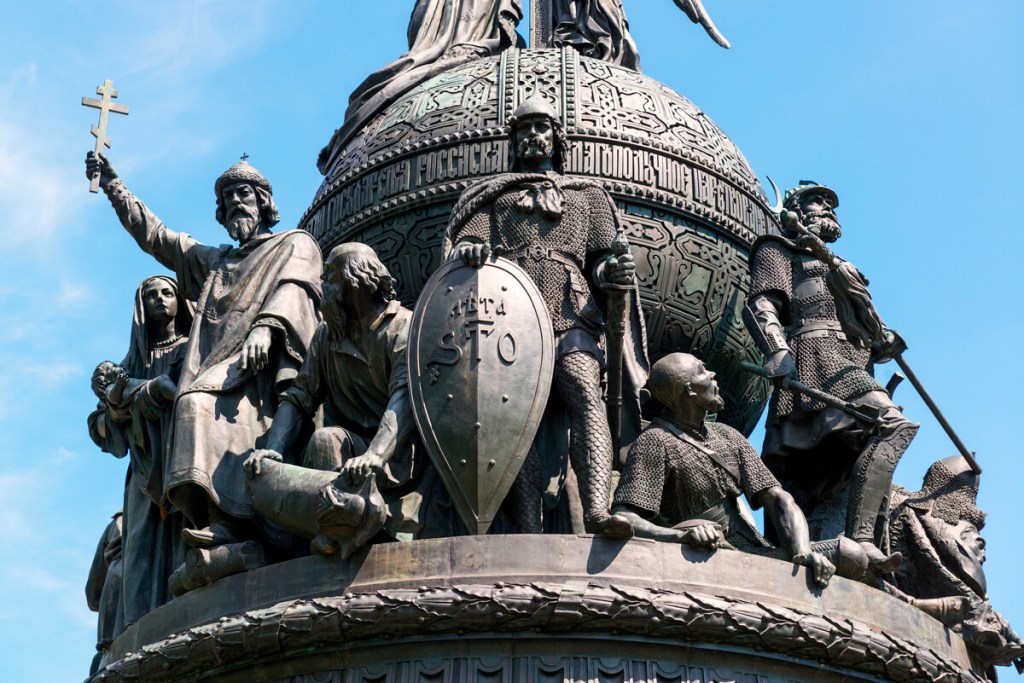
Only about 65 of his paintings and sketches have survived Russia’s diasporas, wars and revolutions. The teacups and other ephemera have long since vanished.
Mussorgsky borrowed from folk music and dances and then felt his way forward. His brother Filaret recalled that the composer, who was largely self-taught, had a love for “everything connected with the people and the peasantry.
Only in 1922, after Serge Koussevitsky, director the Boston Symphony Orchestra, commissioned Maurice Ravel to develop its full orchestral potential. Westernized, Frenchified and popularized in the form most concert-goers know today, some critics found it overdone. The accurate piano original was then finally published in 1931. In the years since, orchestrators, adapters and performers have never stopped trying to make it better. Russian-born Vladimir Horowitz wrote a personalized version of piano Pictures in 1947, “wild, dirty and explosive,” says Naboré. The full suite à la Horowitz is still available here:
Roughly thirty-eight full orchestrations of Pictures are catalogued and another forty or fifty adaptations—many of them on the goofy side—can be found by trawling the web. Eclectic versions for a synthesizer, electric guitar, eight trombones, 23 clarinets, various chamber ensemble combinations, three pipe organs and percussion, accordion, women’s choir, men’s choir, a glass harp, and a Kentucky jug band.
The effect on the ear ranges from stirring (the trombones) to outrageous (rock band Emerson, Lake and Palmer), to just too French for words (the Ravel orchestration, by far the most popular), to cotton candy (Cailliet). For an ear-bending kazoo and pennywhistle parody, Canadian musician Friendly Rich’s orchestra recorded this tribute, which he admits is a butchering:
Such heavyweights as Leopold Stokowski, Vladimir Ashkenazy, Lucien Cailliet (for Eugene Ormandy’s Philadelphia Orchestra), Sir Henry Wood and Leo Funtek also produced orchestrations.
But it is Ravel’s version that causes the most controversy. Russians, who feel they own this music, find his treatment – especially the inclusion of a saxophone – grossly inappropriate. Worse, he is also accused of reproducing errors from an inaccurate piano score. These shortcomings have not prevented the Ravel estate from making millions in royalties, however, as the orchestration became integral to the repertoire throughout the world.
The family fees can be prohibitive, depending on the orchestra and its audience. Swedish movie director Christopher Nupen recalled for me his decision to drop the costly Ravel version he planned to use in a documentary film on Ashkenazy. Instead he opted for the orchestration by Slovenian Leo Funtek. As a bonus, Funtek hewed closer to the piano score – and droppedthe offending saxophone solo.
Later, Russian-born Ashkenazy undertook his own orchestration to restore “complete loyalty to Mussorgsky’s idiom.” Besides, he adds, “in my version these mistakes can be put right.”
Sviatoslav Richter’s criticism went much further. He said in an interview shortly before his death that he considered Pictures to be the “most profound masterpiece of Russian piano music”. But when Ravel tried to improve it, Richter felt, the results were disastrous. “I loathe and abhor” the Ravel piece, he said. The orchestration is “an abomination, a terrible, decorative travesty.” Julian Lampert, a U.S. composer-pianist of Russian descent, tells me he also finds the Ravel version a clash of opposites. It reminds him, he says, of “Grand Marnier poured over potatoes and kasha”.
Music scholars argue in several biographies and monographs on the glories and tragedies of Mussorgsky’s artistic life, focusing first on the spelling and pronunciation of his family name. Variations through the ages had no letter “g,” hinting at the root “musor,” meaning garbage, mucous, or in current slang, “policeman.” One Russian friend tells me she recalls giggles in the classroom whenever Mussorgsky’s name was mentioned. Nevertheless, he took pleasure in signing letters Mussoryanin (in Russian, “he who lives in garbage”.
When Mussorgsky turned his talents to Pictures in 1874, shortly after finishing his great opera Boris Godunov, he selected ten works from the 400 drawings and paintings on display at the Hartmann exhibit to portray in music. They provide one of the earliest examples of program music, the creative process for translating the visual into music. Ironically, six of the ten pictures in the “profoundly Russian” suite were produced during Hartmann’s travels in France, Italy and Poland.
Mussorgsky invented a unique structure to tie the ten pieces together. The pictures are linked by a recurring motif, a “promenade”, to evoke the wandering of an exhibit visitor. The viewer, Mussorgsky himself, first stops at a drawing entitled “The Gnome,” an awkward, jumping dwarf that in its musical depiction was considered “an incredible piece of audacity” in the way it departs from traditional piano writing. Next he stops at Il veccio castello (The Old Castle), painted during his trip to Italy. The music brings out a heart-rending melancholy line, evoking a troubadour performing before the castle. The controversial saxophone appears in this part.

A short promenade returns, then the viewer comes to Tuileries, subtitled Children’s Quarreling at Play. Here the music echoes the sound of animated young voices, one of Mussorgsky’s most effective translations of human sounds to the piano. The frolic and romp of the children virtually leaps from the piano. Next comes a watercolour of a large wooden wagon, titled in Polish “Bydlo,” that combines thick, ponderous left-hand chords of the giant wheels overlaid with a folk tune sung by the driver. A quiet promenade intervenes, then at No. 5 the visitor discovers the Ballet of Unhatched Chicks, a sketch of costumes for a ballet called “Trilbi,” and it appears musically as a charming scherzino that breaks the heavy mood and substitutes a feeling of wild gaiety among privileged children. Next comes another watercolour, this one titled “Samuel Goldenberg and Schmuyle,” which Mussorgsky explained as his attempt to “get at Hartmann’s Jews” and to reproduce more “intonations of human speech.” The music replicates a comfortable Jew speaking in a rumbling voice, alternating with the whining tremulo of the poor Jew.
The longest promenade of the set follows, as the listener imagines the viewer pausing, moving on from picture to picture, finally settling at Limoges, usually subtitled “The Market ( or The Big News)” in which he again picked up sounds of animated chatter. The musical outbursts here were invented to mimic women bickering and exchanging news of the day. Without the promenade, Mussorgsky next moves directly on to the Catacombs (A Roman Sepulchre)” in Paris, that flows from a haunting introduction into a subtheme, “Con mortius in linua mortua, bastard Latin for “With the dead in a dead language.” The eerie melody is Mussorgsky’s translation of a visit to the “place of skulls,” as he wrote on his score, and as he calls out to the macabre scene, “the skulls begin to glow faintly from within”. And on to No. 9, a sketch known as “The Hut of Baba-Yaga,” one of the most exciting passages in the suite, a wild scherzo with unusual harmonies and halting melodies. Hartmann had borrowed “Baba-Yaga” from Russian folklore, a witch who lives deep in the woods. Mussorgsky’s witches’ ride is one of the most interesting of the suite for its thumping rhythms and memorable melodies.
The finale is “Bogatyr Gate, the Great Gate of Kiev,” based on one of the better-known Hartmann sketches, a monument to Tsar Alexander II’s escape from an assassination attempt. He won the design competition for Kiev Gate, with a Slavic war helmet atop it instead of the usual onion dome. He regarded it as his finest work. The monument was never built but the music made it memorable.
Late in life, Mussorgsky’s tragedies multiplied. His operas were dormant or unfinished, his piano suite unpublished. He ended his life as an unpaid assistant teacher at a school for singers. He suffered bouts of depression and struggled with alcoholism. Epileptic seizures became more frequent. His last public appearance as a soloist was at the 1881, commemoration of Dostoevsky’s death, for which he improvised a funeral march..
Mussorgsky was destitute and ill when he sat for a portrait by his friend the painter Ilya Repin. He died March 16, 1881, at 42 just 11 days after the painting was finished, alone in a hospital.
The story of Modest Mussorgsky contains many of the elements of the tortured Russian soul of 19th century fiction – a majestic natural talent, the rise to public acclaim, descent into alcoholism and despair, broke and a pathetic, lonely death.
MJ
Michael Johnson is a former Moscow correspondent and McGraw-Hill veteran of 17 years. He has written for the International New York Times, The Boston Musical Intelligencer, Open Letters Monthly, American Spectator and International Piano magazine. He is a regular contributor to our sister site The Cross-Eyed Pianist
Powered by Squarespace.
Discover more from ARTMUSELONDON
Subscribe to get the latest posts sent to your email.
 ARTMUSELONDON