Schubert’s Winterreise: A Composed Interpretation
Allan Clayton and Aurora Orchestra with Nicholas Collon
Schubert’s Winterreise, published in 1828, the year of the composer’s death at the age of 31, is often described as the greatest song-cycle ever written. Its central themes and preoccupations – love and loss, life and death – resonate through the centuries and continue to have a deeply emotional and philosophical impact today.
Schubert’s setting of 24 poems by Wilhelm Müller traces the psychological journey of a solitary wanderer through an icy, alienated landscape. In his Winterreise: A Composed Interpretation, Hans Zender preserves the cycle’s structure, textual order, and melodic material, but refracts, expands, de- and re-constructs them through a contemporary sound world. The work’s subtitle, “a composed interpretation,” signals that this is not an act of transcription but rather a work in its own right, which reflects the original song-cycle. Zender approaches Schubert as both performer and philosopher, interrogating the emotional extremity and existential bleakness already present in the original.
Zender’s orchestration takes the listener from Schubert’s Vienna, through Mahler and Schoenberg, to the cabaret of Weimar Berlin and the songs of Kurt Weil and his contemporaries. In this way, it challenges received notions of authenticity, historical accuracy and interpretation, and the relationship between performer, composer and audience. If anything, Zender’s Winterreise is even bleaker than Schubert’s with its strong Expressionist flavour and rich sonic associations with contemporary repertoire and instrumentation.
In this new recording, released on the Signum label, tenor Allan Clayton with Aurora Orchestra and conductor Nicholas Collon, take the listener through a landscape of fractured memories, of both music and time, where folk-like simplicity collides with the grandeur of Mahler, the expressionism of Berg, and the wit of Weill.
The opening movement, Gute Nacht, begins with a portentous marching tread, which Zender turns into a protracted fantasia, introducing raw violin notes, then a guitar and other instruments enter, as a fragment of the main melody loops and repeats. This sets up a sense of unease or premonition, before the tenor enters, accompanied by strings.
And it is this undercurrent of unease which makes Zender’s Winterreise so compelling and inventive. Percussion interrupts with biting commentary, there are unexpected dissonances and unsettling fragments, songs dissolve while the orchestration challenges the song line, making the protagonist appear even more alienated and broken.
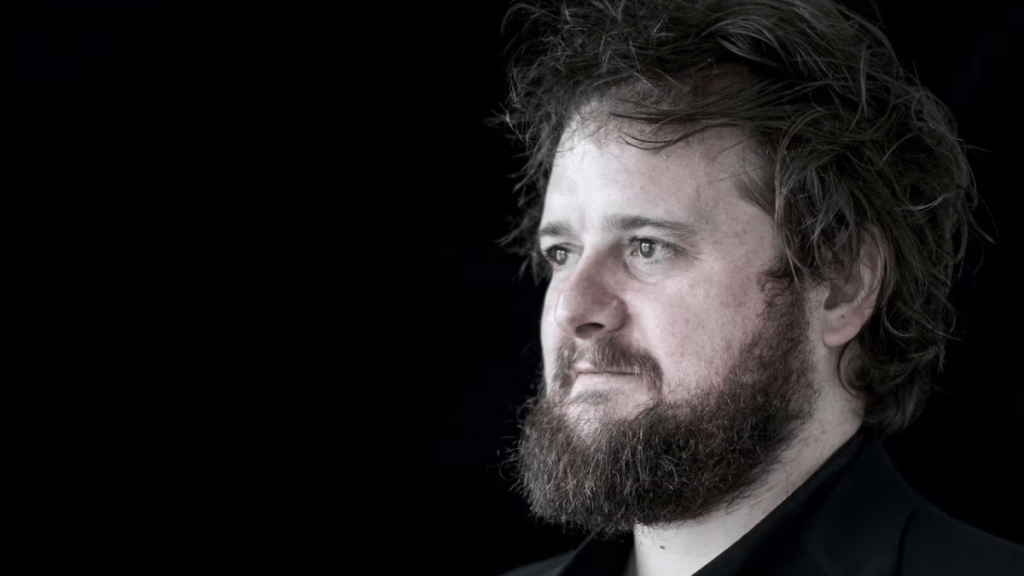
In this new release, Allan Clayton’s expressive, clear tenor voice contrasts and interplays with sparkling, colourful playing by Aurora, creating vivid images and soundscapes.
Zender largely preserves Schubert’s vocal line but enriches it with guitar, accordion, melodicas, saxophone, and striking orchestral effects to evoke storms, frozen tears, fleeting dreams and portents. These timbres allow Zender to externalise the psychological states of the protagonist: cracking ice, distorted echoes, and ghostly harmonics transform the winter landscape into something unstable and hallucinatory. The familiar becomes estranged, echoing the wanderer’s growing disconnection from reality. The final movement, Der Leiermann, is at once bleak and terrifying, the music fading without resolution.
If Schubert’s original leaves you feeling emotionally drained, this interpretation only intensifies Winterreise’s raw truths about love, loss, and despair, offering audiences a compelling contemporary encounter with one of classical music’s most haunting masterpieces.
Hans Zender – Schubert’s Winterreise: A Composed Interpretation is released on the Signum Records label on CD and streaming
FW
Discover more from ARTMUSELONDON
Subscribe to get the latest posts sent to your email.
 ARTMUSELONDON