by Michael Johnson
We have come a long way since female composers suffered denigration for their supposed inability to compose anything of substance. That battle is largely over and the women seem to be winning. Their music is creeping into classical catalogues and concert programmes alongside the men. A musicologist tells me, “There is no longer any such thing as ‘women’s music’, if there ever was.”
Male music-lovers once imagined they heard a more satisfying bass line from the men and just a lot of tinkling and charm from the women. Going by this logic, it’s fair to ask whether Jean-Philippe Rameau was female, whether Erik Satie (listen to his Gymnopédies) was actually a girl, and whether Jean Françaix was a lady. Among the moderns, much of Morton Feldman’s music, by these assumptions, is sexually ambiguous – contrary to his legendary hetero love life.
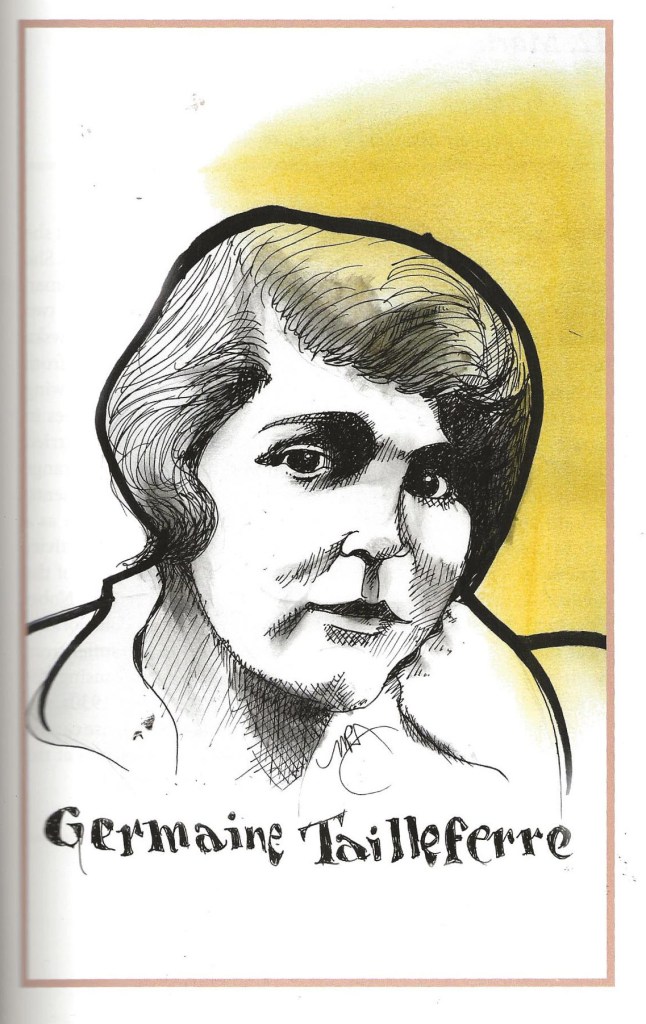
My point? Lots of men have written charming, dainty melodies too, and any honest listener, blindfolded, would have difficulty separating the boys from the girls. My mind wandered into these touchy questions as I studied the background of a neglected composer – Germaine Tailleferre, an alluring French woman who fought the stigma of the weaker sex all her life.
For more than 70 years of prolific composing, and through three marriages, she produced memorable music for opera and ballet, she wrote piano concertos, symphonic works, solo piano pieces, music for small ensembles and some 40 cinema sound tracks. Moving easily among the Parisian Montparnasse set, the culturati of her era named her – with some reservations — the “reigning princess of music,” writes music historian Robert Shapiro.
The only woman in the influential 1920s group of French composers known as “Les Six,” Tailleferre was right to complain that being branded a woman composer was degrading. Even her best friend Darius Milhaud, also in the group of six, tried to praise her but couldn’t resist emphasizing the “scent” of her music. And another close friend, Jean Cocteau, professed to admire her, but likened her work to the wispy works of the popular watercolorist Marie Laurencin. And yet in this performance of her diptych for two pianos, “Jeux de plein air” (Outdoor Games), Tailleferre’s writing is vigorous, bold and original, dissonant and exploratory, quite something for a 25-year-old woman in 1917. In this performance, she displays her range.
When Satie first heard the work he was struck by her originality, and declared, “She is my daughter.”
Tailleferre struggled to be considered asexual in musical terms, asking to be called simply “a composer,” not a “woman composer.” Even today her granddaughter Elvie de Rudder, still teaching music in a Paris lycée, bristles at those who refer to her as “Germaine.” Nobody calls Milhaud “Darius” or Poulenc “Francis,” she says. “So just call her ‘Tailleferre’.”
Easy first-name usage can connote condescension, especially in protocol-sensitive France. With hindsight, we can conclude that Tailleferre was cheated out of her rightful place in the legacy of Les Six. The other more prominent members – Poulenc, Milhaud and Arthur Honegger – are routinely credited as originators of a modern French School of composing. No less an authority on contemporary music as the late Joseph Machlis maintained in his book Introduction to Contemporary Music that Tailleferre and another member of the group, Louis Durey, “dropped from sight” after a brush with fame in the 1920s. Not true. They continued making an impact of their own choosing and at their own pace.
Tailleferre’s natural modesty didn’t help her career. She undervalued herself in part because of the patriarchal culture of early 20th century Europe. Playing her submissive role to the hilt, she told an interviewer she had no grand pretensions about her oeuvre. “It’s not great music, I know,” she told an interviewer. “I write music because it amuses me.” You can almost hear her tiny voice apologizing for what she has done. Despite the old negative assumptions, Tailleferre’s music is being resurrected today by recording companies, orchestral programmers and broadcasters, mainly in France and Britain. As her profile rises, old scores, sometimes tattered, paper-clipped and pasted together, have been unearthed from libraries and played in public venues. BBC Wales is planning a production of her ballet “Le Marchand d’Oiseaux” (The Bird-Seller).
“There is very definitely a revival under way,” says Paul Wehage, an American musicologist and music publisher based in France. As her work is being dusted off, “people are starting to get another idea of her – someone born to compose music.” She is the “most important French woman composer of all time,” he tells me.
The revival is growing among the young as well. French teenagers today learn about her through the syllabus for the general baccalauréat degree which has recently added her story as required reading. The students’ initial reaction, however, tends toward hilarity, for her family name was originally “Taillefesse,” a term of disputed origin that evokes sculpting of the derrière.
She changed her name, but only to spite her father, Arthur, who refused to support her music studies. He considered music an unworthy pursuit and saw the Paris Conservatoire, where she was headed, as a den of vice. “A woman studying music was no better than her becoming a streetwalker,” writes musicologist Shapiro in his historical account Les Six: The French composers and their mentors Jean Cocteau and Erik Satie. Shapiro elaborates:
“She never forgave her father for his inflexible attitude to her artistic gifts – music and the visual arts. Embittered, she is said to have regarded his death (in 1916), as something of a relief.”
Critics past and present have disagreed over her importance as a composer, for she kept up a flow of miniatures and brief pieces, some intentionally dumbed down for beginners, while simultaneously producing monumental works. One critic in 1925 wrote in Le Monde that parts of her piano concerto were “impregnated with a dreamy poetry” typical of a woman. And in London in 1935 her Ouverture was belittled as “slight, gay and perverse”. Another French critic took an upbeat approach to her “Ballade,” finding it new and fresh for 1920, and praising its “spiritual swagger”. In this clip, there is no hint of the gender handicap:
A close reading of her oeuvre reveals a taste for the avant garde, with polytonality and atonality applied to great effect. Her 1964 “Partita for two Pianos and Percussion ‘Homage à Rameau’,” inspired by Bartok’s piece of similar name, has been favuorably compared to Milhaud’s percussion pieces and is perhaps more daring than anything the other five attempted.
Tailleferre was not alone as a woman composer in a man’s world. Specialists point as far back as the 12th century to Hildegard von Bingen as the first major woman composer, followed by hundreds of others who were marginalized by powerful men. Von Bingen’s soaring choral works still sell to CD collectors, and newcomers may be surprised how her “Canticles of Ecstasy” can stir emotions with masterly handling of dynamics and choral harmony:
In more modern times, Clara Schumann and dozens of others fought for recognition, Clara having to fend off her own husband, Robert Schumann, for freedom to make a career. The talented Mélanie Hélène Bonis, a prolific French composer in the early 1900s of vigorous repertoire, and a precursor of Tailleferre, had to adopt the pseudonym “Mel Bonis” to disguise her gender. Contemporary composers who have gained recognition on their merits include Sofia Gubaidulina, Nadia Boulanger and her sister Lili, Cécile Chaminade, Elena Fursova, Lorin Alexander, Meredith Monk, Pauline Oliveros, Linda Catlin Smith and Hildegard Westerkamp, among a long list of others.
Tailleferre fits naturally into this cohort. This winter, in my extensive reading and listening to the music of Les Six, I kept returning to Tailleferre as the most interesting member of the group. She stands out for her original dissonant harmonies and her jolting rhythms. I also like her self-effacing musical modesty. In this mature solo piano work from 1946, “Rêverie” (Dream) she displays a harmonic range and sensitivity equal to Debussy:
Another attraction of the Tailleferre story is her association with a virtual pantheon of great creative minds of her era. She was a close friend of Maurice Ravel and Erik Satie, a favorite of Jean Cocteau and an acquaintance of Aaron Copland, who lavished praise on her for her violin concerto. Also in this hyper-creative crowd were Igor Stravinsky, Pablo Picasso, Georges Braque, Fernand Léger, Amadeo Modigliani, Russian-born cubist Osip Zadkine, André Gide, Guillaume Appolinaire, George Balanchine and Sergei Diaghilev, among others. She once said Picasso gave her the “best lesson in composition” she ever received when he told her to “constantly renew yourself; avoid using the recipes that you have already found.” This counsel she took to heart.
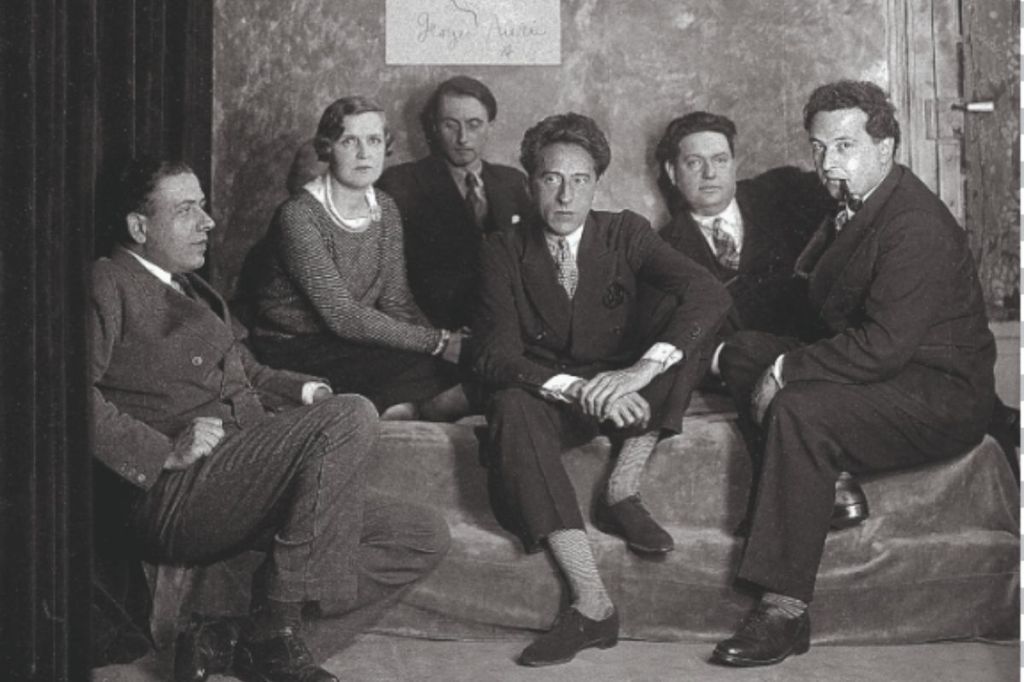
Les Six French composers were in fact a loose club of friends more than a school of composition. Three of them were born in 1892 and studied together at the Conservatoire. Les Six began as Les Nouveaux Jeunes, a group led by Satie and Cocteau. Cocteau’s manifesto, “Le coq et l’arlequin” (The Rooster and the Clown), triggered public interest in the group, and it was nicknamed “Les Six Français” in the magazine pieces of music writer Henri Collet. Tailleferre was welcomed aboard the group as a major talent in 1918 upon publication of her first string quartet.
During the early 1920s, Tailleferre produced some of her major works, including her “First Piano Concerto,” “The Harp Concertino,” and the ballet music for “La nouvelle Cythère” that was commissioned for the Ballets Russes by Diaghilev. The 1930s saw publication of “Concerto for Two Pianos, Choeurs, Saxophones and Orchestra,” the violin concerto and “La cantate de Narcisse” that she worked on in association with the French poet Paul Valéry. And her “Ballade pour Piano et Orchestre” provides perhaps the truest glimpse of her broad capabilities, combining her feel for orchestral color with piano virtuosity.
Tailleferre is credited with one of the first attempts to merge contemporary music with classical structures in her “Sonate pour piano et violon No. 1,” premiered in 1922 by the great pianist Alfred Cortot and popular violinist Jacques Thibaud.
One French critic praised it for being “constantly captivating in its fluidity, unexpected in its novelty, spontaneous in its freshness …” Her neo-classicism, a trend that brought restraint and clarity back to composition after a period of romanticism, showed the way for later works by Stravinsky and Poulenc.
The name attached to Les Six came from a comparison of the group with “The Five,” or the “Mighty Handful” of Russia, comprising Modest Mussorgsky, Nikolai Rimsky-Korsakov, César Cui, Mily Balakirev and Alexander Borodin. Both groups turned inward to develop a national identity in their compositions, free of derivation from the great 19th century Teutonic repertoire which heretofore had dominated. As Les Six joined the creative cauldron in Paris of the 1920s, their compositions were welcomed as an alternative to works of the dreaded Germans, whose culture was rejected by the French after years of militarism, invasion and mechanized war-making. All of Richard Wagner’s compositions were banished from French concert halls for years. Les Six also sought to eradicate the “exalted or sterile” influences of the previous French generation typified by the romanticism of Vincent d’Indy and César Franck. They considered Debussy “dead” and felt Ravel was “arty” and “excessively refined.” American critic Harold Schonberg wrote in his Lives of the Great Composers that they felt “fresh blood was needed,” and the heavy seriousness of classical music was at a dead end. “One had to thumb one’s nose at tradition,” he wrote. “To be lowbrow was to be highbrow.”

Cocteau, the group’s intellectual godfather, urged them on, deriding French-German and French-Russian compositions as “bastard forms of music”. He wanted his friends to produce “French music from France.” If their output sometimes sounds overly accessible today, the public popularity was intentional. Their aim was to be “comprehended by nearly anyone and even appreciated by those who habitually dined on lofty fare,” Shapiro wrote.
Ever the adventurous composer, Tailleferre moved to New York in 1925 to breathe new life into her career. Packing a load of scores in her luggage, she traveled to Philadelphia and convinced Leopold Stokowski to premiere her “Concerto for Piano and Orchestra” featuring the great Cortot on piano. Later during the same visit she performed the concerto with the New York Philharmonic Society under Willem Mengleberg the same night that Cortot was playing it in Boston under Serge Koussevitzky. Her newfound celebrity in the United States led to some twenty-five performances of the concerto. Koussevitzky adopted her as one of his favorite discoveries, offering the American premiere of her “Jeux de plein air” in Boston to great acclaim. Yet the Boston Globe however still hailed her as a “girl composer”: “not in the whole history of music can one encounter more than half a dozen women who have written works taken seriously by musicians,” the critic declared.
Tailleferre’s American adventure seemed to be advancing like a fairy tale when she fell for New Yorker magazine artist Ralph Barton. Within weeks, she had become his fourth wife. After the euphoria wore off she realized Barton, diagnosed as depressive, thought little of her compositions and he discouraged her from continuing. The late Georges Hacquard, in his book Germaine Tailleferre: La dame des Six, describes the Barton salon as a lively New York cultural center, welcoming Charlie Chaplin, Sinclair Lewis, Paul Robeson, Somerset Maugham and other leading lights as intimate friends. At one soirée she played a four-hand transcription with George Gershwin of his “Rhapsody in Blue.” Barton, always footloose and in search of a convivial environment, took her back to France where he hoped they would both find peace. But his psychological disorder worsened, and the marriage disintegrated. They divorced in 1929. He returned to New York, unable to restart his career. In 1931, at age 39, he committed suicide, leaving an explanatory note. An excerpt provides the essential:
“I have had few real difficulties . . . I have had, on the contrary, an exceptionally glamorous life–as lives go. But, since my childhood, I have suffered with a melancholia which, in the past 5 years, has begun to show definite symptoms of manic-depressive insanity.”
Tailleferre’s “Six Chansons Françaises” reflected some of problems that women face in fading relationships. Her song titles include “No, fidelity” and “My husband defamed me?”
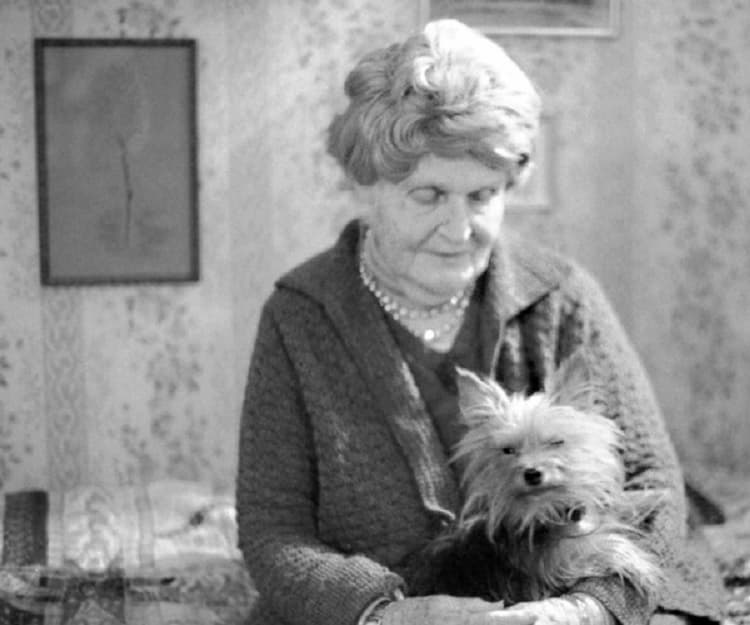
She was still composing when she died in Paris in 1983 at the age of 91.


Discover more from ARTMUSELONDON
Subscribe to get the latest posts sent to your email.
 ARTMUSELONDON