
The Cartier show at the V&A is officially open and what a glittering show it promises to be! I haven’t been yet and before taking myself along to South Kensington, I have been perusing the pages of Cartier, a V&A publication, which accompanies the exhibition.
The heavy tome is a catalogue of sumptuous jewellery that most of us can only dream of wearing and owning. Part 1 entitled, A Signature Style, attempts to pin down the Cartier style and its origins, whereas part 2, Change and Progress, describes the evolution of the brand from a family Paris-based jeweller, to a brand of international renown.
Cartier’s clientele, from the mid-nineteenth century, to the end of the 19th century, was mostly aristocratic. From1900 onwards however, due to a boom in American manufacturing, Cartier acquired a new customer base. American heiresses and wives of enterprise magnates abounded, such as Mrs Cornelius Vandebuilt and Marjorie Merriweather, heiress to the Post cereal empire. These women, referred to as “dollar princesses”, coveted, bought and commissioned Cartier’s sparkling diamond tiaras, necklaces and brooches, and all bejewelled, they felt royally regal!
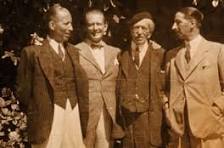
Perhaps the most interesting focus of the book is the story of the three Cartier brothers seen above. Pierre ran the New York Cartier business, Louis was the creative genius behind the whole operation, and Jacques, frequented Maharajas and sourced coloured gems from India and other far-flung places.
Louis Cartier was ambitious for the business from the start. It was he who encouraged his father, Arthur Cartier, to move to a more prestigious address in Paris. Following Louis’s marriage into the Worth family, Cartier set up office in Rue de la Paix, next door to the House of Worth. The Worth connection brought the Cartier House an international clientèle. In 1902, the Cartier brothers opened up an office in London, followed by New York.
Cartier jewellery changed as it entered the flapper era. On Page 25 of the book, there is a magnificent platinum, diamond and pearl shoulder brooch! Quite how they kept it in place is a mystery. Backless dresses in the 1920s meanwhile called for diamond collars and diamond straps which nestled seductively in the crevices of the lower back.
Towards the end of the 1920s, white diamond Garland style which had been the rage at the beginning of the century with American heiresses, now gave way to a new tutti frutti style, which involved lots of colour. Louis Cartier had been bowled over by the vivid green, red and blue, he had seen employed in the Ballets Russes stage sets when Diaghilev’s dancing troupe had come to Paris.
Page 28 reveals a wonderful strap bracelet of emeralds, rubies, sapphires, diamonds and platinum. What is so astonishing about the piece is the way the pierres de couleur have deftly been carved into leaves and berries. Definitely my favourite item. The Hindou necklace P40, worn by Daisy Fellowes, the Singer sewing machine heiress, is also incredibly eye-catching.
Jeanne Toussaint was a great addition to the design team in 1930. There is a wonderful sepia image of Toussaint, Page 31 in the book. Dressed in Chinese silk pyjamas, embroidered jacket and red velvet, silvery-embroidered Russian boots, she’s quite striking and very much her own woman. In the picture, her hair is wrapped into a silk Chinese scarf. Toussaint wore Indian ornaments before they had even been used in fashion. Toussaint was also fond of animals – they appeared everywhere in Cartier pieces – birds, insects, reptiles and tortoises, and most famously, panthers, which were all the fashion since Sarah Bernhart and Josephine Baker had taken them up as pets. Panthers appeared in all shapes and forms. I particularly like a vanity case, Page 37, a diamond panther encrusted with onyx spots, crouches between two emerald trees. Some of the later panthers, encrusted with a wealth of diamonds are a bit bling where this case has restrained elegance.
What the book reveals especially is Louis’s extraordinary creative vision and drive. He was only 23 years old when his father Alfred gave him joint control of Cartier in 1898. Very quickly he set about creating a Cartier style which was gleaned from exploring other cultures, (ie Indian) others arts. Armed with sketch books, Louis’s designers were encouraged to wander around Paris, recording its architecture, old and new, its art and parks. Interestingly, Louis chose not to recruit jewellers, but craftsmen, iron workers and embroiders for example. The focus was on using traditional skills and to transpose them to jewellery design. This was a highly successful creative strategy.
And finally in the book, we arrive at the most iconic Cartier piece – the wristwatch. It’s the first thing we think of when we think of the Cartier brand. We are most familiar with its pared down, elegant design and this design hasn’t changed fundamentally since its inception around 1915. With its square face and Roman numerals, it has become a design classic – the most sought-after wristwatch for men and women.
What the book shows is that there is a lot more to Cartier, than simply the wristwatch.
Everyone will have their favourite brooch, necklace and bracelet when leafing through the book.. You may not even like some of the pieces, finding them vulgar. But knowing the amount of work and thought that went into the design makes you appreciate Cartier jewellery pieces as real works of art.
KH
Exhibition book: https://www.vam.ac.uk/shop/exhibition-ranges/cartier/cartier—exhibition-book-170056.html?srsltid=AfmBOopNP7RpihNdra_2gulLcr1sIp8LDm2qoba8RpkKGfrHmYbfN7zR
Discover more from ARTMUSELONDON
Subscribe to get the latest posts sent to your email.
 ARTMUSELONDON