Dalston’s Cafe OTO hides in plain sight, tucked away from the main drag, the venue’s name invisible to the outside observer until their nose is almost pressed up against the chalkboard by the door. Intimate and somehow inscrutable – quite an achievement for a premises – it hosts a jaw-dropping variety of free jazz and avant-garde artists amid the carefully-curated books, albums and refreshments on sale.
Australia’s The Necks are perhaps the ideal act for this fail-safe space: in fact, one of the staff introducing them joked, with genuine affection, that they were the OTO ‘house band’. For a fantastic few hours last weekend, this felt true, as they embarked on a weekend residency: four gigs in all, a matinee and evening show on both the Saturday and Sunday.
Any readers familiar with the group will realise what an intense undertaking this was. Even within the parameters of fully-improvised performance, what The Necks do is startling. Live, they present as an acoustic jazz trio: Chris Abrahams on piano, Lloyd Swanton on double bass and Tony Buck on drums. At every concert, they take the stage without any forethought or preparation for what they might play. Instead, one of them will suddenly seize on an idea and begin to play. Often, it will be a fairly modest figure or hook, going anywhere and nowhere, a suggestion. Soon, the other two will join in, building the piece from its fragmentary origin to an ever-shifting, constantly-evolving long-form set – usually coming to a climax, then finding a kind of peace at around the 40-50 minute mark. After a breather, they do it all again.
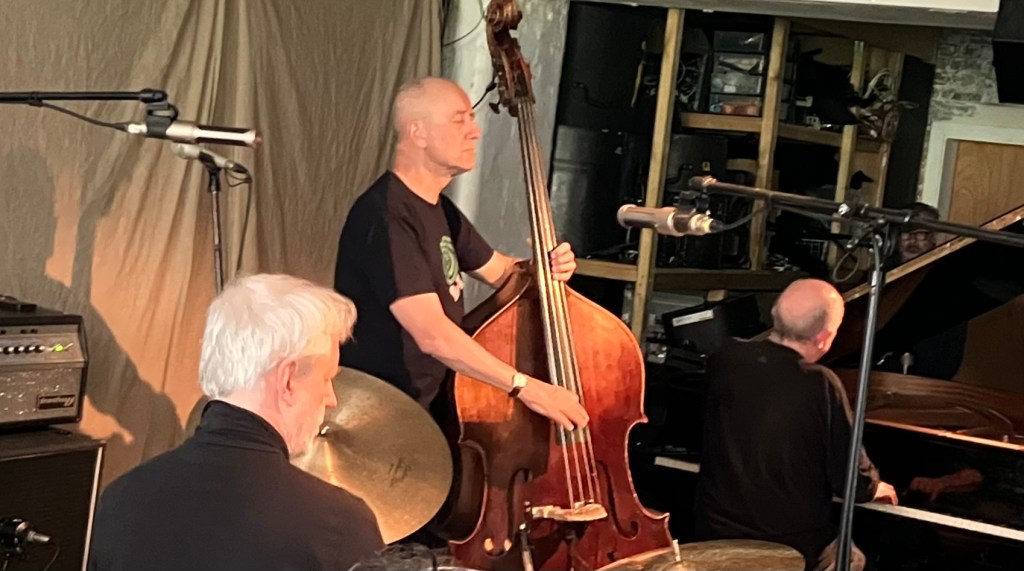
So – those of us with weekend passes would get to hear eight of these spontaneous creations, hewn out of seemingly nothing but the minds and virtuosic abilities of these three men, who have played together for nearly 40 years and must be able to map out each others’ musical directions with unerring, unnerving accuracy.
Necks studio releases emerge from a similar process – but the band allow themselves some extra bells and whistles: editing, overdubs, additional instruments and so on. This is how I knew them. I hadn’t experienced the ‘pure’ concert incarnation until this residency: total immersion, continual reset and refresh. I knew what to expect – but wasn’t sure what I was letting myself in for.
It’s certainly true that the group deftly evade entrapment in any one genre. It might look like jazz, but it doesn’t really sound like it: because the music develops through repetition and restructuring at the most intricate level, it’s no wonder the band are also linked with minimalist classical music or ambient / abstract sound art. Except, of course, that none of the material is through-composed: they produce it there and then, in front of you, and afterwards (unless someone is rolling a tape somewhere) it’s gone forever.
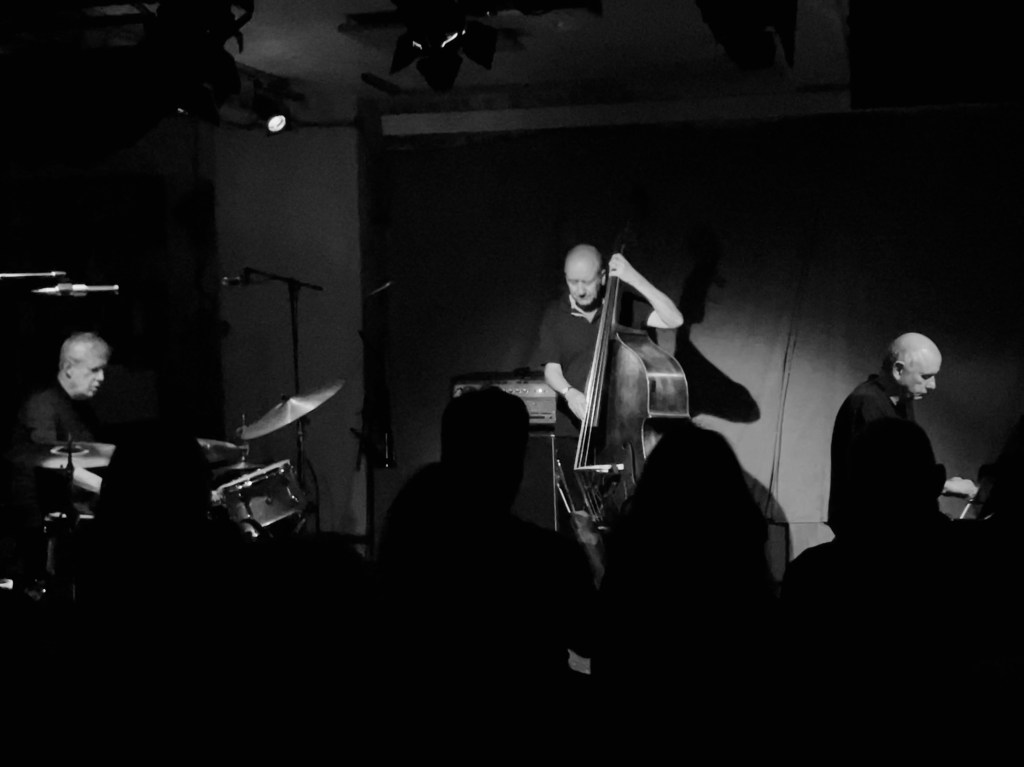
When talking about any musicians with an extraordinary rapport, I try to avoid those clichés that flood the brain – it’s telepathy! Alchemy! A mystery. I think this does a disservice to all the actual hours these artists put in, the hard-won skill and shared sensibility that provides the bedding, the safety net for such sustained inspiration to take place.
That said, I could probably point to one of the four gigs that was so powerful, you could almost believe something else was present in the room: the Sunday matinée. The first set achieved a kind of unabashed beauty. Buck started the improvisation with chimes, which somehow (to this writer’s imagination) conjured a natural-world atmosphere that Abrahams and Swanton drew out further. The early stages of the improvisation formed an elemental ‘ebb and flow’, where the notes seemed to come in and out of focus. This rhythm gradually found a lilting gear, almost funky with a kind of Eno-reminiscent, laidback drift. Eventually a rising piano figure pushed the band into abstraction until the chimes returned to bring it home. I actually didn’t want this one to end.
After the break, this imaginary eco-narrative I’d subconsciously used to frame what I was hearing was still in evidence. Swanton’s percussive strums across the bass strings, accompanied by Buck scraping the end of a drumstick across a snare – my visual imagination showed me scorched earth, cracks in the ground. Then a sudden switch from Buck, replacing the scraping with looser, freer taps on the cymbals, unlocked an array of melodic bass from Swanton, allowing Abrahams to decorate the canvas, like rain on the desert. But cathartic dread is never far away, and one seismic shift after another in the overall sound suggested looming catastrophe, the density such that – as tired an observation as it may seem – it really felt like there was more than three instruments in the mix. Brilliantly, the band can go from a cacophony like this to just emptying out the ‘body’ of the sound, reverting to one melodic idea each almost simultaneously, signalling the way out of the piece, to the end of the gig. This set drew a standing ovation. The two halves of the concert taken together left me drained and exhilarated, perplexed and delighted.
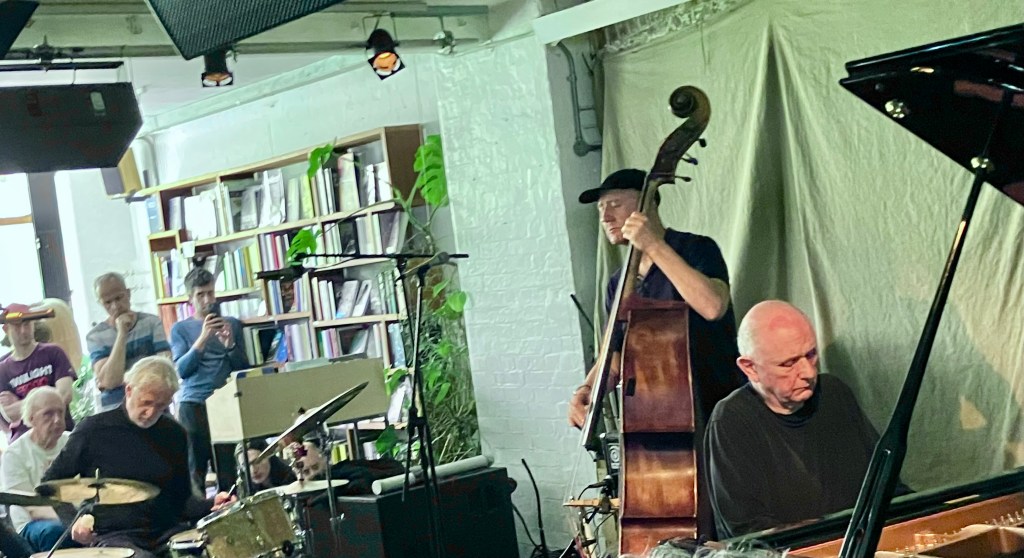
If I sound overcome by that particular gig, it’s because I was. But that was the apex, if you like, of a continuously spectacular weekend, every set featuring moments that one almost grieves are now lost to history.
The second set of the Saturday matinée went full tilt into almost a raga-style drone with Buck, again, extraordinary to watch. Dispensing with his sticks to beat the snare with one hand and keep a constant tambourine shake going with the other, he ground his left foot on a tray of pebbles, and took up other pieces of percussion to strike his kit. Swanton’s hyperactive bass line gave Abrahams space to set up a swirling exchange of chords, a warp and weft that only subsided when Buck gradually let the air back into the improvisation and onwards to eventual quiet.
The first set on Sunday evening was one of the most intriguing – extremely sparse, resisting the ‘wash’ of sound for an achingly long time, the piano laying out for a significant stretch at the start, the piece apparently hanging by a thread. It’s tempting – if almost certainly wide of the mark – to see it as the trio’s response to possible fatigue, the gargantuan task of such close-packed high-octane performance. Even when the noise starts to gather momentum, they never quite ‘pull out the pin’ – the results are trapped, a little claustrophic, only winding down when the piano fractures the pattern.

Perhaps it’s no surprise that the final sets on each day felt the most ‘jazz’, as it finally got dark outside and hints of a subtly more relaxed vibe crept in, however transient. On Saturday night, Abrahams struck up a low-register rumble, with his bandmates locking into a compatible groove. For a few moments, they might have dipped their toes into the same waters the Jarrett Trio (for example) swam in. But the rhythm soon started to circle round and slam into itself, locked in a loop so tight I wondered if we’d need to stage an intervention; however, Swanton held the key this time, switching from bowing to plucking; the piece bent into a new shape, the trio rocking out into a pounding, euphoric outro.
What kind of sonic tightrope is this, sturdy enough to hold all three of these remarkable performers? The mental and physical exertion must be enormous, and yet they are so calm a presence on stage, moving just as much as they need to, appearing very much as the conduit or channel for this thrilling, fascinating music that pours out of them. I noticed that even their stage positions felt a little unusual – when I see small musical groups (from other jazz bands to string quartets or chamber choirs), the eye contact and body language feels crucial. When The Necks play, Abrahams’s piano is over to the right, rather than the left – so Swanton and Buck are behind him. He doesn’t so much as glance at them during the concert, and they play for much of the evening with eyes shut or fixed firmly on their own instruments.
To me this has something to do with democracy and trust – there is no question of any of them ‘leading’ and they have pared down the essence of their responses to what they hear, not what they see. As a result, our trust in them is richly rewarded, shared routes towards extremes in sound that band and audience travel together. An experience I wouldn’t have missed for the world.
AA
(Photos by AA.)
Discover more from ARTMUSELONDON
Subscribe to get the latest posts sent to your email.
 ARTMUSELONDON
that is a beautifully observed, deeply felt and clearly written review. i’ve never had the opportunity for such an immersive Necks experience; i’ve seen them twice, 20 years apart. You do a great job of conveying the intensity of the accumulated performances. You may not need random recommendations from the hoi polloi, but Sydney Dance Company is about to tour their most recent piece, Momenta, to Europe for 7 weeks. They are head and shoulders – perhaps trunk, too – Australia’s best modern dance company. This is a great show; fantastic lighting design, powerful dancing and imposing score. I’m pretty sure it will hold up in international company.
cheers
Andrew
they/m, their/s
LikeLike