by Michael Johnson
The tough-minded London-based Chinese virtuoso pianist Siqian Li has established a promising career concertizing around the world and has now released her first CD, Voyage Among Fragments. Like everything she does, she makes the most of the little fragments of her international life.
Siqian was recognised as exceptional from an early age, when she began private piano lessons and later studied at the Sichuan Conservatory. Progressing steadily, she won acclaim in Asian performances and competitions, eventually entering the Beijing Central Conservatory of Music at the age of 10 – so talented that she was allowed to bypass the entrance audition.
It was her semi-final performance at the Leeds International Piano Competition in 2018 that launched her global career. Her advanced studies took her to the New England Conservatory and finally the Royal College of Music in London, where she is now working on an Artist Diploma, a post-master’s development programme.
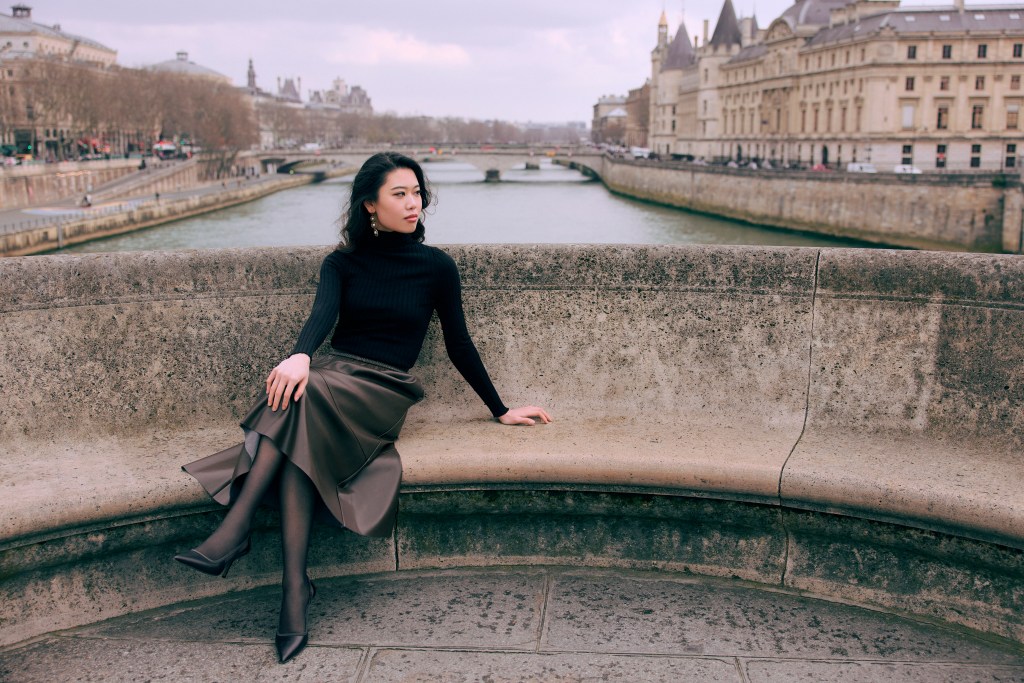
In an hour-long telephone interview recently, she spoke with me in the frankest terms, breaking away from the usual clichés of musicians in self-promotion mode. In a deadly serious tone, she recalled in fluent English how her teachers encouraged her to be “well-behaved” in musical terms. Now that she is an independent adult of 34, she asserts firmly, “I don’t think that is a compliment. I want to be close to people who are daring, maybe a little crazy.”
She told another interviewer: ”Risk-taking is crucial to attaining greatness as a musician and artist. It is how we grow, innovate, and create transcendent experiences for audiences.”
Our conversation focused on her development as an individual, musical and otherwise. She articulates her ideas with sophisticated fluency. Herewith an edited transcript of our interview:
You seem to be on very good personal terms with your principal teachers in China, in the U.S. and the UK. Doesn’t this mean you have become more an internationalist than just another Asian star ?
Yes, and I enjoy that. To experience the world to the maximum is a healthy thing. If you don’t, you won’t see the world comprehensively.
This must have an impact on your ability to interpret freely. Are you able to be your own person, to choose the repertoire you like and play it your way?
That’s what I feel an internationalist is. You can see everything from different angles, and that’s important. Otherwise you would never understand why people see things in a different way.
Now you are a Londoner. Have you rebuilt your life, leaving China behind ?
Sometimes it would be nice to be with family in China , but I am quite independent, mentally and physically. I have friends here and everywhere. But yes it kind of feels like I am rebuilding a life in London. But maybe in five years I will move somewhere else. (laughs)
You are still studying at the Royal College of Music. How has that experience changed you?
In London, I really feel this desire for freedom, which has been with me since I was a child. I always had that urge. I have never liked to do what other people tell me to do. In China, my teachers believed in making students ‘well-behaved’. I don’t think that it a compliment. In London I want to be close to people who are daring, maybe a little crazy.
You say Georgian pianist Alexander Kostantia of the New England Conservatory in Boston helped you discover your sensitive side. How did he do that?
He was so passionate. With him, every note counts. He helped me learn how to address my emotions through music – to reach my limits through musical performance. My time studying with him was truly life-changing. He is a dear friend with a deep connection.
Your repertoire seems light on contemporary music. What holds you back?
I feel some contemporary composers create just for the sake of creating. Often it doesn’t speak to me. I am looking for that spark.
Asian pianists who study in the West have been criticised for being overly disciplined. How have you achieved such freedom in your interpretations?
Before I went to the States (to study at the New England Conservatory), I came to London (to study at the Royal College of Music), and travelled in Europe, and I was a bit like that, over-disciplined. It felt like everything I played had to be ‘well-behaved’. In a way, it’ s a good thing. Music needs a lot of discipline, and that is a strength for Asians. As my experience accumulated, I started to feel the music much, much more. I opened my mind and let the music in. It’s a process. It’s about balance.
Wasn’t it shocking as a beginner to hear what Western composers and performers were able to do?
No, we learned Chinese music and Western music at the same time. Technique is not a problem for Chinese players studying professionally. But we must also understand the meaning behind the music. That’s the difference. It not just music. It’s about history too.
What do you gain from playing jazz?
Jazz attracts me because I always want to break through that wall of discipline. I go to jazz bars to listen to players in solos, ensembles and jam sessions. It’s so good.
Isn’t the piano craze something relatively new in China?
The piano is a Western instrument. Before 1949, I don’t think the piano even existed for us. When we opened up, things from the Western world started to come into China.
“Jasmine Flower” on your CD is a near-perfect merger of East and West. Has composer Wang–hua Chu invented the future? Or are there others out there merging East and West?
Chu is from an older generation. He has based his music on Chinese folk tunes. Tan Dun is younger and more famous worldwide. His score for “Crouching Tiger, Hidden Dragon” won an Oscar in 2000 and found an enthusiastic new audience in the West.
Pianist Zhu Xiao-Mei shocked the world a few years ago with her book about the rigorous training at Beijing Conservatory during the Cultural revolution of the 1960s.
Nobody of my generation has really experienced that because it is far from modern times. We heard a lot of stories about how brutal it was – virtually hell on earth. The target was partly Chinese people who played Western instruments. For that generation, it was a wound. For us, the younger generation, it’s part of history.
Don’t Chinese conservatories create unbearable stress by demanding too much too soon?
In a certain way, yes, it might be hell. But maybe it’s a good thing. It helps you clarify whether you want to do this for a living or not.
There are a lot of Asian pianists enjoying successful careers. Should Western students – some on the lazy side – be afraid of ending up in an overcrowded profession?
I don’t think you should be afraid of that. I don’t think some Western students are lazy but they sometimes do not have motivation. They don’t want it enough. They should not be afraid of competition.
You want to learn things other than hammering on the keyboard day and night. What did you choose?
I took some history classes as part of being selected for the “Best of the Best—Innovative Talent “ programme of the Ministry of Culture. My Chinese teacher was always saying you have to learn a lot of things other than music. I slowly started to appreciate all these things, like art history, for example.
Has all this study helped you nurture your musicianship, to become a better musician?
Yes, because aesthetics are so important. You need to have good taste if you want to do something in the world. It opens you up.
Why do think that you attract such large numbers of music lovers to your performances? What are you doing on the stage that makes you a success?
I think everyone comes to my concerts for different reasons. I just try to be myself, and let that attract people.
What are you working on as a follow-up to your first CD?
I am taking a break. I need a break for many different reasons – artistically, mentally, musically and physically.
After your break?
I am exploring, looking at possible collaboration with other musicians – a new kind of collaboration. I want to explore. It sounds a bit crazy, I know. Maybe I will work with Chinese instruments. Maybe a combination of piano and percussion.
Voyage Among Fragments is released on Siqian’s own label, Sangitta Music, on CD and streaming
Meet the Artist interview with Siqian Li
Discover more from ARTMUSELONDON
Subscribe to get the latest posts sent to your email.
 ARTMUSELONDON