A couple of watermelons still share the stage with the artists as they receive our applause. They are the lucky ones. Their fallen comrades gave their lives in mostly spectacular fashion, just one of the bravura surprises in this wildly inventive production.
‘Out of Her Mouth’ is a joint venture by Dunedin Consort, who supply the players for the evening; Mahogany Opera, which commissions new, diverse and inclusive operatic works; and Hera, an organisation producing work by women and gender-minority artists.
*
On paper, this could have been a Baroque recital like any other. Well – perhaps not quite. The programme features three of Elizabeth Jacquet de la Guerre’s cantatas setting stories of women from the Bible. This is notable in itself – a genuinely rare chance to hear these works live. It’s hard to believe that these are the première UK performances of the cantatas since they were written over 300 years ago. Until, perhaps, you consider that the composer was a woman – even one who enjoyed some success in her lifetime.
This is a key theme of ‘Out of Her Mouth’, presented as music “written by a woman, about women, for women”. The cantatas are as intriguing as they are beautiful, and would have carried themselves well in a standard concert format. But that isn’t the treatment they receive here.
Instead, director Mathilde Lopez has fashioned them into a continuous ‘portmanteau’ of connected tales, reminding us that – even though we’re watching a group of separately conceived works – the thread running through them all is the same old story, repeating itself.
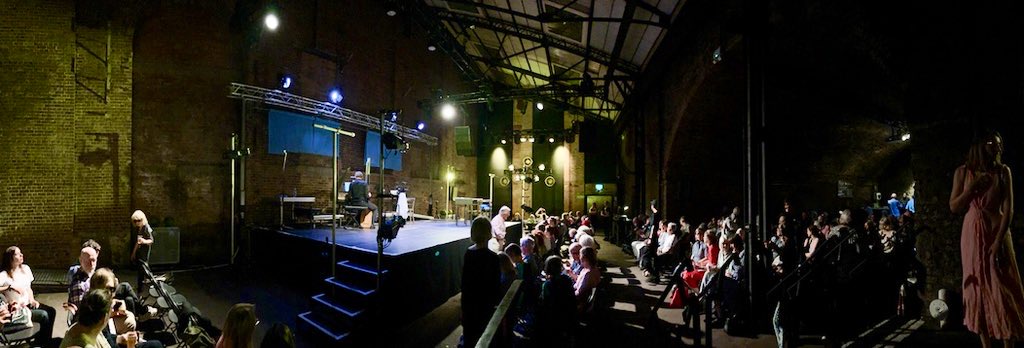
Three sopranos each take one of the cantatas: in the running order, Anna Dennis sings Susanne, Alys Mererid Roberts sings Rachel and Carolyn Sampson sings Judith. However, all three women interact with each other onstage throughout; as each one takes her turn in the spotlight, her two colleagues assist in the narrative, move props or offer a supportive reaction, like a silent chorus.

*
From the word go, ‘Out of Her Mouth’ seeks to challenge your preconceptions. In its opening seconds, before anyone sings a note, the production wears its inclusivity on its sleeve. Susanne describes the stage set, performers and scenario, speaking steadily and clearly into a microphone. Her words scroll past as text, projected on paper rolls hung across the back of the stage. She then moves on to read out the first in a series of extracts from what appears to be anti-discrimination law. One quick search on the Hera website later, I learn these are articles from the UN Declaration on the Elimination of Discrimination Against Women (1967).
I loved the boldness of this. At this point in proceedings, we in the audience don’t even know when a cantata will actually start. Defiantly ‘woke’ – aware, accessible, generous – and unapologetically foregrounding social and sexual politics, this is opening the gate instead of keeping it.
The microphone / declaration framework replays for all three women, helping to provide the overarching structure that makes ‘Out of Her Mouth’ so successful as a unified work. These cool, detached summaries – conveying resignation and resilience – give the women power as tellers of their own stories, so that when they burst into Baroque song, we can regard it almost as flashback, memory. It restores to the central characters, as well as Jacquet de la Guerre herself, a modern voice with agency, in contrast to their past situations, when this voice was suppressed. The business with the microphone in fact leads to a moment of exquisite comic timing from Sampson (which I’m reluctant to spoil) – suffice to say, she demonstrates visually in a split second how the mechanism for having a voice can confer power. The libretto, which makes these disparate styles and channels of expression cohere seamlessly, is by Toria Banks of Hera. The language is witty and naturalistic, easy to follow and utterly contemporary.
This wit also carried through to key moments in the direction and staging. The Dunedin Consort musicians gamely took part. Katarzyna Kowalik continued her impeccable playing on the harpsichord despite finding herself on the receiving end of a character’s physical affections. Violinist Tuomo Suni, whose main musical contribution didn’t arrive until Judith’s cantata, sat seemingly playing a game on his phone, a low-key personification of indifference to the women’s laments, and despite being landed with a watermelon in his lap.
*
Another rug-pull: in those uncertain initial moments, you might think the three soloists are being asked to present as well-worn stereotypes: tomboy, innocent and vamp. Or are they sending them up? Neither. In the event, the show coldly exposed my reductive male gaze: it was only my knee-jerk mental response feeding the clichés. Multiple nuances emerge. Susanne looks back on an incident in her youth when she rebuffed the advances of two older men, who then try – and, fortunately, fail – to have her sentenced to death for adultery. We hear her reflect on her bravery… but we see someone traumatised, radicalised by the experience. Dennis’s role must be complex to negotiate emotionally – Susanne is not a tragic victim, but bears intangible scars – and she sang with a combination of yearning and cocksure realism suggesting multiple layers of thoughts and feelings.
Rachel was promised to Jacob after carrying out years of farm labour for her father, Laban. When the wedding arrives, Laban tricks Jacob into marrying his elder daughter Leah instead. (One imagines that Jacob’s ‘male gaze’ can’t have been especially observant.) Laban doubles down on the deception, suggesting to Jacob that he can take Rachel as a second wife, but only in exchange for more work. Here, Rachel’s spangly boots and bridal attire – dishevelled hen-party accessories – become poignant reminders of her treatment by her father and husband-to-be, reduced to a bargaining chip, the victim of her dad’s sharp practice. She laments the outcome, which was clearly in line with Laban’s proposal: “It isn’t what I hoped it was.” Roberts was heartbreaking, her delicate, youthful timbre burnished with premature regret.

The widow Judith is an object of desire for military man Holofernes, who has just besieged her city. Not letting such a trifle impede the path of romance, he tries to seduce her. Judith, however, is using her allure as a trap. Plying him with drink, he passes out, giving Judith the opportunity to psych herself up, grab his sword and behead him while he sleeps. Almost – but not quite – overwhelmed by what she has done, she rallies, and returns to her people with Holofernes’s head. Here, her long white slip conveys potential love interest, femme fatale and, finally, angel of death.
Judith’s is surely the most flamboyant of the three cantatas, and the production gears this towards being a proper finale, with a key shift in the lighting and the graphic dramatisation of Holofernes’s demise. Sampson rose to the occasion with a fearless performance. She made full use of her bright, clear tone and her mastery of the speed and agility this music requires – essentially making Judith as beautiful in sound as in appearance. But there was also an element of playing ‘against type’, as Sampson allowed glimpses of Judith’s psychosis to appear across face and voice. Winning smiles became devilish grins. Occasional notes were attacked, bitten on, spat out, as Judith steeled herself to release the violence inside. We really felt that Judith was brought to the edge of insanity – and the resulting explosion (literally, from the relevant watermelon’s perspective) was chaotic, climactic and cathartic all in one.
An endlessly rewarding, remarkable creation. I hope it has an ongoing life, on disc perhaps but even better, in future performances.
AA
Discover more from ARTMUSELONDON
Subscribe to get the latest posts sent to your email.
 ARTMUSELONDON
One Comment Add yours