Credit Apple and Biscuit
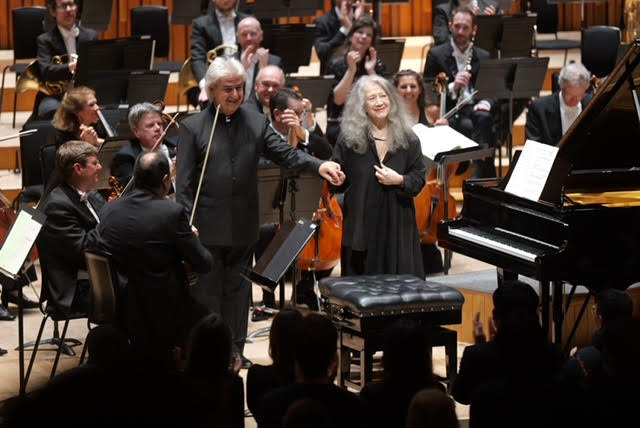
To the Barbican Centre I went last week to see Martha Argerich perform Beethoven’s Concerto no. 2 in B flat major with the Oxford Philharmonic Orchestra. On the program also, Samuel-Coleridge Taylor ‘s Ballade in A minor and Tchaikovsky’s Symphony No 4 in F minor.
Outside the Barbican auditorium a long queue snaked around the pillars of Level minus one. Classical music fans clutched their tickets in anticipation of seeing Argerich, legendary pianist, in the flesh. Argerich is a rare bird in London – even if you might be lucky enough to obtain a ticket, it is not always possible to see her. On this one night however in central London, Argerich was putting in an appearance with the Oxford Philharmonic orchestra, or OPO, an orchestra whose reputation has grown ten-fold in the past few years, largely due to the tireless work of conductor and musical director, Marios Papadopoulos.
The evening commenced with Samuel Coleridge-Taylor’s Ballade in A minor, a work which launched Coleridge-Taylor’s career in 1898. It’s a vigorous, jaunty score, interlaced with gorgeously languid episodes of tenderness. These interludes of loveliness were judiciously reined in by Papadopoulos who only permitted the strings to let loose in the finale.
The grand piano was brought in, and in came Martha, her grey mane floating on air. She sat on the piano stool, rubbed her hands, adjusted her seat several times, and as the orchestra played a good few bars before her intervention, she decided to surrender to the music by swaying blissfully on her stool.
I admit to having not been a particular fan of Beethoven’s Piano Concerto No 2. In the listless recordings I had listened to of other orchestras, I was left with a ‘so what’ attitude – and I am not the only one. The great Beethoven himself was dismissive of his early orchestral attempt.
It’s a good reason not to rely on recordings and to go and see orchestras perform live!
In Argerich’s and Papadopoulos’s interpretation (and by extension OPO’s hands) the concerto was given shape and meaning. In the first con brio movement – Argerich was remarkable at speed displaying the remarkable strength she still possesses in both hands. In the slow adagio, the playful, heartfelt conversation between pianist and orchestra was a joy.
You have to see Argerich live to begin to understand her power to bewitch.
OPO wrapped up the evening with Tchaikovsky’s Symphony no. 4 which explodes with bracing brass. A Russian folk song followed with dancing peasants, birds, the dark woods, where passion lurks. Tchaikovsky wrote this as he was struggling with his sexual identity. Nostalgic love, passionate love, and there was a wonderful return to masculine brass, now a call to order.
Tchaikovsky’s symphony was a wonderful showpiece for OPO – a dramatic work on beauty and pain. Papadopoulos abandoned himself to the drama and force of the piece.
An exciting performance all round – this Argerich – Papadopoulos combination with OPO will prove to be a real winner with audiences.
KH
OPO continues their season with the Bach Mendelssohn Festival which takes place from the 28th February – 20th March at the Sheldonian Theatre, Oxford. On 26th May 2025 the OPO performs John Rutter, Mozart and Beethoven at the Carnegie Hall whereas OPO soloists join Nigel Kennedy 1st June at the Southbank Centre. On 6th June, OPO performs Wagner, Mats Lidstrom, Tchaikovsky’s Pathétique at the Sheldonian Theatre, Oxford.
Discover more from ARTMUSELONDON
Subscribe to get the latest posts sent to your email.
 ARTMUSELONDON