Great performances of chamber trios and quartets often rely on the special relationships of players who communicate without words. But brothers and sisters have a natural advantage, having learned music from childhood together. Body language, discreet nods and the composer’s own “dialogue” work best among groups of siblings.
The Pascal Trio (father and two sons) and the Korean-born Chung Trio (brother and two sisters) stand apart. Both groups have enjoyed international acclaim for their live and recorded performances.
And now in the past few years even more striking combinations have appeared. Not two, not three but four brothers and sisters from the same household are making music together, notably the remarkable Ukrainian-Franco-Russian Tchalik family. And coming up behind them are the young Breshears Quartet of San Francisco made up of two boys and two girls of the same family, aged from 9 to 14 and confidently playing by heart Beethoven, Brahms, Mozart, Borodin and others in the chamber repertory.
Musical families have often produced talented children, some playing publicly with their parents. Their homes typically resound with their own music and they absorb their musicality almost from the cradle. The best of them grow up with mature musical sensibilities. I observed this artistic symbiosis at first hand. Of the six siblings in my family, five of us developed as reasonable musicians but only one continues to perform. We never formed a quintet, alas. Four of us chose to make a decent living in medicine, publishing, motherhood and the military.
Of special interest in this realm of string ensembles are the aforementioned Pascal Trio and Quatuor Tchalik, both based in Paris. Denis Pascal, pianist and founder of his family’s group, calls the connection with his sons “primordial”. He tells me in a telephone interview that nothing beats living together for producing a “natural unity”. “Our interrelationships are unique. We have a special dialogue, like another language,” he said. He is especially pleased that sibling rivalry is nowhere in their experience. “We know each other so well that competition or domination just does not occur.”
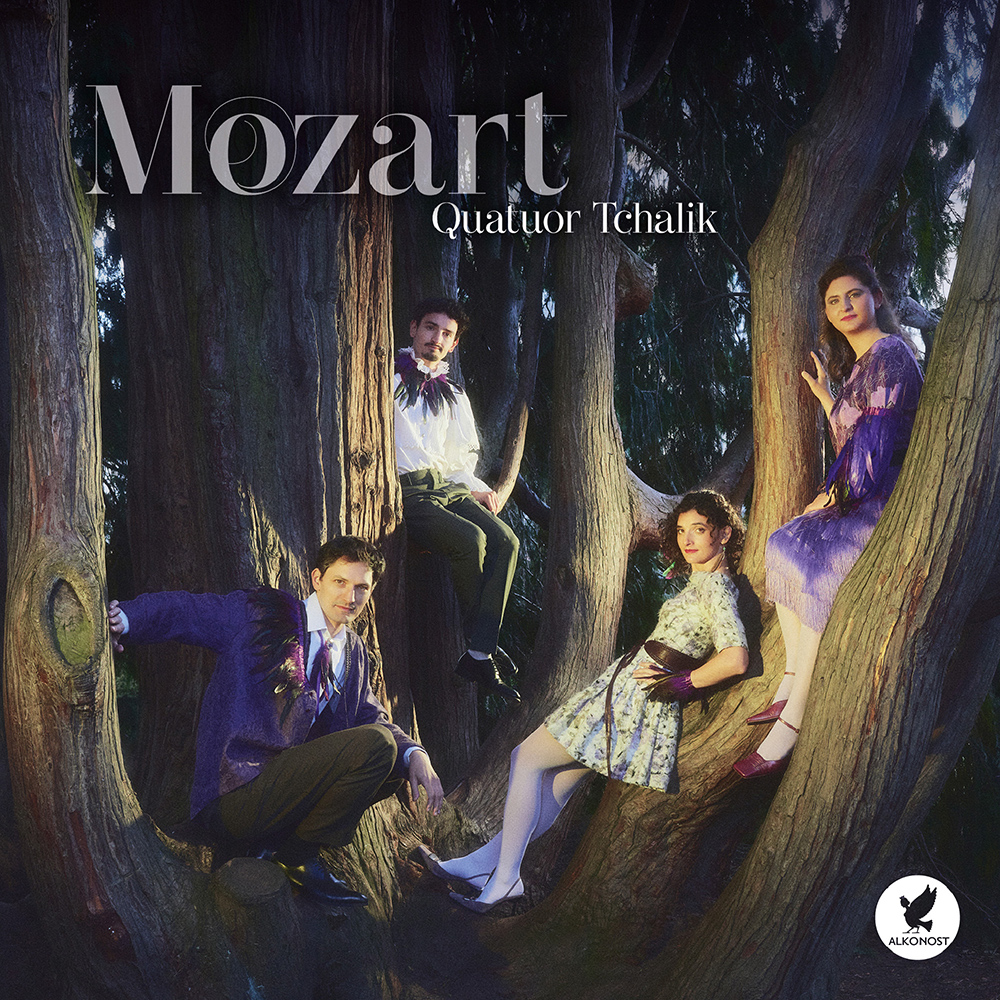
The Tchaliks go one step further, uniting two brothers with two sisters in what feels like perfect harmony. In their liner notes, they recall that they “grew up with Mozart, and his music grew in us”. Winner of first prize in the International Mozart Competition in Salzburg in 2018, their bookings have soared ever since. They have recently released a CD of three related Mozart string quartets (ALK010), the fruit of several years of planning and research. They chose three of the six quartets Mozart dedicated to Haydn, “The Hunt”, “Hoffmeister” and ¨”Prussian”. Their aim was to present three different facets of Mozart’s art .
Constructing the three-quartet programme kept them occupied for several years. “After experimenting with a thousand interpretive possibilities, deconstructing them and selecting (the best) among them, we have fixed them in this disc, titled simply ‘Mozart’”. An alert listener will hear ideas borrowed from “The Magic Flute” and “The Marriage of Figaro”.
The Hoffmeister, No. 20 in D major (K. 499) is a favourite of the players, for the way Mozart gave it lightheartedness while “concealing considerable complexity”, they write in their erudite accompanying booklet. One critic put it slightly differently. The quartet, he wrote, “Is despairing under a mask of gaiety”. Yet another formulation takes the cake for poetry in music criticism: The finale contrasts “wisps of delicate wit with a dense welter of tangled polyphony”. Mozart named the quartet as a tribute to his friend, benefactor and Vienna music publisher Franz Anton Hoffmeister.
“The Hunt”, composed in B-flat major (K. 458), has become the most celebrated and accessible of the quartets, opening with a simple hunting call, two violins making the strings somehow sound like horns in a call to the hounds. These figures develop into musical material described by one Mozart fan as “astonishing and comprehensive”. The energetic finale conveys, in the words of another commentator, the “bristling excitement of the chase”.
Completing the three-quartet set is the “Prussian” No. 22 in B-flat major (K. 589), so named for Frederick Wilhelm II, King of Prussia. Some Mozartians believe he wrote this one on spec, hoping to please the king. Besides ruling Prussia, Frederick Wilhelm was a friend of European intellectuals, including Voltaire, and an accomplished amateur cellist. A lyrical cello solo in this quartet may have unveiled Mozart “striving to capture the king’s fancy”,
wrote Misha Amory, a leading Boston violist and critic. He called the finale a “graceful movement whose main idea is like a game of leapfrog, always echoed at half a bar’s distance”. He sums it up as typical Mozart, ”a strong, assertive phrase answered by a witty, quiet rejoinder”.
Such a triptych of Mozartian genius immediately captivates the listener, and holds attention, writes Amory, as a small, seemingly simple phrase becomes a “sonic collage” with bits of melody overlaid on top of a busy contrapuntal exchange.” Precisely.
MJ
Discover more from ARTMUSELONDON
Subscribe to get the latest posts sent to your email.
 ARTMUSELONDON