For any listener, there’s a special kind of excitement reserved for when favourite artists – those you’ve been following separately for some time, collected their records and so forth – suddenly collaborate.
Examples that spring to my mind include ‘The Marble Downs’, a masterpiece made by one of the UK’s greatest (and much missed, certainly by me) folk-rock bands, Trembling Bells, with Americana mystic Bonnie ‘Prince’ Billy; as well as ‘Choose Mortality’, the brand new release from The Flesh and the Dream, a duo formed of the highly distinctive vocalist / pedal steel guitarist Heather Leigh and electronica genius Shackleton.
Classical music operates in different ways, of course, with singers, players, ensembles and organisations criss-crossing paths and forming all sorts of collaborations all the time – so these moments rarely seem to occur in quite the same way. But ‘Notebooks for Anna Magdalena’ by Mahan Esfahani and Carolyn Sampson is a summit of the most refined, sublime kind between two outstanding musicians.
Mahan Esfahani is probably most renowned as a champion for the harpsichord, and its place as a vehicle for modern as well as early composition. (He is also an accomplished writer, and presenter for BBC Radio 3.) He dovetails recordings of the more ‘traditional’ repertoire for the instrument with less predictable fare: a particular favourite of mine is the ‘Musique?’ album, which takes the harpsichord to levels of intensity you might not have previously thought possible.
Rewind to, let’s say, around ten years ago, and you would probably associate soprano Carolyn Sampson most closely – if not exclusively – with early / Baroque music, especially Bach, Handel and Purcell. But from the 2015 release of recital album ‘Fleurs’ sprang a series of meticulously-programmed, beautifully performed and recorded art-song releases, mostly with pianist Joseph Middleton – a partnership that has also led to some electrifying recitals and the commissioning of important new work from composers including Hannah Kendall and Cheryl Frances-Hoad.

In context, ‘Notebooks for Anna Magdalena’ is the latest in Esfahani’s ongoing ‘complete Bach keyboard works’ series for Hyperion Records. As part of that vast journey, there was a risk this album could be a glittering curio – because it certainly is curious.
The notebooks of the title, gifted by JS Bach to his second wife Anna Magdalena, consist mostly of short, fleet-footed pieces – so many, in fact, that there’s not enough room to list them on the back of the CD. Not all of them are by JS Bach – it includes works by several contemporaries as well as some of CPE Bach’s earliest efforts. However, before one is even tempted to think something like “good grief, doing a mixtape for your best girl was a lot more time-consuming in the 18th century”, it’s important to note that much of the notebooks’ content is in Anna’s hand.
As Esfahani’s liner notes (always buy physical copies of Esfahani’s releases if you can – his notes are always witty and informative, a great deal of knowledge worn very lightly) make a couple of points very clear. First, the notebooks reflect the fact that Anna Magdalena had been, independently of JS, an extremely accomplished keyboard player and successful professional singer – hence the abundance of vocal works included, that Sampson performs here. Second, that the notebooks accordingly assume a greater significance as an illustration of the rapport shared by the couple; assembled as much by Anna Magdalena as her husband, it represents some of their favourite music to play together, the stuff they gave house room.
Certainly, playing the album makes this interpretation feel true. The pieces range from danceable to worshipful; loving to humorous (witness a five-minute ode to smoking which would have delighted the occupant of Poulenc’s ‘Hôtel’).
The atmosphere of domestic intimacy is enhanced by the decision, in both performance and production, I assume, to embrace delicacy and quiet. The recording is immaculate. Esfahani’s decision to play the clavichord – softest of keyboard sounds – instead of the harpsichord on several tunes is a genius move, drawing the listener in still further, almost as if we are eavesdropping on a private musical evening. Sampson’s bright, clear tone and exquisite technique are in full evidence, given here with an honest, tender ease that enhances the album’s ‘scenario’. With voice alone, she brings balm; she shines light into the room.
Esfahani notes that he wouldn’t have wanted to record the ‘Notebooks’ with anyone else; hearing the trust he places in Sampson when she carries a heart-rending devotional song above a solo clavichord, you can understand why.
*

The chance to hear Esfahani and Sampson perform from the album live – their first concert together – arose only last weekend, on the opening day of the Three Choirs Festival, held this year in Gloucester.
Holy Trinity Church, Longlevens – one of the festival’s outlying, smaller venues – offered an ideal acoustic for the duo to bring the CD to life. They had a difficult balance to strike. The power of the album resides partly in its modesty: the ability of both performers to make their virtuoso renditions sound plausibly like two people only playing for each other, and that such virtuosity is a natural function of the musical, as well as romantic, bond between Bach and Anna Magdalena.
Here they would have to perform the pieces ‘out’ to us, the audience. As I waited for the recital to begin, I wondered if this would be the point where the ‘Notebook’ material might shrink slightly. Not at all – in fact, it just reminded me that ‘miniature’ does not equal ‘minor’. Esfahani effected seamless transitions between tracks, allowing their cumulative power to build, while Sampson, whose smile you could swear was audible, soared – radiating the joy-giving aspects of the song selections. The outcome was exactly what one looks for ‘live’: a performance that honours the source, but somehow seasoned with a little more grit and grandeur.
Both enthusiastic communicators, Esfahani and Sampson introduced and explained aspects of the programme, which brought the audience further into the experience and refreshed the domestic intimacy conjured by the CD into an informal, welcoming atmosphere. I think this ability to combine music-making at the highest level with a relaxed, inclusive attitude towards the audience made what happened halfway through the concert all the more startling.
*
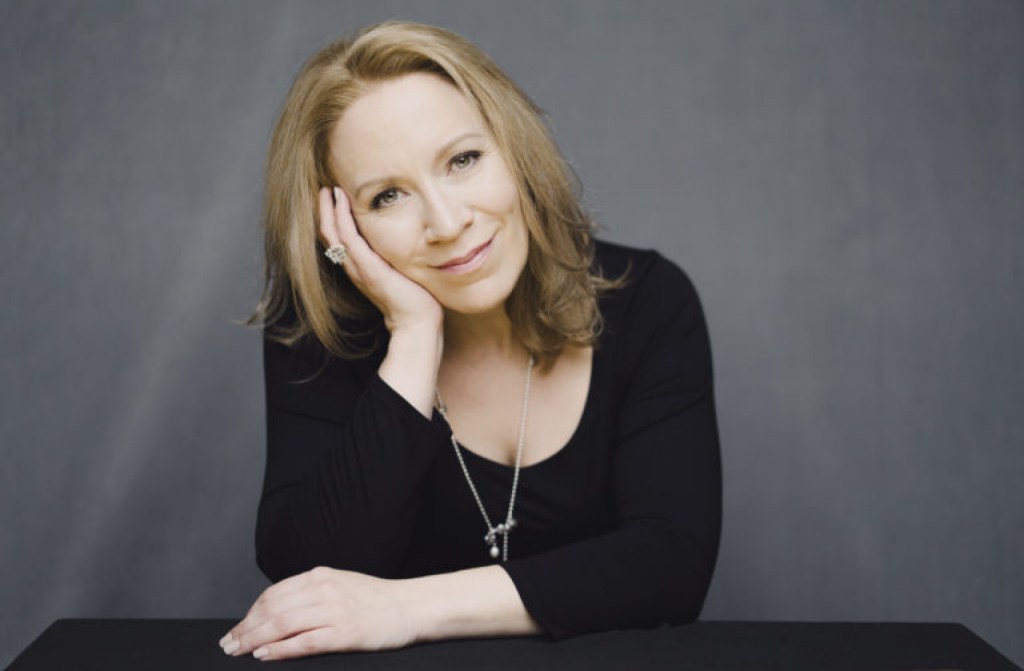
Just before the interval, the programme included a world première, a special Three Choirs commission for Esfahani and Sampson. ‘Az nahāyate tāriki’ (‘From the deep end of darkness’) is a song cycle by Nilufar Habibian, setting three Persian poems by Forough Farrokhzad. Both composer and poet are Iranian women; the ‘Women, Life, Freedom’ movement in Iran provided the inspiration for the new work.
The first song gives its name to the whole cycle; the two that follow are called ‘Cherā?’ (‘Why?’) and ‘Be āftāb salāmi dobāre khāham dād’ (‘I will greet the sun again’). The poems, even in English translation, possess a steely beauty, dealing starkly with oppression while allowing a glimmer of hope by the cycle’s close. As Sampson introduced the première – again striking a key note of inclusivity by observing that the live performance of a new work is something players and audience bring into the world together – Esfahani was busy preparing the harpsichord. Sampson put on a pair of glasses: this was a challenge; this would need focus.
I then saw one of the most riveting, chillingly effective art-song performances I’ve ever witnessed. Instead of sitting down to start playing, Esfahani stood, leaning over his keyboard, orbiting the area, sounding the strings in the harpsichord directly, at times with what appeared to be a piece of plastic – a ruler? – visibly clasped between his teeth when he wasn’t deploying it on the instrument to draw out a keening, or distorted accompanying note.
Sampson began to sing, at a much deeper register than normal, with both hands clasped over her mouth. As the songs progressed, she would vary the physical limitations on her voice: at times she took one hand away, so that only one remained over her mouth and more sound escaped. At others, she brought a hand stretched flat, horizontal, to her lips and moved it quickly up and down, causing an ululation effect. At one point, the vocal part was deprived of its music altogether, as Esfahani repeated the mantra (in Persian) “sound… sound…only sound”.
It’s hard to imagine a more apt musical metaphor for the topic addressed by the text. Everything screamed constraint, as if the performers had been initially robbed of their ‘signature’ abilities – while at the same time, the piece demanded they try to surmount those constraints, pushed to their limits in order that some music can escape; that they be heard. I was struck by how the movements imposed upon the duo became part of the method of communication: Sampson signalling a kind of semaphore with her controlling hands; Esfahani enacting a strange, invasive dance with his instrument. We could feel the desperate reaching for any mode of expression, any way to regain control.
The tension was sustained throughout almost the whole quarter-hour of the cycle. As the third song admitted a shaft of light, Esfahani had the brief opportunity to play conventionally and Sampson could fully unleash her voice: the effect had the power of a lightning bolt. I can’t imagine the sustained concentration and rehearsal that must have gone into achieving this degree of emotional intensity at this level of precision.
I was interested to read that Habibian was also an improvising musician (she plays the qanun, a Middle Eastern instrument a little like a dulcimer or autoharp) who had also performed at venues like Café Oto – an environment where I’ve been much more used to hearing avant-garde folk/world performances and where I can wel imagine something like this performed as well.
Back in church – in this classical context – it also proved a perfect fit. In recording the ‘Notebooks’, Esfahani and Sampson have restored a portrait of a woman who, while successful and accomplished, was still destined to ‘disappear’ into domesticity, to the point where she is almost invisible to history, and the pieces she assembled unnecessarily relegated to ‘minor’ status. Live, they provided a sensitive framing device for Habibian’s and Farrokhzad’s unflinching examination of the silencing of women that continues today.
AA
Discover more from ARTMUSELONDON
Subscribe to get the latest posts sent to your email.
 ARTMUSELONDON
One Comment Add yours