ENO’s new production of ‘The Elixir of Love’ is a witty and affectionate take on Donizetti’s comic romance, beautifully realised and performed.
On entering the auditorium of the Coliseum, you immediately notice something a little out of the ordinary. Instead of the normal safety curtain, a big screen spans the stage, showing a stylised drawing of a television with what looks like an old 70s or 80s BBC ‘ident’ playing across it. (Some of our greyer-haired readers will remember these animated test-cards, primitive in comparison to the programme intros we see now.) Closer inspection reveals some cunning changes particularly suited to the venue.
This callback to entertainment of the past – nostalgia to some and perhaps retro-chic to others, depending on your own, shall we say, ‘vintage’ – runs through the whole staging (credit to director Harry Fehr and designer Nicky Shaw).
The setting of the opera itself is brought forward from late 18th century Spain to 1940s Britain. However, the action is framed as though we are watching a TV sitcom – specifically in the style most associated with the producer David Croft (the most obvious example for our purposes must be ‘Dad’s Army’).

It’s a pleasingly perfect fit. Croft’s programmes often specialised in placing broad, cheeky humour (‘you’d never get away with that today!’, ‘different times!’ etc) and fallible, if not downright hopeless, characters in situations of gloom and adversity – war being the most common. In this way, they struck a potentially fragile balance (or, if you prefer plainer language, ‘had their cake and ate it’) between sending up British stiff upper lip attitudes with a generous dash of seaside-postcard silliness – while still mining the seam of reserved melancholy underlying much of our stereotyped national humour.
Today, we can also see the irony of feeling an extra layer of nostalgia, for those shows: not for their outdated attitudes, but their suggestions of stability, reassurance, even comfort. So often, their characters’ schemes and antics symbolised escape or rebellion – in the safe confines of that box in the living room – before placing them back to square one for the following week…So our laughter allowed us to escape our own worries or problems for that half-hour before the closing credits sent us back into real life.
Fortunately, the conceit is sustained brilliantly throughout the more generous running time of ‘Elixir’. The more disquieting undercurrents are still there. It’s food for thought that some of the sexual and class politics translate so easily from the time Donizetti was depicting to the mid-twentieth century: how far they travel beyond that is something we could well examine, and guard against. And in this forties version, the background conflict that emerges as a major plot point – as Nemorino briefly joins up to free himself of his love for Adina – is of course World War II, bringing home the utter lunacy of this act with real immediacy and heft. (The peasants of the original are now farmhands and Land Girls on Adina’s estate – so Nemorino has every chance of avoiding conscription. The photo below shows Segomotso Shupinyaneng in a winning turn as heroic gossip and news-bringer Giannetta.)

One reason the production is so delightful is its loving recreation of the sitcom format not just as an ‘idea’ but in its look and feel, even pace. The gorgeous sets have that air of elegant economy: exactly the same structure for the whole opera, but we are ‘downstairs’ in Act 1 and ‘upstairs’ in Act 2 (more class comedy), exactly as if one room is above the other in the house.
Bringing the household to life are ENO’s Chorus. It’s all too easy to take for granted how magnificent they sound – and how they clearly relish the estate workers’ interaction with the soloist roles – but this interpretation of the opera makes full use of their talents for physical action and silent comedy. Movement director Anjali Mehra has made the absolute most of this remarkable ensemble: they are the production’s bloodstream, their ceaseless energy providing the visual momentum that carries the concept, convincing us for these two to three lightning hours that the estate has been functioning at full tilt before curtain up and will go on after our final applause. The more you let your eyes take in their activities, the more you notice – as so often – the characters they inhabit start to assert their individual personalities amid the throng: there is especially excellent business from choristers Fiona Canfield, Claire Mitcher, Claire Pendleton, David Sheehan, Adam Sullivan and Susanna Tudor-Thomas (and I apologise for failing to make further IDs from my upper circle seat!). You won’t forget the bravura tableau in Act 2 when news breaks that Nemorino has come into money and the action freezes: I must not say more.
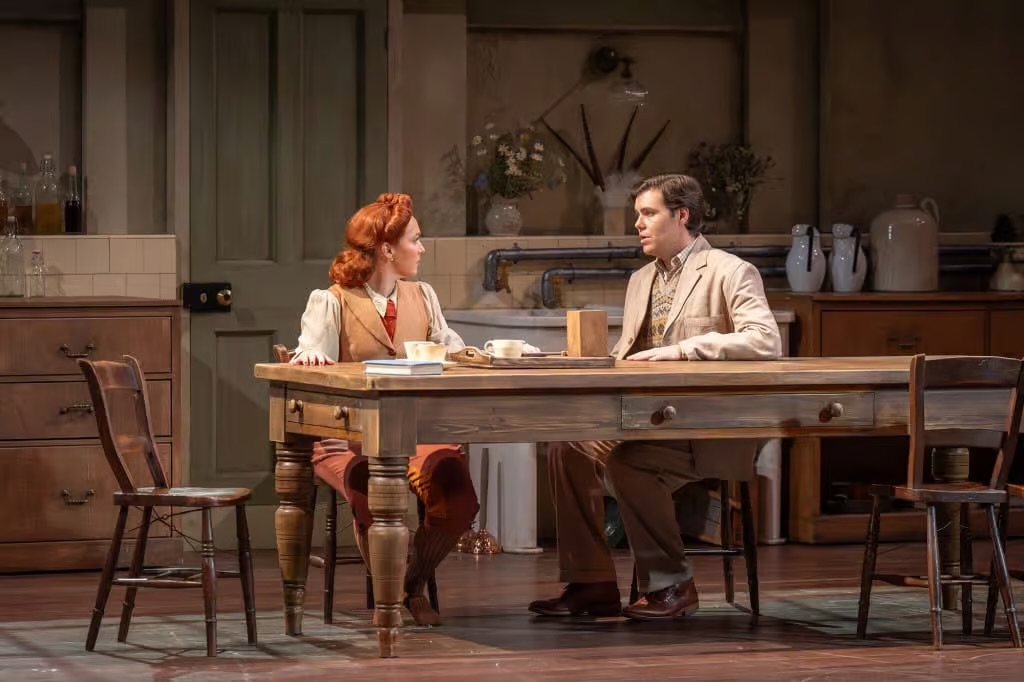
The team upfront are just as engaging, matching their beguiling vocal delivery with vivid, affecting characterisations. Rhian Lois is star power personified as Adina – her fickle, spiteful treatment of her would-be lover feels seasoned with hints of confusion, stubbornness and actual affection (Nemorino’s refusal of her cup-of-tea peace offering makes him a stronger man than I). During her duet with charlatan Dulcamara, which forces her to properly acknowledge her love for Nemorino, she finds that rare thing in a sitcom, a moment of sublime stillness. Surely, you think, this is illusory – and maybe it is – but so real is her performance at that moment, realisation and acceptance written across her face, that the opera seems to slow down just for her.
Thomas Atkins similarly side-steps any pitfalls of making Nemorino irritating or pathetic by nailing his internal struggles and bringing them out as awkwardness, as much on a journey of self-discovery as Adina. This gives the character some appealing credibility, as the ‘elixir’ – which is just wine, after all – instead of turning him into a bold, cocky caricature may in fact calm his nerves and mannerisms to some extent without the need for magical properties.

Some amusing and inventive parallels are drawn between our two antagonists, the conman Dulcamara (Brandon Cedel), who sells bottles of his hopeless potion to everyone in sight, and the officer Belcore (Dan D’Souza), who takes his potential conquest of Adina for granted. While Adina and Nemorino travel some emotional distance, Dulcamara and Belcore resolutely refuse to develop. Both Cedel and D’Souza give fine performances, offering appealing, attractive adversaries rather than pantomime villains. They are both flanked by a pair of silent companions – one by his partners in crime and the other his fellow officers – who each help their boss to sell their particular deception: a passing observation that the promises of glory (in bedroom and battlefield alike) in the military are as much a fiction as the conman’s mixture.
Finally, conductor Teresa Riveiro Böhm draws maximum warmth from the rather lush ENO Orchestra, giving the impression of the whole pit indulging in a collective swoon. Join them if you can.
AA
At the time of writing, ‘The Elixir of Love’ has 7 performances remaining, closing on 5 December 2024. Book on the ENO website.
Production gallery photos by Marc Brenner.
Discover more from ARTMUSELONDON
Subscribe to get the latest posts sent to your email.
 ARTMUSELONDON