While Barb Jungr has interpreted a range of songs by both Bob Dylan and Leonard Cohen throughout her career, this marvellous new release is only her second album to bring them together as ‘twindred spirits’ of sorts.
The first, ‘Hard Rain’, is an essential, blistering listen, focusing on the politics in the poetry. However, this record, as the title implies, has a more upbeat feel: an urge to celebrate, to find joy and escape, even from the midst of gloom. It’s full of sparkle and surprise; exactly the kind of disc that’s guaranteed to make you feel better after each play.
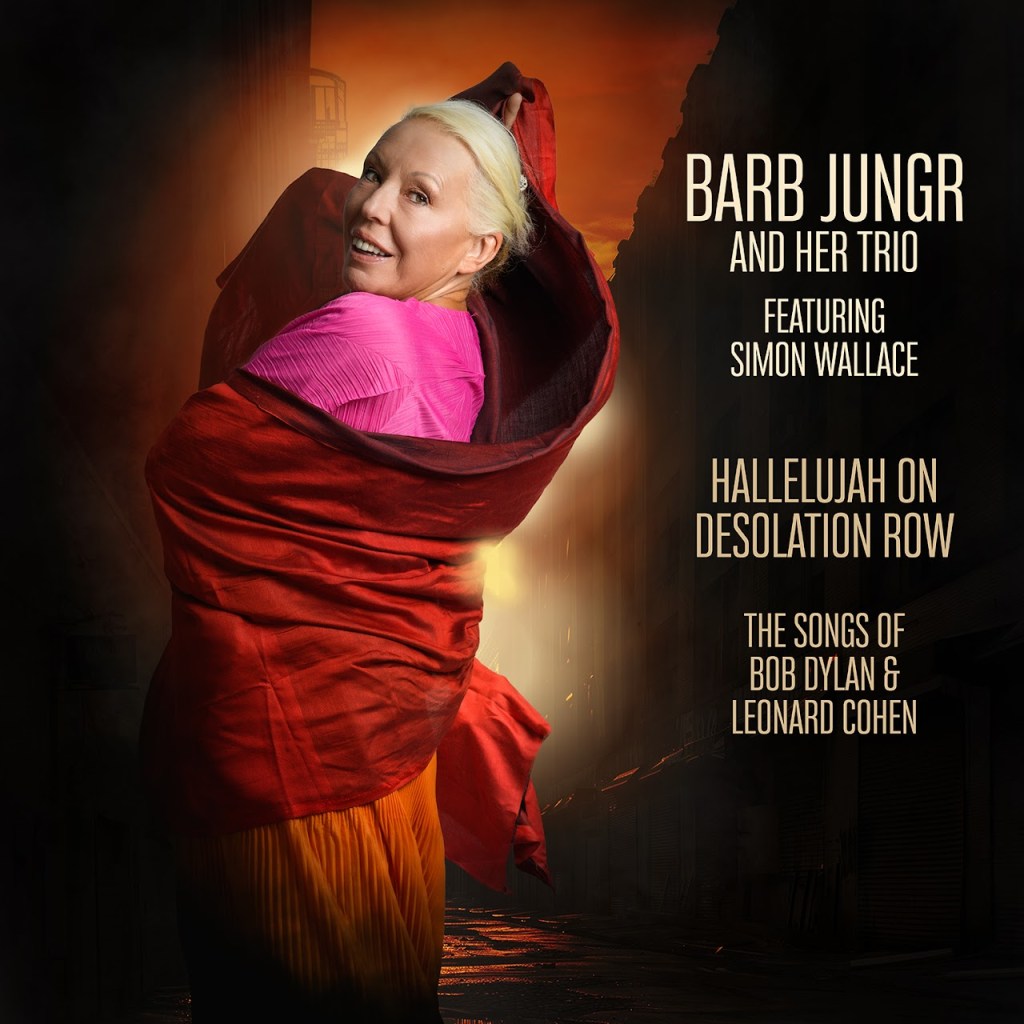
I feel fortunate to have had two ‘first listens’ to the material. Back in November last year, Jungr played a set based on this programme at London’s Artsdepot. While Jungr absolutely owns the room in a jazz cabaret setting, there’s undoubtedly something special about seeing her live in a concert auditorium, where her and her musicians’ razor-sharp focus is rewarded by a silent, rapt audience, savouring every detail. Arranger and pianist Simon Wallace can make any song a launchpad, taking it in whatever direction he and Jungr desire: here, he creates one supple, spacious treatment after another, giving us ample room to hear Davide Monteverdi’s beautifully-judged basslines.
The album adds percussionist Gary Husband – not on a drum kit, but supplying delicate, characterful touches and washes on a range of instruments. More additional melody than mere rhythm, he adds an entire extra dimension to the sinuous groove.
There’s a spotlight here on some late-period stuff: Cohen’s ‘Slow’ and ‘You Got Me Singing’ both hail from one of his comeback-era records, ‘Popular Problems’, and we also get a spectacular ‘Mississippi’, from Dylan’s ‘Love and Theft’. These wryly reflective choices receive sympathetic, spirited performances from the Trio, who inject spry swing into the originals’ stately steps.
And as I’ve said before, these songs are so lucky to have this voice.
Something that unites Dylan and Cohen – for this listener, at least – is their solid, even stately approach to melody. You could almost say simple (which is not to throw shade – creating a simple tune is far from a simple task), but that’s not quite it: it’s more about building tunes that reflect and make a virtue out of the ‘restraints’ of their voices. Dylan’s abrasive timbre or Cohen’s fathomless depth – whether these are benefits or limitations is entirely in the ear of the beholder.
But this shared feature makes them perfect subjects for Jungr, whose voice is all benefit without limitations. Her warm, rich tone brings such fluidity and flexibility to the melodies that the effect really is as close as you can get to that utopia of ‘hearing them again for the first time’. I mentioned ‘Mississippi’ earlier, one of those great Dylan lyrics where the words just seem to pour out of nowhere: the ceaseless agility of Jungr’s reading could convince you these thoughts are entering her head at the moment she delivers them. The smile is audible.
Personal favourites abound. I’ve always loved Cohen trapped in his ‘Tower of Song’, his rumble no doubt shaking its foundations. Jungr’s bold reinvention unmoors the melody from its strict confines, allowing us to hear a phantom singer straining at the leash, wanting out of her prison. And one of the first Dylan songs I ever heard, ‘Love Minus Zero / No Limit’, is reimagined into an arrangement that mirrors the shocking maturity of those early lyrics.
Expecting the unexpected is always a good way to approach a new Barb Jungr release. A case in point is the opening track, ‘Hallelujah’. Ever since Jeff Buckley’s version – which I suspect is starker, more spare than many remember – ‘Hallelujah’ has ossified somewhat, clogging up the power-ballad pick ‘n’ mix, with Cohen’s own recording suffering at the hands of its dated production. Onstage, Jungr tells a wry anecdote about how she had to be talked into considering the song herself. Without spoiling too much detail, she and Wallace manage to locate a kind of desperate release in the tune, the light in the dark. As so often with Jungr, you may have heard the song many times… but never like this.
And two of the Dylan tracks are in fact what you might call ‘Bob-adjacent’. The second track to be released from the album (or ‘new single’, in old money) is a deft take on the Traveling Wilburys’ ‘Handle with Care’, its nimble shuffle honouring the segmented ‘jigsaw’ nature of the song, reflecting each member’s contribution.
The other is ‘Kansas City’, a song born from the ‘New Basement Tapes’ project where T-Bone Burnett gathered a band of acolytes to write tunes for a stash of re-discovered Dylan lyrics and record the results. The sensitive setting (by Marcus Mumford and Taylor Goldsmith) for these aching words is a strong start.
One reason Jungr is such a successful interpreter of songs by men is her ability to convey strength and tenderness at the same time, laying bare their innate vulnerability without sacrificing any courage or resilience. She sets ‘Kansas City’ loose from its scratch band origins and makes it into what must now be a future standard. Its anguish and beauty rips out and repairs your heart within the space of four minutes.
Magisterial, like the rest of this masterclass of an album. Warmly recommended.
AA
Photos of Barb Jungr by Steve Ullathorne.
Buy ‘Hallelujah on Desolation Row’ directly from the artist’s shop on Music Glue, along with her other independently released albums, including ‘Hard Rain’.
Find tour dates on Barb Jungr’s website.
Discover more from ARTMUSELONDON
Subscribe to get the latest posts sent to your email.

