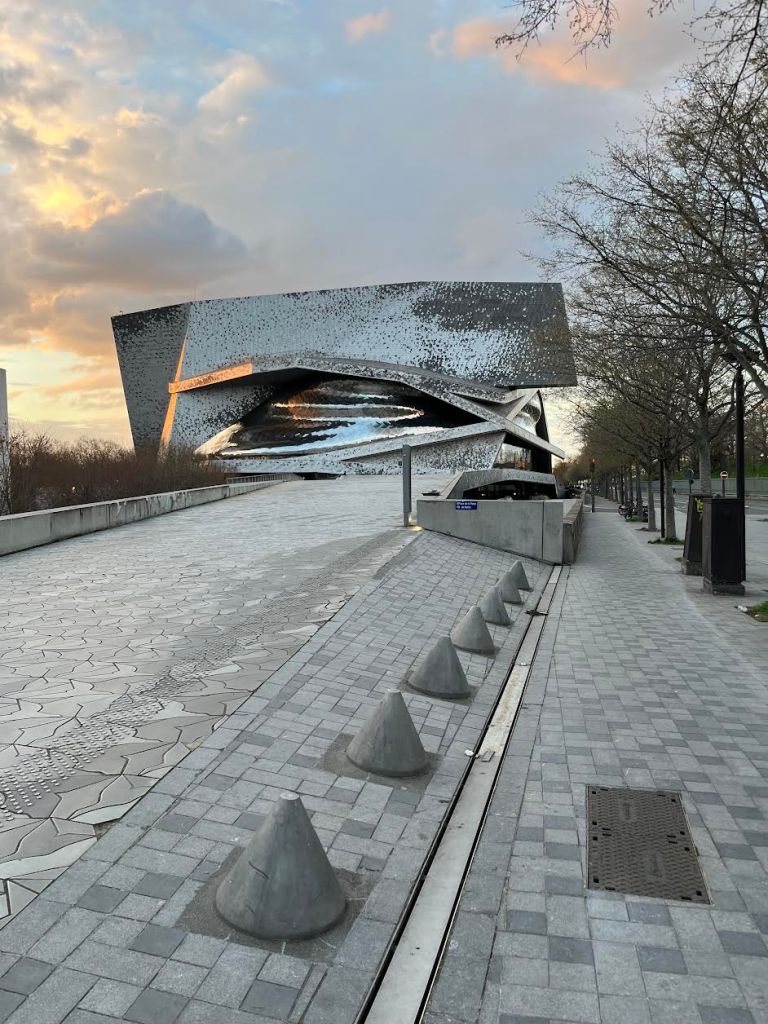
This week it was off to the Philharmonie de Paris, a state-of-the-art concert hall in the north-eastern periphery of the French capital. Paris may be my second home, but this was my first visit to this musical institution designed by the architect Jean Nouvel. Opened in 2015, after a six year wait, there was a lot of grumbling about the bill when it first started operating. It benefits however from a great acoustic and, as well as housing its own leading symphony orchestra , L’Orchestre de Paris, it has many other eminent ensembles passing through its doors.
I was there to see charismatic Uzbek conductor, Aziz Shokhakimov, lead the Orchestre Philharmonique de Strasbourg (OPS) in a program of new music by Oscar Strasnoy with a second half devoted to Shostakovich’s masterful 7th Symphony.
The metro ride to the concert hall was quite an adventure. Six stops from the Gare du Nord to métro Hoche, a walk to the périphérique where you are made to cross a busy road, an even busier tramway junction, which finally deposit you into the Avenue Jean Jaurès. The Philharmonie rises before you, its facade a face with a winking eye, or an oyster shell that gleams in the setting sun (see header photo).
The concert hall was shut when I arrived. The lobby area and bars open at 7.00pm.
Early, I perused the programme to read up about Strasnoy’s double concerto for cello, piano and orchestra. His Sinfonia Concertante , was a tribute to pianist Alexandre Tharaud and cellist Jean-Guihen Queyras, both widely respected artists and soloists accompanying the OPS that evening.
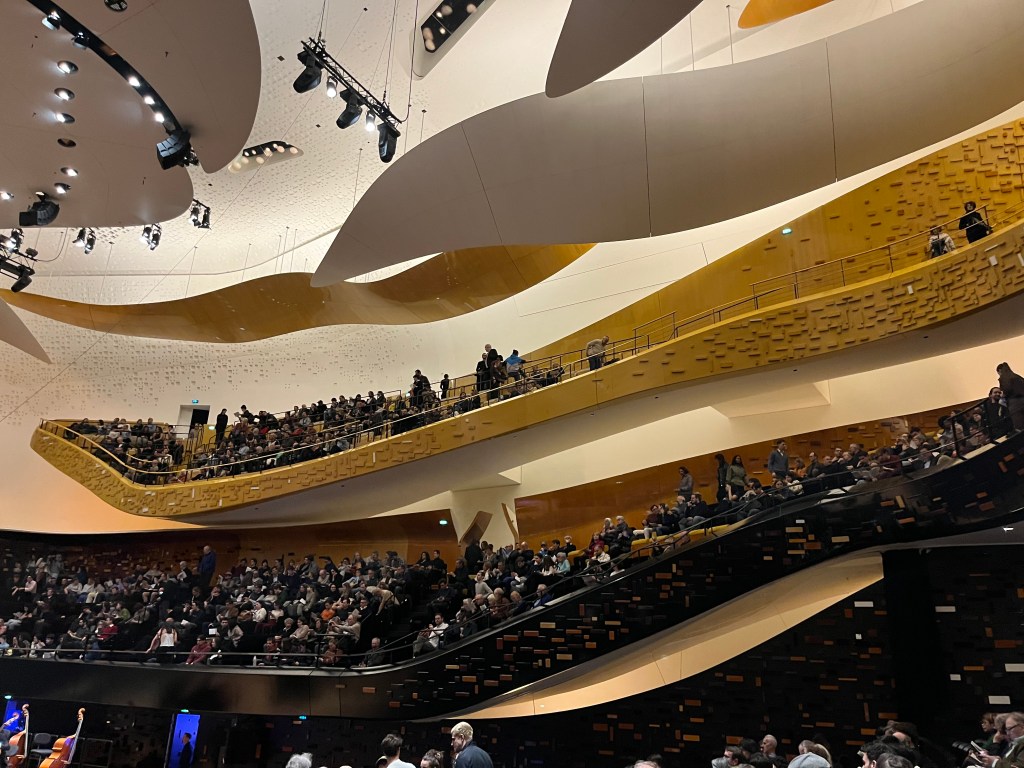
8.00pm I was seated in the magnificent auditorium – Grande Salle Pierre Boulez. The architecture was not dissimilar to the Royal Festival Hall – but freer in its design!
Strasnoy’s score was whimsical with repeated minimalist moments that build, rather in the Philip Glass mode – but also different. There were tender, warm passages when the orchestra seemed to have gone under water! Strasnoy’s inventiveness has been likened to Ravel who, I am sure, would have loved to have seen Tharaud clip several magnets onto his piano chords to produce vibrations and sustained notes. He would also have appreciated the pianist donning a white glove so that he could run his fingers sharply up the piano keys.
Shostakovich’s 7th Symphony followed and the excitement rose in the Grande Salle Pierre Boulez. I had been mesmerised by Shokhakimov’s Rite of Spring with the OPS in Strasbourg May 2025. Works with a strong narrative and iconic status are without a doubt, Shokhakimov’s cup of tea.
Associated with the Second World War, Shostakovich’s 7th Symphony is partially a product of the Stalin years when the score, at least the first movement, was already simmering in Shostakovich’s head – safe from Stalin’s prowling eyes. The 7th didn’t get written (we think) and certainly not performed, until 1942, during the horrific siege of Leningrad, during which, 1 million citizens were said to have died of starvation. On 9th August 1942, an orchestra of just 14 musicians was found to play Shostakovich’s 7th Symphony. It rang out over loudspeakers across the besieged city. Some musicians had been lured back from the front with a promise of extra rations!
It was a tremendous boost for the citizens of Leningrad and beyond, and not surprising the piece became synonymous with resistance. The score was smuggled out of the country and reached New York where Toscanini conducted it and made it known to millions in a radio broadcast.
All this was swirling in my head, combined with family memories of my own. Two elderly great aunts from St Petersburg (Leningrad) huddled round my grandmother’s samovar in Paris in the early 1970s, talking about their survival of the siege. I didn’t speak a word of Russian but still my Georgian grandmother shooed me gently out of her sitting room.
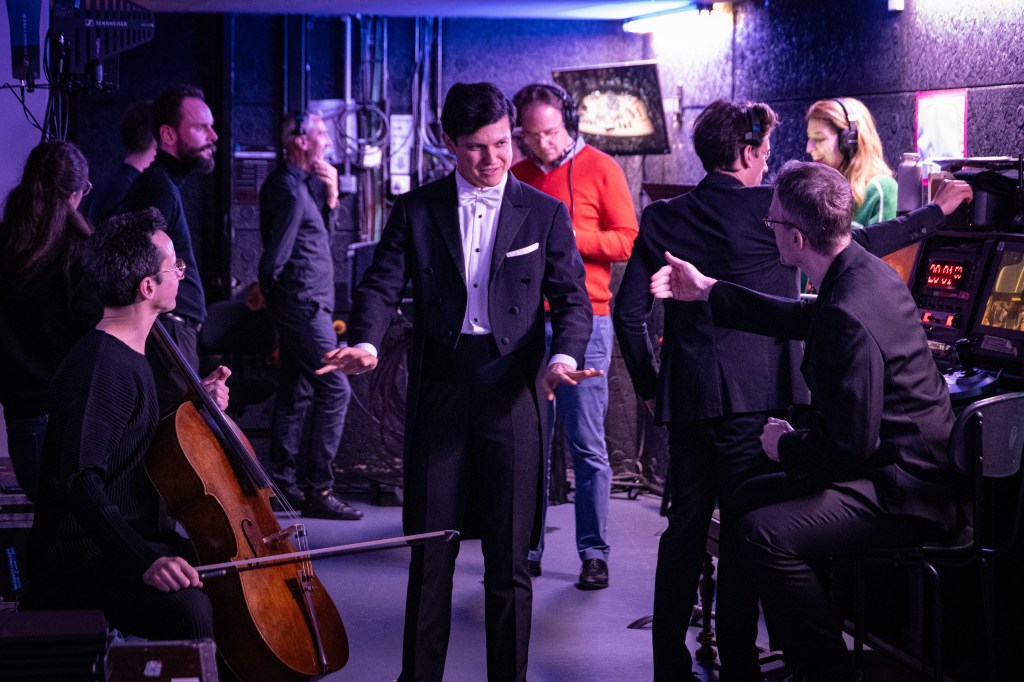
Shokhakimov stepped out onto the stage. At 37 years old, he’s still a kid in conducting years, but he started early – aged 13 – in Tashkent, Uzbekistan, where he grew up. I wondered what this work meant to him as he was poised to start. He is too young to have met elderly relatives from that period, but I imagined the stories he might have heard, might still here on family occasion as the vodka gets passed around the table.
The first movement got on the way. A proud, majestic musical outpouring, signifying strength,, confidence, solidity. It was followed by a lyrical passage and from the distance came a bristly drum and a lolloping march. The air was jaunty and became increasingly grotesque as Shokhakimov upped the volume. The ‘invasion theme’ as it is known got taken up by different sections of the orchestra and then they played it in unison for good measure. The passage is unforgettable and brilliantly conveys the stupidity of war.
The Adagio third movement was exquisite – opening with a choral sound played by wind instruments. You can also hear Ravel’s Bolero drumming. The piece revs up and my lasting impression of that evening, was of Shokhakimov jumping up and down as if performing some dance on stage.
This was a widely energetic, powerful and meaningful performance by both orchestra and conductor.
Don’t miss Shokhakimov and the OPS in London in 2027!
KH
http://philharmonique.strasbourg.eu/
Discover more from ARTMUSELONDON
Subscribe to get the latest posts sent to your email.
 ARTMUSELONDON