I was already excited about this evening before a note had even been sung or played. The start of a new ENO season: a happy occasion in itself. But I was also new to this acclaimed David Alden production, which was last given in 2014, only a few months before I went to my very first ENO opera – Anderson’s ‘Thebans’ – and then just kept going. (“Coli, I think this is the beginning of a beautiful friendship…”)
This memory came back to me as I walked back out onto the street afterwards, slightly dazed. In recovery mode, I was still somehow aware that what I had just seen was so powerful, so extraordinary, that it made me feel the same way that I did back then, when I was discovering opera itself for the first time. I don’t know how this feels to other people: but sometimes it’s as if you’re hearing new sounds; or even finding new ways to listen. I had seen ‘Peter Grimes’ twice before – and been deeply affected both times, it’s that kind of piece – but this was like coming across a new version, unlocking some of the work’s secrets.
Get to this one if you can.
All the photos here are by Tom Bowles, taken from the ENO website production gallery.
(Ahoy! Spoilers from this point on.)
*
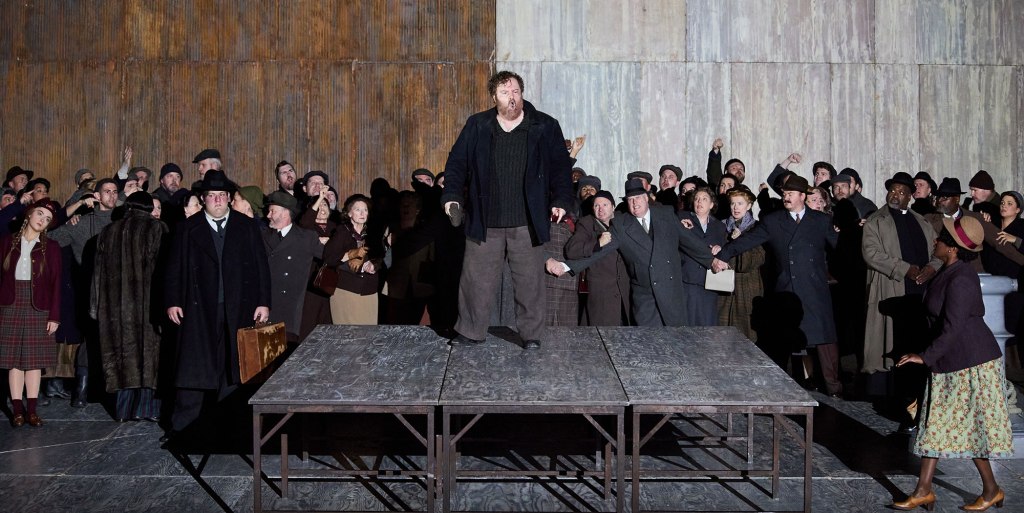
For those unfamiliar, the action takes place in ‘the Borough’, a fishing village. One of the fishermen, Grimes, is a misfit: stubborn, enigmatic and barely in control of an inner anger that can easily boil over into violence. The community ostracises him in particular because his previous apprentice died in mysterious circumstances (before the action of the opera). But there is no way to convict him – or, as it turns out, prevent him from continuing to work and take on new help.
Grimes only appears to have two allies. He is in love with a local widow, Ellen, who reciprocates his feelings. Balstrode, a retired Navy captain, also has enough time for Grimes to try and stage the occasional intervention.
But Grimes is driven by his desire to get rich, so that he and Ellen can make a fresh start, give the new apprentice John a home, and lay the rumours to rest. This leads only to exhaustion, overwork and despair. Ellen notices bruising on John’s arm and, her confidence shaken, admits to Grimes at the worst possible moment that their plans are likely to fail. Raging, Grimes strikes Ellen, and drags the boy off to go fishing, only for history to repeat itself, as John falls from the cliff to his death.
Meanwhile, reports of Grimes’s outburst lead to a Borough mob hunting him down. They find the hut empty as Grimes recovers the body from the shore below. But as evidence of the new tragedy emerges, several prominent villagers re-ignite the general hatred towards Grimes and the mob stirs again. Balstrode realises that this time, it will end in murder; so he instructs a defeated, compliant Grimes to take his boat out one last time, and sink it.
*
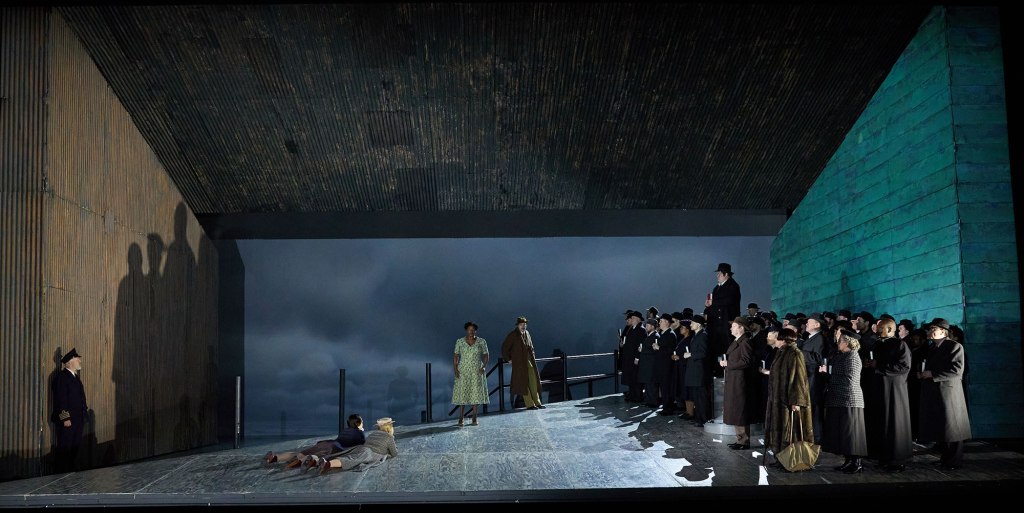
I wanted to give a reasonably detailed synopsis, so that I can discuss the treatment of it freely. In fact, the action of the plot doesn’t fully convey the breadth of the opera. To begin with, it succeeds in creating a complete sense of the Borough through breadth – the villagers en masse, who behave almost as a hive mind, addled with fear and prejudice; and depth – the contrasting cast of eccentric supporting characters who mostly personify aspects of corrupted, seedy Borough life.
Against this, Grimes is not so much three-dimensional as human dark matter: deliberately kept ambiguous by Britten and his librettist Montagu Slater, Grimes lashes out at what he loves and jumps the wrong way on every decision. As mentioned in the programme notes, Grimes can arguably symbolise a number of different outsider motifs – for example, Britten’s pacifism or sexuality. However, I feel this production succeeds in conveying possibly the most devastating version of this isolation: Grimes’s already tenuous grip on sanity, or even reality, and how that comes to the surface.
*
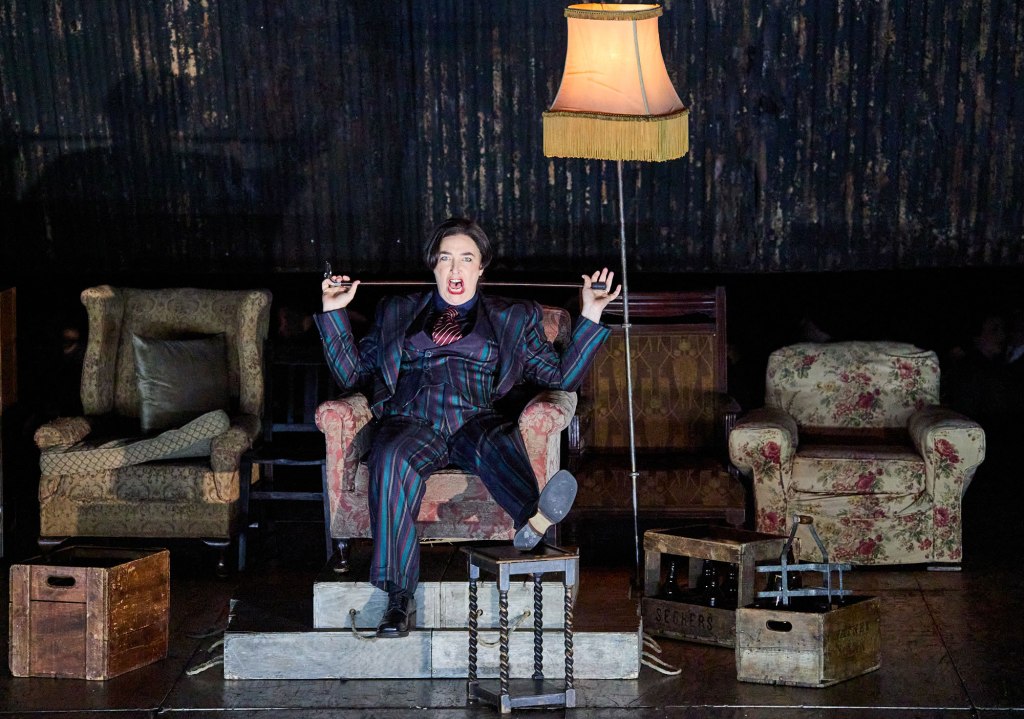
Alden’s version of ‘Peter Grimes’ updates the opera to the time it was written. The unflinching gaze on the murkier side of life – pub landlady Auntie prostituting her two nieces, village chemist Ned Keene pushing drugs to the paranoid Mrs Shelby, lay-preacher Bob Boles spewing hatred and intolerance – takes on a chilling immediacy as the whole community grinds against its collective post-war PTSD propped up by sex, dope or the Lord.
The Borough seems to exist in a heightened reality. Ordinary people do not speak to each other in the way they do in this libretto (Ellen talks to John the apprentice about how “the treason of the waves / glitters like love”; Grimes’s famous aria begins “Now the great Bear and Pleiades / where earth moves / are drawing up the clouds / of human grief…”) – and onstage we see the visual equivalent of this artifice, this poetry.
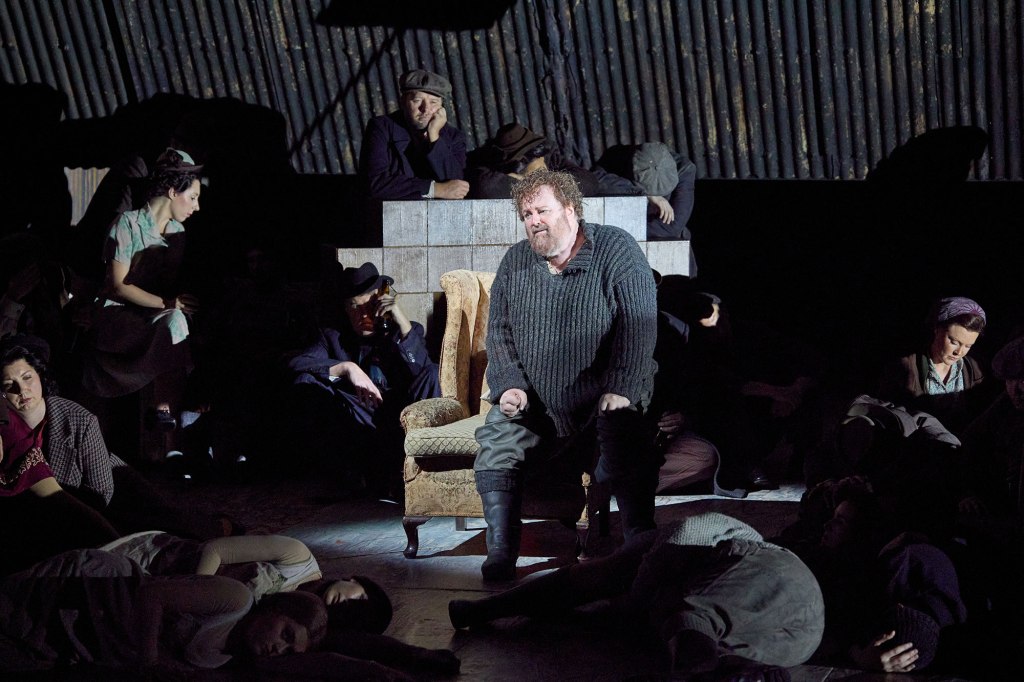
The staging and lighting are among the most effective I’ve ever seen in a theatre, and they are crucial to taking the Borough into some other realm: psychological, metaphorical, surreal – it could be any of all of these. The word that kept coming to my mind – ironically, perhaps, in the context of live performance – was ‘cinematic’; and I mean this as the highest compliment, as it created a world wholly other from our real one, right in front of our eyes and ears.
It seems facile, perhaps, to say that the rectangle formed by the front view of the stage is like a ‘screen’ – that could apply to any play – but here, it conjures up claustrophobic dread in exactly the way a horror film might. The Coliseum’s auditorium is famously vast – we the audience are in a huge space, focusing on this rectangle, and the sharply receding sets (especially for indoor scenes) use leading lines to drag that perspective further into the onstage space, as if the world itself is fencing Grimes in. At one point he cowers in the crease of a literal corner, but the ‘corner’ is created mid-stage, so he is in the exact centre of our vision.
The lighting, too, is extraordinary, the absence of light as meaningful as its presence. The Borough mob move in and out of focus, half-illuminated, part human, part predatory creature. The new apprentice, shortly before his demise, cowers in the flesh, but is double-lit to show his much larger, wraith-like shadow on the wall. At one astonishingly effective moment, Grimes – not far from the end – stands between his two ‘ways out’: Ellen, with her love, and Balstrode, offering the suicide solution. The lights trap him on the spot, a straight line of shadow joining all three characters, Grimes pinned in the centre.
And some of this displacement is achieved in costume alone. Auntie is in androgynous suit and tie, evoking Weimar cabaret; her ‘nieces’ in identical uniform, awakening all kinds of desires in the Borough menfolk; and speaking of uniform, Balstrode still presents himself head to toe in his officer’s kit, cleaving to his past life and its rules and routine.
Perhaps the most striking visual element of all – that screamed ‘cinema!’ to me the loudest – is the movement. The ENO Chorus must be a gift to any director in this regard – taut, versatile, and in coordination with each other to seemingly telepathic levels, they deliver when it comes to physical as well as vocal action. In the shanty scene, they realise an intricate, exciting dance routine almost, it first appears, for the brio of it: but nothing is accidental, and the thrilling accuracy of the shapes they throw to the off-kilter rhythm underscores the hive-mind, mob mentality that’s brewing, former individuals starting to coalesce with one menacing intent. The mobile staging even crushes them together, maintaining their momentum as space gets tighter and tighter. This kind of theatrical equivalent of a filmic ‘close-up’ is also used for individual characters, the lighting amplifying more individual moments and movements: the robotic mirroring of the ‘nieces’, John’s convulsions, even Balstrode’s silent salute to the departed Peter.
There is another indelible scene involving the Chorus, where their gradual formation of the mob is shown moving back and forth, as they gradually occupy the stage. Surging, in other words. They undulate, push forward and recede, like waves.
We know that at Grimes’s moment of disintegration, the sea will claim him. Here, I felt more than anything that the sea is ever-present, waiting for its prey to be delivered. It’s there in Britten’s music, those interludes that give us, among other things, the perfect musical representation of the oncoming storm and gathering unrest. And the Borough itself is almost at the sea’s mercy already, suffering floods and erosion. This staging brilliantly dials that up, the murky blues and greys of the set, and even the villagers, embodying the invasive water, ready to swallow Grimes up.
*
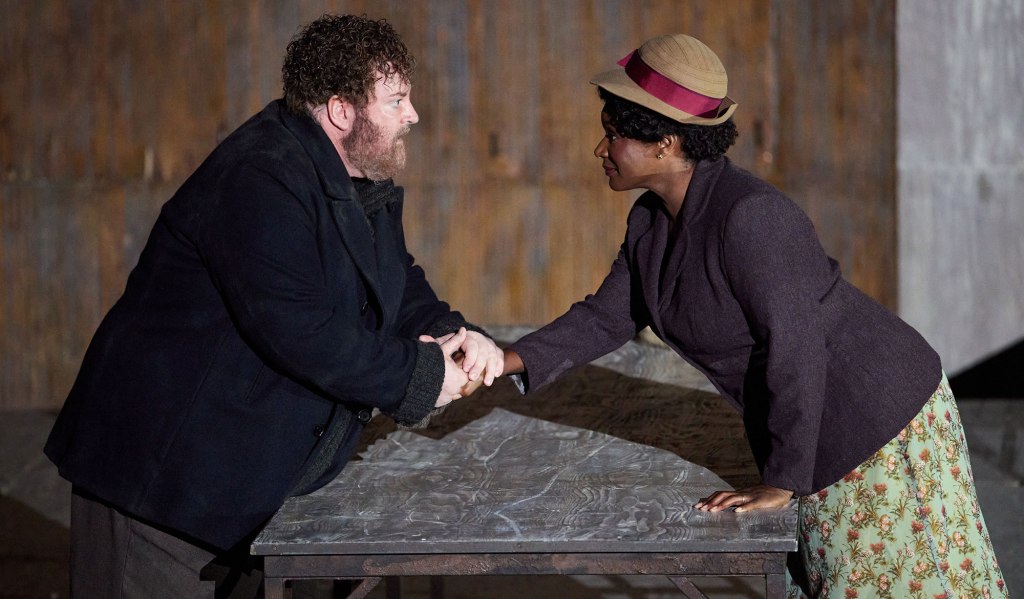
A brief digression: I wonder if the ‘cinematic’ feel of this version goes deeper. Carefully composed, angular/symmetrical visuals could suggest a number of directors – say, Anderson, Bergman – and the unsparing focus on a man’s psychological collapse haunts the work of ‘alpha-male’ film-makers like Scorsese or Coppola… but bring these two motifs together and I think of Kubrick more than anyone else. If we imagine most film auteurs are at least partly making films about themselves, I think Kubrick often projects a cold directorial gaze into his movies, often through a ‘presence’ that has almost pre-ordained the dissolution of his protagonist. HAL from ‘2001: A Space Odyssey’ and the Overlook Hotel in ‘The Shining’ are two clear examples, but there are also elements in the secret society of ‘Eyes Wide Shut’ and the state in ‘A Clockwork Orange’. The original plot has a few potent similarities with ‘The Shining’ – the central male figure is burdened with a previous alleged crime against a child, that means the woman who loves him cannot fully trust him. The source that should restore his dignity and become his salvation is in fact the force that will steer him towards his destruction. Visual echoes include the torchlights against the makeshift dark corridors, reminiscent of the film’s illuminated maze, and perhaps most of all the stylised presentation of the ‘nieces’ calling to mind the Grady twins. None of this is to say that there is any conscious link at all between ENO’s ‘Grimes’ and any of the films I mention, and it wouldn’t matter if there was. But I find parallels between works interesting, especially across genres: that to examine a certain subject in a certain way can lead to complementary artistic results. And these (cross-)reference points matter. An opera-curious film buff or horror enthusiast could attend this production and immediately make a connection. It would be great if they read this flight of fancy, and did just that.
*
But of course this is opera, not the movies, and the full wonder and terror of ‘Peter Grimes’ is unleashed through hearing it sung and played in the house. The ENO Orchestra were on incredible form under Martyn Brabbins, who drew out their lush sound and then harnessed it for tension and threat. The result was expansive, exhilarating; they achieved that rich, almost warm ambience that felt very much like an early-to-mid 20th century radio orchestra. In my imagination, it was the live equivalent of ‘hearing the room’ in the way you sometimes do when you play a vinyl record. Pairing this ‘feel’ with Britten’s careering between sometime fractured, angular action and moments of exquisite beauty somehow conjured the impossible, made the score seem both breathtakingly vast and oppressively claustrophobic. An overwhelming, cathartic experience.
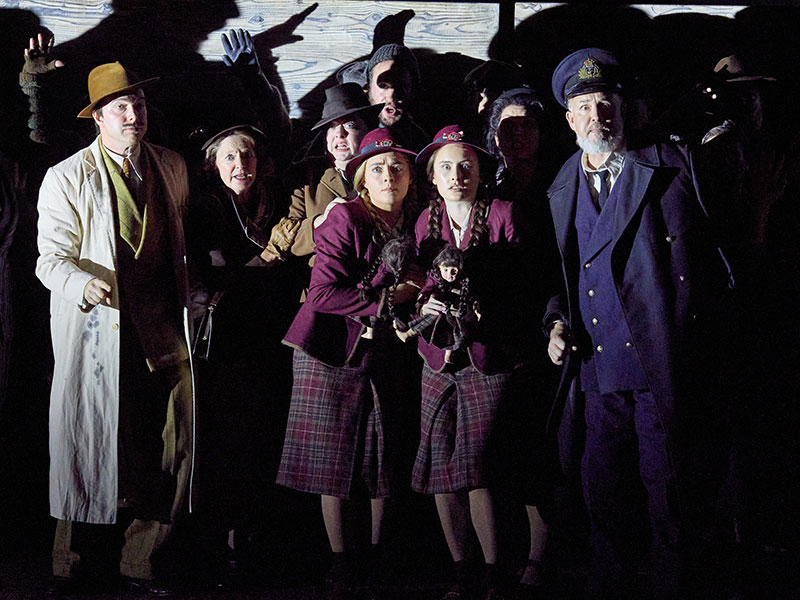
I’ve already sung the Chorus’s praises: playing the Borough must be one of their finest achievements, the full force of their voices bringing an entire community to vivid, livid life. The soloists themselves made for a fine ensemble, and it seems wrong to single anyone out. As Grimes, Gwyn Hughes Jones caught the precise balance between fury and fragility, narrowing his rich tenor at times of rage: a robust actor, he seemed able to visibly diminish before our eyes. Elizabeth Llewelyn gave us a thoughtful, complex Ellen: not a 2D angel, but as fraught and lost when she dashes Grimes’s hopes as she is comforting towards the apprentice. Plaudits, too, to Alex Otterburn’s lithe, febrile Ned Keene, Simon Bailey’s commanding Balstrode, and the chameleonic Christine Rice bringing a sinister sympathy to Auntie.
Finally, as I think this is the ideal production to see just how transformative the technical work on a show can be, I want to mention Maxine Braham (movement), Gary James (reviving Adam Silverman’s original lighting), Brigitte Reiffenstuel (costume) and Paul Steinburg (set design). You too were the Borough.
AA
Book tickets for ‘Peter Grimes’ through the ENO website: https://www.eno.org/whats-on/peter-grimes/
Discover more from ARTMUSELONDON
Subscribe to get the latest posts sent to your email.
 ARTMUSELONDON