Rebeca Omordia is a pioneering champion of African art music – that is, works by African composers that blend the influence of both their own musical roots with their experience and knowledge of the Western classical ‘canon’.
Back in spring 2022, I wrote about Omordia’s CD ‘African Pianism’ (SOMM Recordings), a stunning collection of solo piano music by composers representing a wide range within the genre, hailing from Ghana, Morocco, Nigeria and South Africa. The term ‘African pianism’ itself was coined by the composer Akin Euba, in recognition of the way the modern piano is particularly suited to conveying the unpredictable, percussive rhythms of various African native/folk traditions.
Happily, that album now forms part of what will hopefully be an ongoing survey of this music: starting with ‘Ekele’, Omordia’s 2018 debut release on the Heritage label, and reaching its latest instalment with ‘African Pianism, vol.2’ (also on SOMM).

Like any good sequel, this follow-up gives us ‘more of the same’ in the best way, revisiting elements of the previous record (two composers make welcome reappearances), while expanding or leaning further into certain areas to widen the listeners’ perspective.
Because of its origin in African musicians gaining access to traditions from abroad, African art music is relatively new. As a result, Omordia is not only documenting an emerging regional phenomenon: she is also providing a valuable platform for younger, contemporary writers. ‘Vol 2’ foregrounds this aspect a little more than before: four of the featured composers were born in the 60s or later, and eight of the selections are world première recordings. Two standouts for me are the exhilarating opening track, ‘Elilta (Cry of Joy)’ by the Ethiopian composer Girma Yifrashewa (due to perform in the African Concert Series next March – see below) and the dizzying ‘Prelude in E-flat’ by Mokale Koapeng, capturing in a lightning two minutes the dance rhythms he heard growing up in Soweto, South Africa.
Omordia’s virtuosic touch brings alive every nuance of this music’s expression, from the spiritual to the sensual. I hope this series continues for as long as there are works for her to re-discover and bring to our attention.
*

Omordia’s commitment to the project goes beyond performing and recording African art music herself – she is also founder and curator of the ‘African Concert Series’. This initiative brought much of this music and its players to wider attention through a series of recitals both live and (during the pandemic) online, culminating in a regular residency at the prestigious chamber venue Wigmore Hall in London, UK.
Currently, each booking period at the Wigmore includes a full-day African Concert festival, filling the venue’s usual weekend slots at 11.30am, 3pm and 7.30pm. The most recent of these took place on 20 July 2024, and was the first occasion that I could make all three gigs.

The first concert, ‘African Art Music for Woodwind’, elegantly reinforced the blended nature of the genre. We witnessed the fluid interaction – including some improvisation – between Baba Gallé Kanté’s Fulani flute and Rowland Sutherland’s modern instrument, driven by the percussion of Kanté’s colleagues in the African Cultural Group, Moussa Dembele and Richard Olatunde Baker. Omordia herself took part in some of the most exciting repertoire: we heard two of Fred Onovwerosuoke’s Pieces for flute and piano, along with the original piano solos that inspired them (part of the classic ‘24 Studies in African Rhythms’ suite, eight of which make up such a captivating sequence on the ‘Ekele’ album).
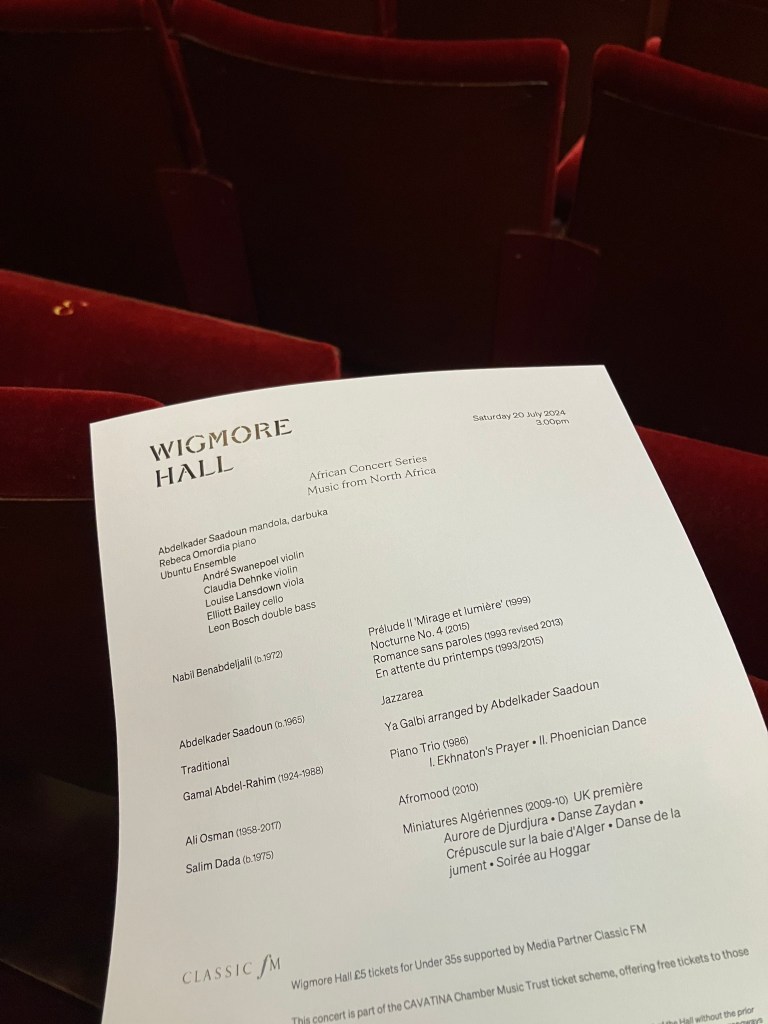
This was followed by a fascinating programme of ‘Music from North Africa’, performed in the main by Omordia and members of the Ubuntu Ensemble (a string group featuring the great double-bass player from South Africa, Leon Bosch). With a past performance at London’s super-intimate Africa Centre lodged in my memory, it was a thrill to hear the Ensmble’s sound fill the Wigmore acoustic with music from Algeria, Egypt and Sudan. Omordia began the concert solo with pieces by the Moroccan composer Nabil Benabdeljalil, drawn from both ‘African Pianism’ albums. A central highlight of the gig was an appearance from Algerian rai maestro Abdelkader Saadoun playing music for voice and mandola – especially his own vibrant composition, ‘Jazzarea’.

The final concert of the day, ‘African Choral Music’, widened the scope even further. Here, the Lichfield Gospel Choir had curated an eclectic programme combining spiritual and traditional African sacred music with songs of wider African heritage, such as Gregory Porter’s ‘Revival’ and Labi Siffre’s ‘(Something Inside) So Strong’ – as well as a few ‘off-remit’ selections that leant closer to US R&B/gospel.

Their collaborators for the evening were the Imbube Singers, a powerhouse sextet from South Africa who – despite being outnumbered by the gospel choir by around eight to one – electrified the stage with each appearance. I hope they return to the Series soon.

*
Time to look ahead.
I couldn’t be more excited about Omordia’s next SOMM release in collaboration with soprano Omo Bello, ‘African Art Song’ – especially as I couldn’t attend their Wigmore recital last year. The contents of the disc look irresistible. For those of us gradually building up a picture of African classical music through these recordings and concerts, there’s a real sense of anticipation to hear vocal work by composers who have formed the backbone of the piano recordings: Ayo Bankole, Akin Euba and Fred Onovwerosuoke. Bello and Omordia also explore composers linked to the African diaspora, from 18th-century artistic polymath Joseph Bologne to contemporary British voices Errollyn Wallen and Shirley J Thompson.
‘African Art Song’ is released on 18 October – you can pre-order from the label, or our recommended classical specialists Presto Music.

And on the live front, Wigmore Hall has now announced dates for the next two African Concert Series festivals: Saturday 15 March and Saturday 19 July 2025. The latest Wigmore brochure outlines the 15 March line-up:
- 11:30am – ‘Piano Music of Ethiopia’: Girma Yifrashewa plays his own compositions, alongside those of Emahoy Tsege Mariam Gebru (see below).
- 3:00pm – ‘Violin Music of the African Diaspora’: Aisha Syed Castro (violin) and Adam Heron (piano) with a recital of works by William Grant Still, Florence Price, Wynton Marsalis and Samuel Coleridge-Taylor.
- 7:30pm – Sing Africa: This South African choral ensemble present an evening of song from their home country.
Tickets for the three concerts above will go on general sale from 1 October 2024 (and bear in mind that priority booking is available for the various levels of Wigmore Hall membership).
Details for 19 July will be published shortly before the booking period for summer 2025 opens.
*
Finally, a brief mention of Emahoy Tsege Mariam Gebru – an Ethiopian nun who composed solo piano pieces, chamber works and songs throughout her long and extraordinary life (she died in March 2023, aged 99).

If you have yet to discover Emahoy’s music, now is an excellent time. Back in 2006, one of CDs in the celebrated ‘Ethiopiques’ series focused on her performing her own piano compositions. She was a singular entry amid the more jazz, folk and rock of the other artists featured. While it is possible to ‘read’ a blues element into the atmospheric, ‘demo’-like nature of some of her recordings, and her sparkling runs might conjure up a Monk (or ‘Nun’!) experiencing an attack of delicacy, this is clearly classical music, and she regarded it as such herself.
Perhaps this ‘jazz’ perception is partly due to the steady, rhythmic pulse that so often underlies to the melodies. Her music has a kind of stateliness, a serenity that makes you feel there is a still centre to it even at its most swift, challenging or intricate: an elegant freedom. Its remarkable nature, to me, makes Emahoy a crucial figure in the African art music story.

The Ethiopiques disc is, I believe, a bit of a rarity, but no matter. Mississippi Records have been releasing handsome reissues, on CD and vinyl, covering all the work on the original compilation and more. These are widely available, so support your local record shop – or, for maximum flexibility, visit the label’s Emahoy page on Bandcamp, where you can get automatic downloads if you buy physical copies – or simply opt for the downloads by themselves.
AA
Discover more from ARTMUSELONDON
Subscribe to get the latest posts sent to your email.
 ARTMUSELONDON