Have you ever wondered how opera stars are made? One tends to think of a simplistic scenario, one in which opera stars are born with a god-given voice, which, eventually, projects them to fame.
But life is not a TV competition. For most young artists, there is a process, and it can be lengthy, lonely and costly. To win prestigious vocal contests it helps to have the best opera trainers. This is where private donors – and, most importantly, organisations like the National Opera Studio come in.
The National Opera Studio, the NOS for short, is partly funded by the Arts Council and also by the generosity of private individuals and trusts. It is a small but potent organisation, only a handful of young singers, perhaps ten or eleven, are accepted every year onto the specialised opera course. The competition, as you can well imagine, is fierce. Once students get on the course they enjoy access to mentors, directors, choreographers and orchestras, for the jewel in NOS’s crown is the close links it enjoys with the UK’s greatest opera houses like ENO, Scottish Opera, Welsh National Opera and others.
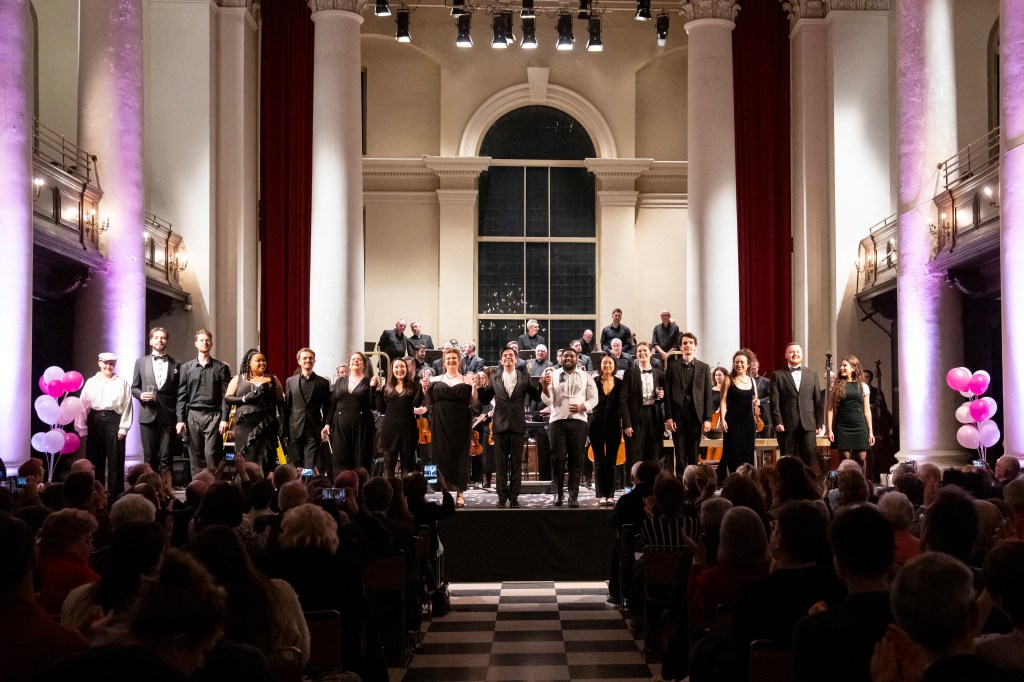
With this in mind, I was excited to attend a special NOS evening last week at the Sinfonia Smith Square. At this special evening, NOS young artists had the opportunity to sing on stage with the English National Opera orchestra.
The programme entitled Lust and Laughter was well curated, giving the audience the opportunity to hear young artists sing both romantic and comic repertoire. Puccini’s Bohème, Massenet’s Cendrillon, and L’Amico Fritz by Mascagni, were offered up alongside Humperdinck’s endearing Hänsel und Gretel, Mozart’s Così fan tutte and the opening duet of the operetta, The Merry Wives of Windsor.
Young sopranos and mezzos sang in different styles, ranging from bel canto to dramatic opera. The ensemble of singers were also called on to display their language skills by singing the librettos in their native French, Italian or German language.
I am a stickler for pronunciation and diction and often find that this area needs more work – some students stood out with their clear diction such as Scottish soprano, Rachel McLean.
The singing from all eleven artists was of the highest order and careful casting went a long way to projecting each singer in his or her best light.
There were scenes that stood out for me however.
La bohème provided the longest operatic extract. Act 3, where serious couple, Mimi and Rodolfo, pitch against the more boisterous and playful Marcello and Musetta, provides one of the most exquisite Puccini moments you will ever hear in opera. The two duets at Sinfonia Smith Square were sung well,. Moloko Letsoalo in the role of Mimi, giving us her beautiful burnished soprano and Egor Sergeev as Rodolfo, his fine Russian baritone.
I loved Nancy Holt’s Hänsel, Holt was exceptional in a young trouser role. Meanwhile Sarah Winn and Ana-Carmen Balestra sang a marvellously tender and poignant Cendrillon duet. It was breathtaking – Massenet’s score drawn out deliciously by the ENO orchestra.
Most surprising and successful was the partnering of Olivia Rose Tringham and Luvo Maranti in L’amico Fritz where Tringham’s formidable, dramatic soprano, paired well with Maranti’s soaring, Italianate tenor. It was a surprise to hear Maranti reveal his real potential here.
The evening showcased the wonderful talent springing out of NOS. And to have the ENO orchestra was an extraordinary coup!
Please see the link below if you would like to attend some NOS events. I urge you to do so if you are an opera lover.
KH
Subscribe to the NOS newsletter to be kept up to date with all the latest news and events at the Studio. Head to http://www.nationaloperastudio.org.uk
Discover more from ARTMUSELONDON
Subscribe to get the latest posts sent to your email.
 ARTMUSELONDON