Carolyn Sampson deftly sidesteps that ‘difficult 103rd album’ syndrome, teaming up with regular duo partner Joseph Middleton on the remarkable ‘Schubert’s Four Seasons’ – a worthy successor to their first two releases dedicated to this composer, ‘A Soprano’s Schubertiade’ and ‘Elysium’.
Followers of this team will be well aware of their gift for programming, and on the three Schubert albums in particular they have found fascinating ways to navigate through what must be the most daunting catalogue in art song. This time, we spend a year in Schubert’s company but, ingeniously, we move between winters, which works superbly for the repertoire’s emotional arc.
In sync with its subject matter, there is a real sense of a continuum to the album’s sequence, the subtle variations in the flow of time passing. We get moments of Schubert’s bottled lightning (especially turbulent closer ‘Rastlose Liebe’), but elsewhere the duo stretch out into some longer song choices, giving the disc overall a magnetic, even luxurious rhythm.
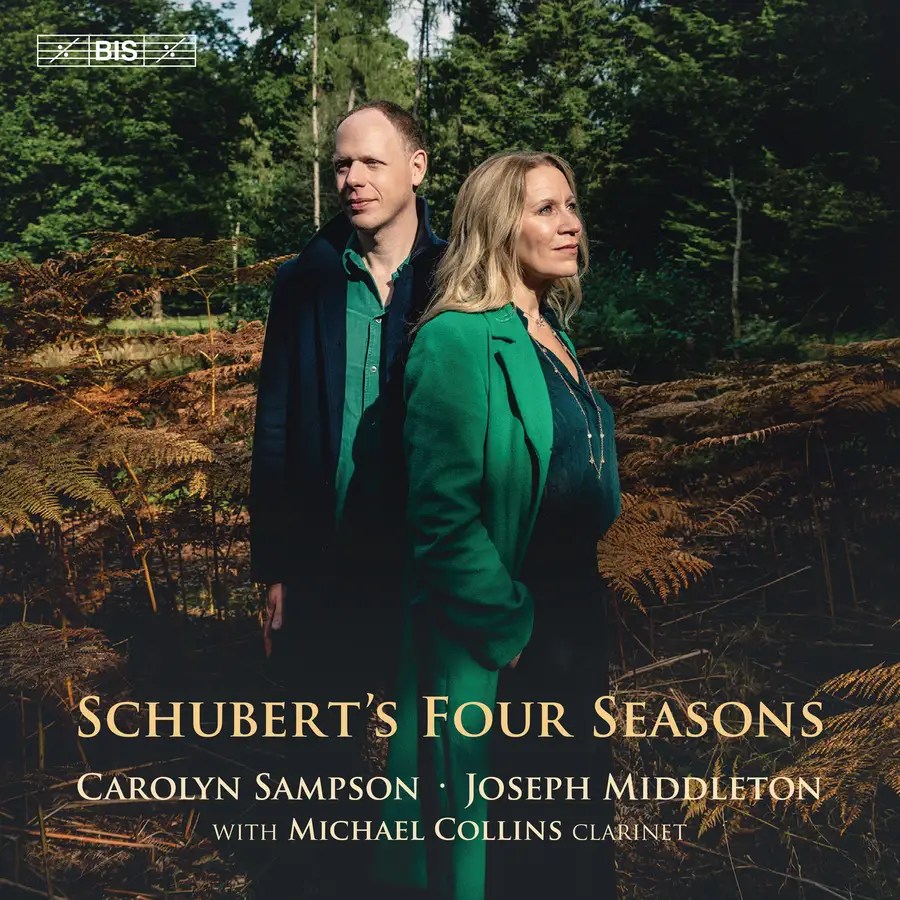
I found these truly immersive, an opportunity to absorb the sound the pair make in more detail. There are the shifting sections of ‘An den Mond in einer Herbstnacht’, where the changes in pace and dynamics are in total harmony. It’s tempting to reach for clichés and write about ‘telepathy’ or ‘playing as if with one mind’… but that isn’t actually what you hear – which is surely a combination of rapport, respect and rehearsal. Attention to detail, and to each other. Sampson and Middleton have their own quite distinct musical ‘personalities’ but they are on exactly the same wavelength, the latter’s responsive fluidity the perfect foil to the former’s sensitive clarity.
Another example is the beautiful rendition of ‘Im Freiein’. Middleton – left-hand robust yet restrained and right-hand delicate, chiming – creates the ideal sonic framework, building the acoustic space, even, for Sampson’s rich, complex vocal, bringing a conversational warmth to this most agile, searching melody.
The album’s obvious epic is ‘Der Hirt auf dem Felsen’ – the famous ‘Shepherd on the Rock’ – featuring guest soloist Michael Collins. The call and response between voice and clarinet is intricate and intimate, both capturing the subtle ‘yodelling’ lilt the song demands: listen especially to how Sampson closes the first verse – such elegance and precision, so lightly worn. The ‘duet’ aspect is further enhanced by the impeccable production typical of BIS releases (here, courtesy of Jens Braun) – the ‘closeness’ of the recording reveals a breath here, a tap of a key there, rewarding headphone listening with a genuine ‘in the room’ vibe.
To indulge myself and focus on one song in particular: ‘Nachtviolen’ makes an appearance here. This has long been one of my favourite Schubert songs. Perhaps the version I’ve listened to most is the 2014 recording of this song by Christian Gerhaher and Gerold Huber. Now, thanks to this album, my love for the song has been refreshed and reinvigorated, exactly what you would hope a new interpretation of a beloved piece would achieve. If Gerhaher laid down the soft cloak of night, Sampson’s voice is like glistening dew, shining its light on Middleton’s lush, yet restrained, accompaniment. There is a moment amid its general beauty – listen out for the word ‘fort’ – that has more than once made me catch my breath. (Schubert seems to know the likely effect, and repeats it for maximum audience satisfaction.)

Other highlights abound. ‘Herbst’ is stunningly realised, Middleton’s autumnal piano closing in on Sampson’s lonely protagonist, gales gathering strength in the left hand, leaves rustling in the right. Sampson’s infinite shades and storytelling gifts are widely in evidence: take ‘Der Winterabend’, where throughout, with subtle shifts in tone and energy, she draws out her character’s resilience and resignation as their observations move away from their surroundings to look inward.
And in ‘Im Fruhling’, both artists meet the song’s seemingly impossible demand: to contrast – and yet coalesce – the brightness of spring’s renewal with the lover’s sorrow and solitude. The song’s structure has a moment of weakness for the narrator (the fifth verse) where their resolve seems about to break… then a pause, and then they rally. But the duo create a gentle tension throughout – the tenderness of Sampson’s delivery met by Middleton’s sympathetic support, their minute gear changes – the heartrending effect is of thoughts occurring in the moment, a psychological portrait of real depth.
Well, spring is here. The perfect time to allow this increasingly brilliant partnership to recharge your love of Schubert with their fresh perspective. Warmly recommended.
AA
This release is available from Presto Music, along with the rest of the Sampson & Middleton back catalogue.
Discover more from ARTMUSELONDON
Subscribe to get the latest posts sent to your email.
 ARTMUSELONDON