‘Tao of Glass’ is somewhere between play and performance art, a mix of memoir, meditation and music. It’s a show only actor-director Phelim McDermott could create, and probably only now. It brings together the elements one might expect from him – innovative uses of movement, props and puppets to create a visual language, a universe where the piece can live and breathe. But here he shines a light inward, using Glass’s music as part-canvas, part-mirror to share something deeply personal and inspiring.
From the first minutes of the engaging opening scene, so natural is McDermott’s delivery, his recollections and meditations so fluid and unforced, that ‘Tao of Glass’ immediately assumes a kind of spontaneous, conversational vibe. This casual, relaxed ‘thinking-aloud’ wasn’t quite the companion to a Glass soundtrack I was expecting – forgetting in the moment that music is one of the most expressive ways to think aloud we have.
In fact, this contrast between McDermott’s seemingly near-random approach and the clichéd anticipation of a steady, robust musical framework from Glass – the impulsive meeting the impassive – is just one of the multiple themes woven into the piece so deftly.
Before long, we’ll remember that – of course! – McDermott is the mind behind Improbable, the ensemble that brought his ideas to life with such impact at English National Opera: the juggling acrobatics of ‘Akhnaten’ and the exquisitely-timed interaction of people and projected text in ‘Satyagraha’. We see constant evidence of his precision and attention to detail, whether in the uncanny-valley accuracy of the puppet design, a tour-de-force speech laced with samples and soundbites, or even his own physical presence – especially a sequence set in a flotation tank, where he literally pivots with only a thin portion of his lower back connecting him to the floor.
(In tandem, the show also reminds us of Glass’s ability to generate unforgettable emotional highs and lows from his patterns and figures – particularly in the ‘Coma’ section, more of which later.)
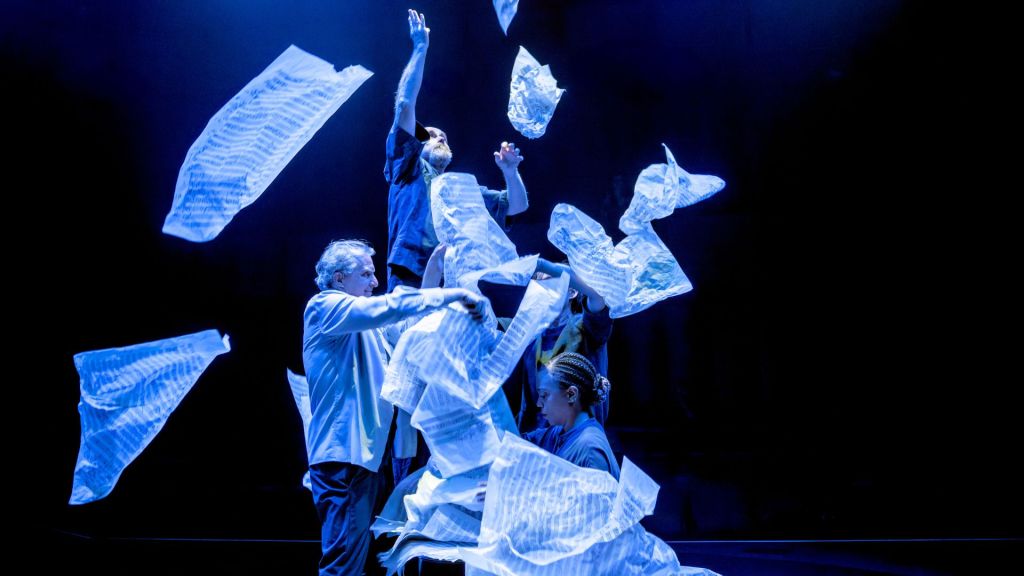
It’s tempting to call the visual creativity on display ‘magical’ but that would do it a disservice. McDermott and company hide nothing; they show all their working, elevating the art of practical effects into the sublime. I’ll resist including ‘spoilers’ about the actual shapes and images they create, but prepare for surprised delight as McDermott (with excellent partners-in-mime Sarah Wright, Janet Etuk and Vic Llewellyn) make full use of Soho Place’s revolving stage in the round to startle us with each coup de théatre and simultaneously show how it’s done.
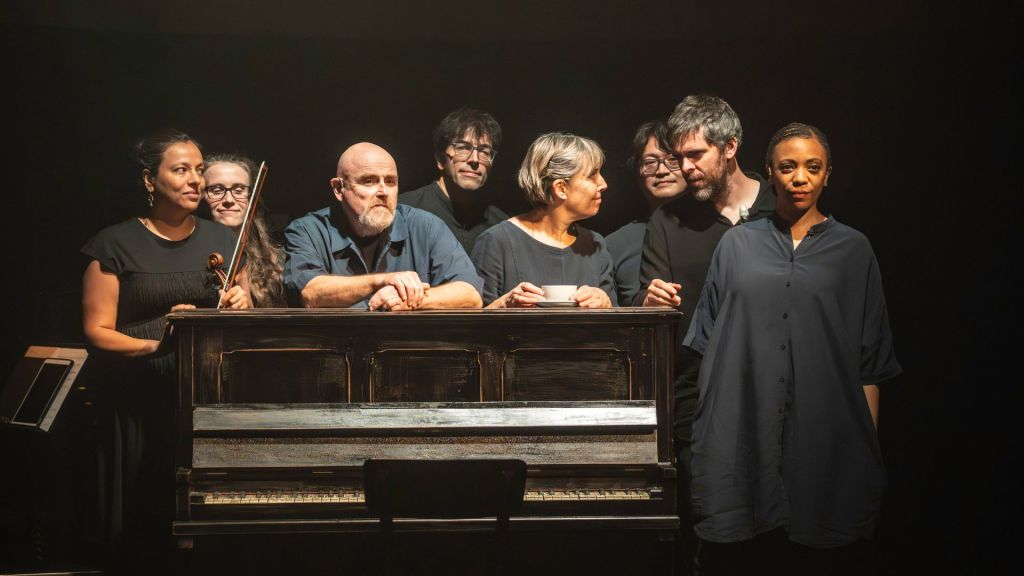
At one level, ‘Tao of Glass’ is a near-monologue – exquisitely dramatised and scored, but a monologue nonetheless with occasional interjections from the supporting trio. However, I can scarcely imagine it existing as a linear script or published play – instead I picture its puzzle-box construction set out on shuffle-ready index cards, or the thin paper sheets used so effectively in the performance itself.
It’s about a show that doesn’t happen (or does it?) and a show that does (or does it?). It follows McDermott’s wanderings through corridors of Eastern thought: the art of kintsugi (fixing broken objects with golden paste, embracing the shining flaw as a beautiful enhancement) and the teachings of Taoism. It’s about the search for the unattainable; coping with feeling unmoored as a child, then again in adulthood. It’s an extraordinarily empathetic work: I felt seen, knowing all too well that chaotic swirl of interests and identity, the messy quest for answers (intellectual and spiritual) that still add up to something resembling completeness.
How it hangs together: McDermott is so attuned to Glass’s music that his storytelling adopts some of its rhythms and cadences, with ‘slight returns’ of certain phrases or even anecdotes, recurring or repeating in slightly different or more developed versions. In this way, our appreciation of the ‘whole story’ builds over time, allowing us to add layer upon layer as if we were absorbing a Glass motif.
A beautiful, and extremely bold, example of this: two sections in the second half that partner each other (‘Coma’ and ‘Closing’) succeed so well because of the emotional investment in Glass’s creative powers that McDermott not only stirs up in himself but in us, too. In the later stages of such a vibrant, kinetic performance, these pieces are almost unsettlingly still, abandoning the spoken word, but absolutely riveting, the only real movement onstage being the movement of the stage itself. A supernaturally quiet audience hangs on every note.
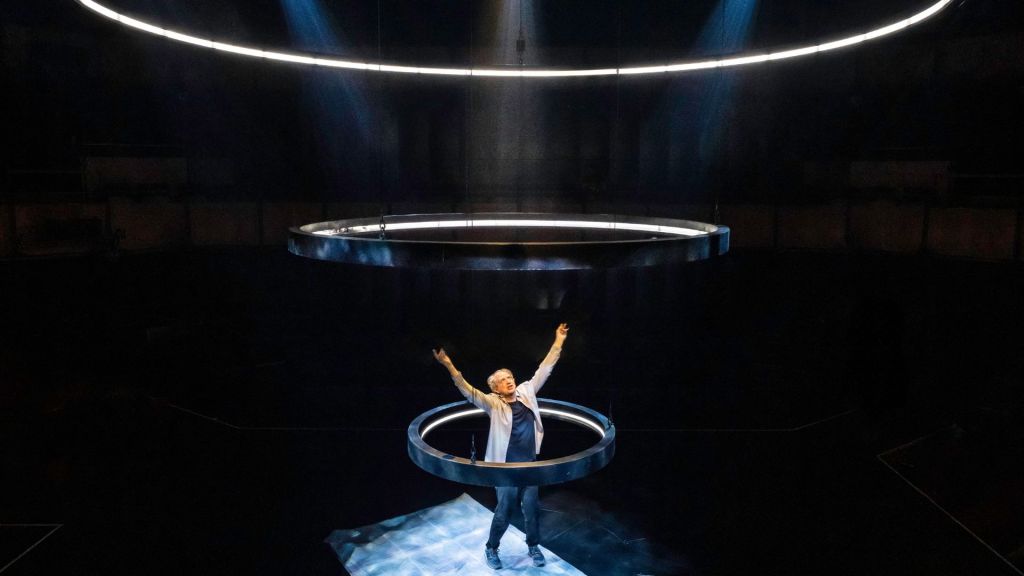
Much of the Glass work I’ve encountered live, whether the portrait operas at ENO or the monumental ‘Music in Twelve Parts’, has had an epic quality, achieving its transcendental effect through creating a vast, ritualistic experience, mass-like for the masses. ‘Tao of Glass’ demonstrates that using the sparsest resources in the most intimate setting does nothing to diminish this power. If anything, it enhances it, as McDermott shows how surrendering to this music as an individual is as transporting, spiritual even, when quite alone.
As the show ends, I sit there mildly, happily stunned as my mind sorts and shuffles the various elements of the evening that now come together. Seemingly disparate at first, jagged shards of narrative have somehow cohered into utter completeness. McDermott himself is the golden adhesive, his unique creativity and vision reassembling the fragments of his experience into something more beautiful, more than the sum of its parts. He did kintsugi us, after all.
AA
‘Tao of Glass’ runs until 12 September 2026 – tickets available here.
Main image by AA; all production photos are by Johan Persson, from the online gallery.
A five-track EP of music from ‘Tao of Glass’ is available and warmly recommended. If you buy from Bandcamp, you will support the artist directly and have the option to download the audio at the quality of your choice.
Discover more from ARTMUSELONDON
Subscribe to get the latest posts sent to your email.

