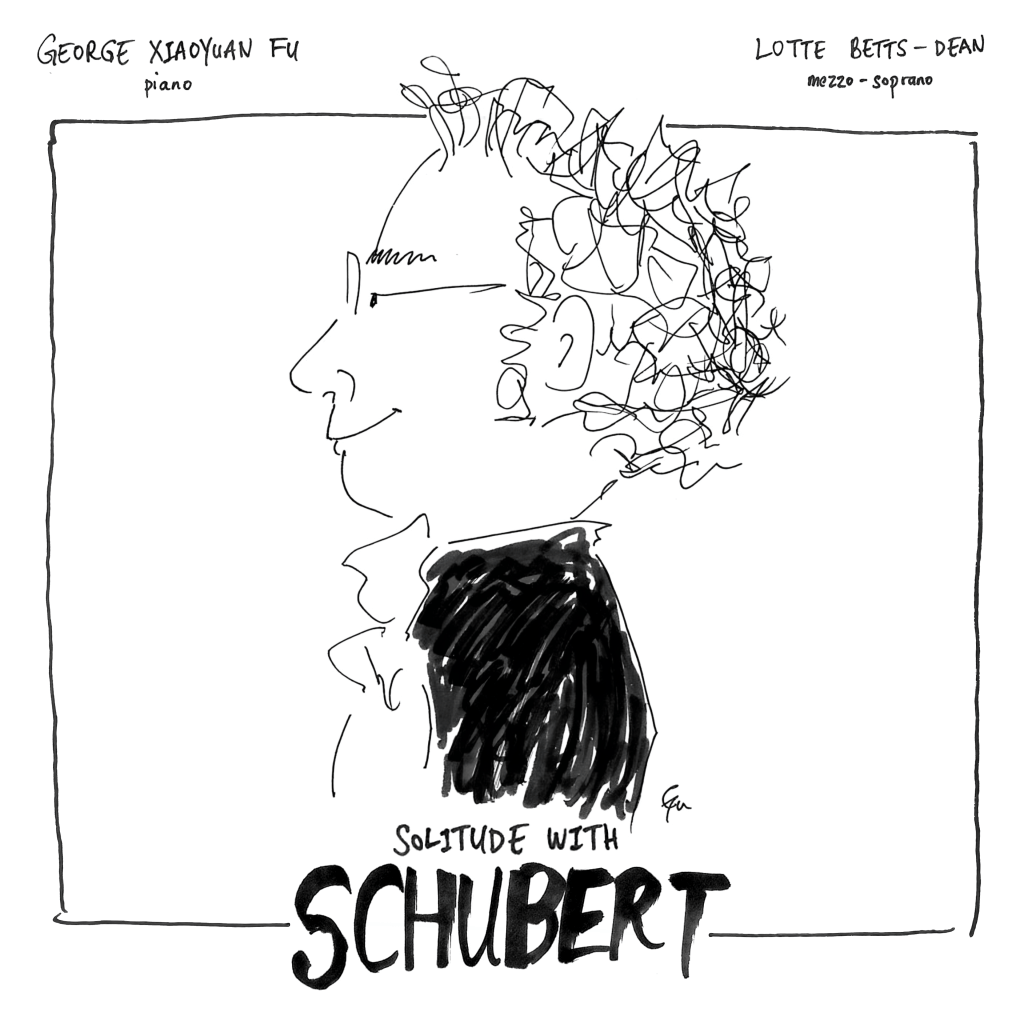
When George Fu lost his father, he turned to Schubert for solace. Fu likened the experience of playing Schubert’s Sonata No 19 in C minor to receiving “a hug from 200 years ago”. Out of this difficult time came a recording, Solitude with Schubert.
Impressed with the Schubert project, Karine Hetherington from ArtmuseLondon, went to find out more from the artist.
Congratulations on Solitude with Schubert. Is solitude both a good and bad thing would you say?
That’s exactly the point! I guess we pianists spend most of our time on our own. Some of the most wonderful things are only possible to experience by yourself. But then again, feeling isolated can be one of the worst experiences as well. So depending on how Solitude is framed, it can cut both ways.
The Schubert Sonata in C minor you play on the album and the Allegretto are magnificent. One never tires of the drama and the surprising interludes of light and warmth – all this, Schubert, and you of course, express so finely.
Can you describe the process of curating this particular album? Psychologically and musically?
I’m very proud to record the C minor Sonata as a ‘first statement’, and I’d certainly like to record more Schubert. In some ways I chose it because it feels like a good ‘introduction’ into how I would want to play a substantial work such as this.
My first idea to play and record more Schubert came during 2020, during the pandemic, and as a result Lotte Betts-Dean and I had decided to work on the Einsamkeit song cycle together. I thought of those two large works acting as emotional anchor points, and the other works would be pieces that could frame them appropriately. Key relationships are also things I occasionally think about: the c minor Allegretto seems like such a perfect prelude to the Sonata, for example.
Do you sometimes worry about playing very well-known repertoire, especially live?
It depends on the repertoire. With some works, it’s very clear to me how I want to play them, so ‘outside influence’ doesn’t play a very big role. If that idea isn’t as clear, then yes it can be daunting (and distracting). It’s best not to think too much about things like this in my experience!
You have brought in Schubert’s vocal writing to the album.You accompany rising mezzo soprano, Lotte Betts-Dean on the album. How did you two come to perform together? And how did you come across this lesser-known Schubert song cycle Einsamkeit where Lotte Betts-Dean’s mournful mezzo in Gib mir die Fülle der Einsamkeit is stunning.
We worked on a video project together in 2020, called Postcards from Vienna with Jonathan Berman. For that project we worked on some Mahler songs together. Lotte had actually stumbled upon it around this time and we decided to explore it together.
I know you compose – have you ever composed for the voice. If not – would you like to?
I would definitely like to compose for the voice, and I’d especially be interested in writing songs for the Chinese language. My grandmother was a poet and left behind lots of poetry. It would be very meaningful to set those words to music.
You finish off the album with Schubert’s beautiful Hungarian Melody – sometimes the simplest of tunes are the best … what do you think? Why did you use it here on this album?
It is one of the most beguiling tunes ever written and shows Schubert at his best. I could think of no better way to end the album – or the recording session.
Where are you off to now touring and what are you playing?
I’ll next be going to the Bard Festival in upstate New York to play Mozart’s Fifth (actually first!) Piano Concerto. Right now I’m on holiday!
What do you like doing to relax?
Perhaps it’s not ‘relaxing’ in the conventional sense (I am often more tired), but I have a two-year-old daughter who keeps my hands full. Without any doubt, spending time with her makes me a better artist.
KH
Discover more from ARTMUSELONDON
Subscribe to get the latest posts sent to your email.

