The city of Mahagonny rose and fell three times in the space of a week in ENO’s recent ‘blink-and-you’ll-miss-it’ production. Fortunately, enough people did notice and the entire run sold out – so I am glad to have made it to the closing night.
This uncompromising, scathing satire from Kurt Weill and Bertolt Brecht tells the story of three fugitive criminals who found a new city in the middle of nowhere, solely for the purpose of luring revellers in pursuit of decadence and fleecing them for as much as they can. By the time the sin-driven society collapses, an assortment of ne’er-do-wells have been sucked in, chewed up and spat out.
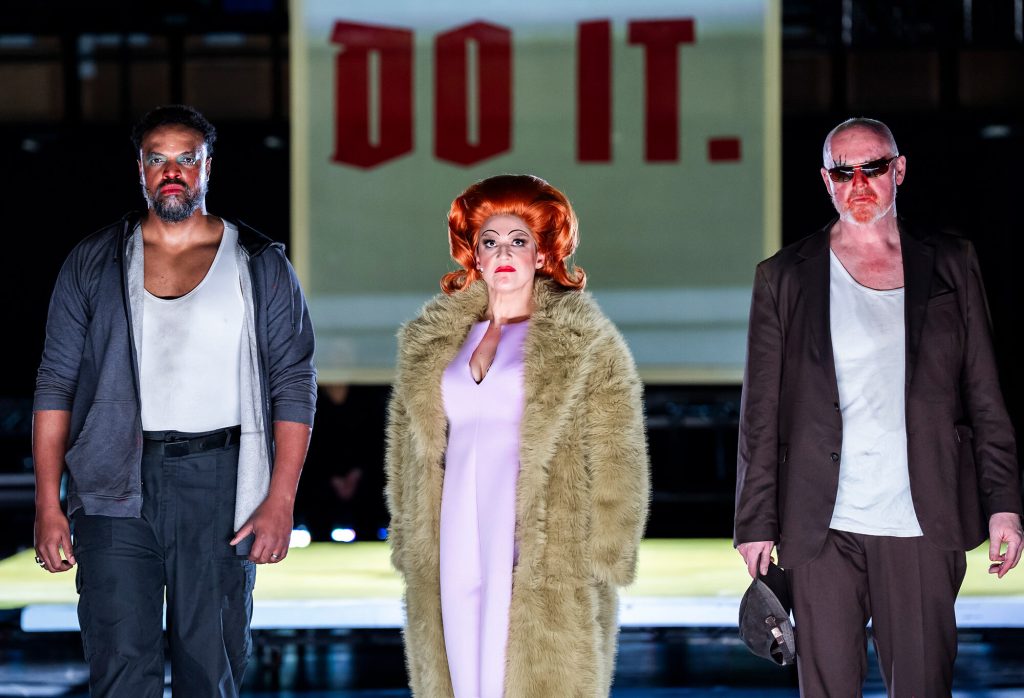
Although a full-blown staging, it initially made me place it in what feels like an accidental/unofficial series of recent ENO productions that advertised themselves as low-key but in fact contained multitudes (such as ‘Duke Bluebeard’s Castle’ or ‘Mary Queen of Scots’).
What we saw was not lavish but garish: crates and boxes, signs and graffiti, cast dressed in civvies from a lost dark age of music video. The production choices themselves seemed to comment on the action.
What stops this runaway train of an opera, with its careering mix of classical and cabaret styles, from de-railing completely? Brecht’s parcelling up of the surreal narrative has the ‘rise’ and ‘fall’ of the city framing the near-revue sequence in the middle, cycling one-by-one through a litany of the characters’ vices. In this incarnation, it’s also how the set and props reinforce this structure, walkways and windows through and round makeshift rooms, cuboids ranging in size from suitcase to truck. This literally was a ‘pop-up’ city, an emporium out of nowhere ready to profit from, then fall prey to, market forces. The container aesthetic brought home the notion that everything in Mahagonny, from morsels to morals, could be compartmentalised and commoditised.
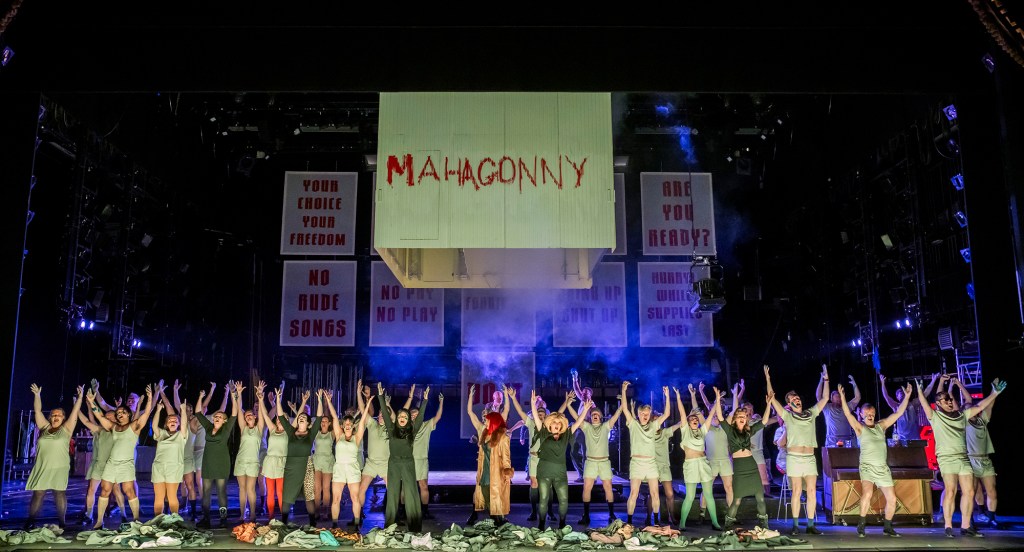
Radical, riotous, and relentless: the evening fizzed with a kind of pinkish, guerilla energy. I soon realised that, the large scale notwithstanding, the vibe it gave me more than anything conjured up the ‘breakaway’ ENO Studio Live initiative from the last decade. (I was interested to read afterwards that director Jamie Manton and designer Milla Clarke first worked together during that project: their creative rapport pays huge dividends here.)
The most crucial connection for me between those modest, yet inspirational productions and this temporary explosion is the foregrounding of ENO’s magnificent Chorus.
‘Mahagonny’ itself needs to be a main character, a shapeshifting car-crash community of decadence and dissolution, and the Chorus – always moving parts in human form, always finding the individuality in their group identities – bring this malevolent mass to vibrant, varied life. Special mention in this respect to sopranos Joanne Appleby, Ella Kirkpatrick and Claire Mitcher, and mezzos Deborah Davison, Sophie Goldrick and Susanna Tudor-Thomas in their stand-out group portrayal of ‘Jenny’s Girls’.
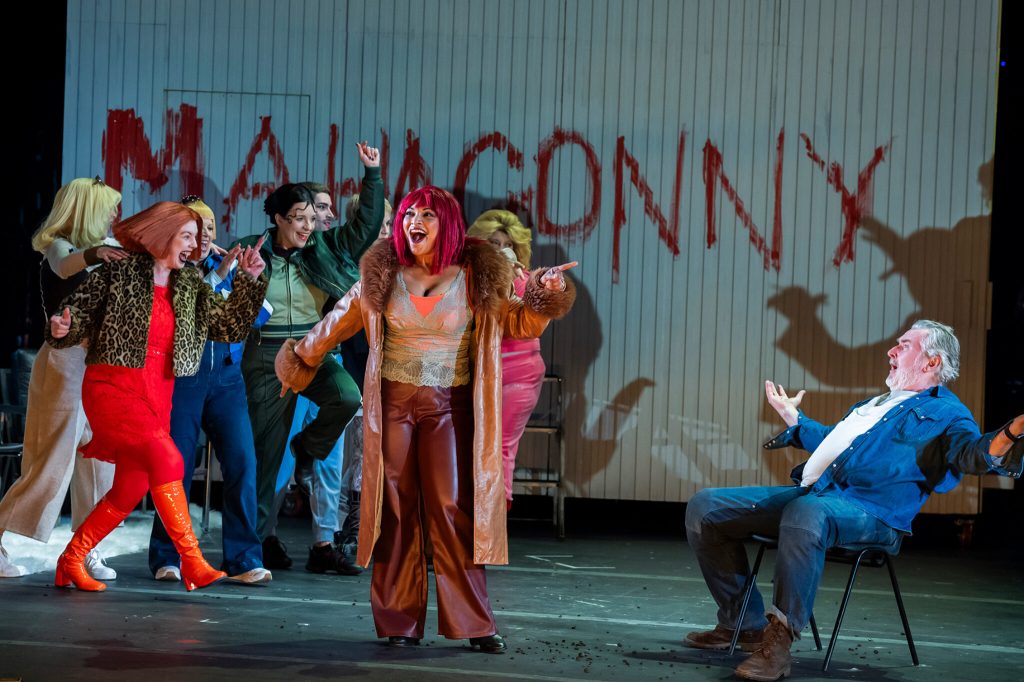
It’s a nice irony that a piece creating stars of its chorus levels its soloists into unsympathetic victims and casualties. The brilliant casting – sly, playful, perfect – exploited several different versions of star wattage and mercilessly smashed the bulbs. An utterly (on the) game Danielle de Niese launched herself from glamour into grime as ‘whore-with-a-heart-of-stone’ Jenny, while Rosie Aldridge’s showstopping musical-theatre versatility led to an Ethel-Mermaid powerhouse version of Widow Begbick. And Simon O’Neill, Wagnerian hero, spent much of the action inebriated, tethered to a lamp-post. The troupe luxuriated in fine actor-singers – it was especially thrilling to see familiar faces that had come through ENO’s Harewood Artist programme, such as Alex Otterburn, Elgan Llŷr Thomas and Zwakele Tshabalala. Everyone involved gave 100% commitment to their own degradation or destruction: a finite time had by all.
Under incoming Music Director André de Ridder, conducting his first opera at ENO since his appointment, the Orchestra feel supercharged, swinging us into submission with a riveting command of the score’s controlled chaos. With both Chorus and Orchestra on this kind of form, I’m even more excited than usual for the upcoming new season announcement.
AA
All photos by Tristram Kenton from the ENO production gallery.
Discover more from ARTMUSELONDON
Subscribe to get the latest posts sent to your email.
 ARTMUSELONDON