From fights to frights at the RBO, as I managed to escape from reality there twice in a week: first to see ‘Siegfried’, the third instalment in Barrie Kosky’s ongoing Ring cycle for the company.
While we’re talking very narrow margins, ‘Siegfried’ has tended to be my least favourite of the four Ring operas. I’ve been fortunate to see some wonderful performances and productions, but somehow the opera itself has felt innately ‘underpowered’ to me dramatically.
After all, it has the thankless task of getting us from the devastating emotional assault that closes ‘Die Walküre’ to the climactic rollercoaster of ‘Götterdämmerung’… placing an extraordinary burden on a single (and not always that sympathetic) character to get us there.
Kosky’s high-octane take instantly torpedoed my apprehension. The first two entries in his RBO Ring were as idiosyncratic and inventive as you’d expect, but from curtain up this felt directed by a man possessed.
Any element that might have suggested a ‘longeur’ in the action was ruthlessly ramped up into a tour-de-force of imaginative brio. There was the cacophonous broken metal shards and decaying-steampunk machinery in Mime’s workshop. The nervous, agitated circling of Fafner’s lair before the trump-card reveal of the dragon-giant himself. Erda emerging – literally – from the fabric of the earth, her elder self. Or the world of darkness giving way to floral rebirth with Brünnhilde’s awakening.
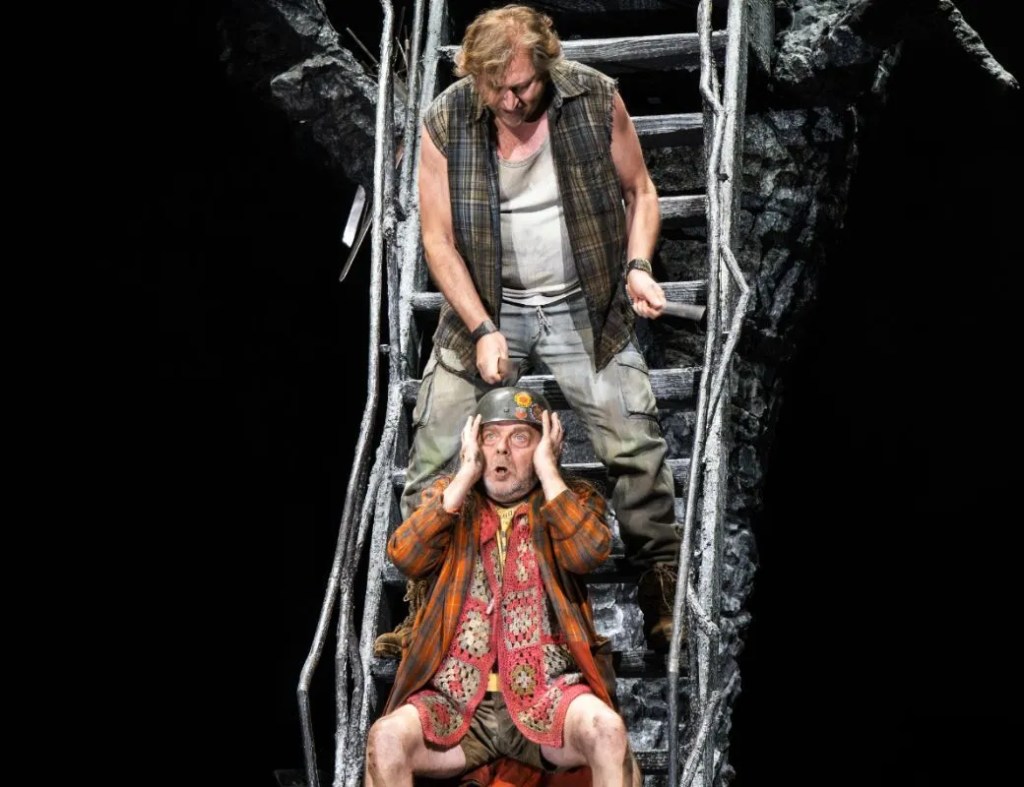
Your eyes darted around looking for Kosky’s visual cues and motifs just as your ears navigated their way through Wagner’s motifs. Sudden sparks and golden glows were smartly, sparingly deployed. Sword and Tarnhelm, or cross and crown of thorns?
Realising this supercharged vision would of course be impossible without Herculean feats of energy from the performers – who rose to the challenge both on stage and in the pit.
As Siegfried, Andreas Schager was tireless to a genuinely heroic level. With apparently paranormal reserves, he powered through the role embodying not just the voice and volume, but the character’s stroppy-teen mannerisms, arrogant nonchalance, and awkward, misplaced strength.
But his colleagues matched him. Everyone achieved a kind of peak vocal delivery, making it seem not effortless exactly, but perfectly natural, as if this was generally how they chose to speak to each other – and the same applied to their acting prowess and relentless physicality. Peter Hoare roared out of the traps as Mime, flipping his ingratiating sliminess into hyperactive, self-destructive rage; Christophers Maltman and Purves, as Wotan and Alberich, prowled around each other with barely-suppressed aggression, electrifying their encounter. And Elizabet Strid’s Brünnhilde put her suitor through an actual kiss-chase for most of the final act. (Sarah Dufresne sang an enchanting Woodbird off-stage, while Illona Linthwaite maintained a stately presence as the watching, elderly Erda, marching to a different drum.)
And – importantly, engagingly – it was funny. Comedy is woven into the opera (for example, Mime’s accidental confession), and not taking the whole affair too seriously paid handsome dividends. By leaning into the lunacy of the story, Kosky gave us room to breathe, to enjoy the heightened myth-madness of the tale without ever making it ridiculous or nonsensical. Accordingly, the more moving moments (especially as many of us know what’s coming) landed with greater weight.
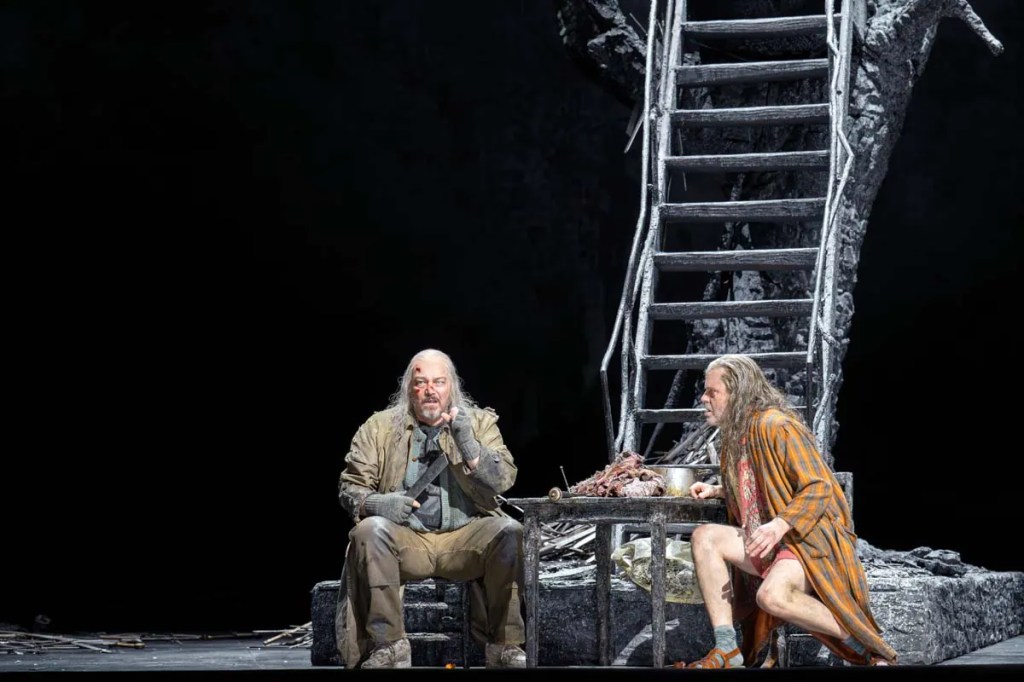
Pappano brought the entire orchestra on stage for the applause, a gesture they richly deserved. As well as riding high on their momentum, I heard more detail than ever in the score, felt more gratifyingly alive than ever to recognising and understanding the various signature themes. An all-round brilliantly-conceived evening; the anticipation for ‘Götterdämmerung’ has just become more agonising.
Fortunately, the wait for my next opera was only two days: back in the same building but down in the Linbury Studio Theatre for a new production of ‘The Turn of the Screw’.
As someone who loves ghost stories as much as Britten’s music, this is one of my very favourite operas. I always marvel at the economy of Myfanwy Piper’s libretto, forcing us – in the spirit(s) of James’s elusive story – to reach into the depths of our imaginations for impossible answers, and how Britten sustains a soundtrack of unease and dread, channelled menacingly here by members of the RBO Orchestra under Bassem Akiki.
This was a cunning, uncanny production, perhaps the most successful I’ve seen in creating a genuinely disturbing and unsettling atmosphere ‘live’, in the way a horror film might. In practical terms, it overlaid the onstage actions with projections onto a near-invisible gauze curtain that stretched across the entire ‘fourth wall’. In this way, the otherworldly, ethereal images made a translucent barrier between the characters and audience.
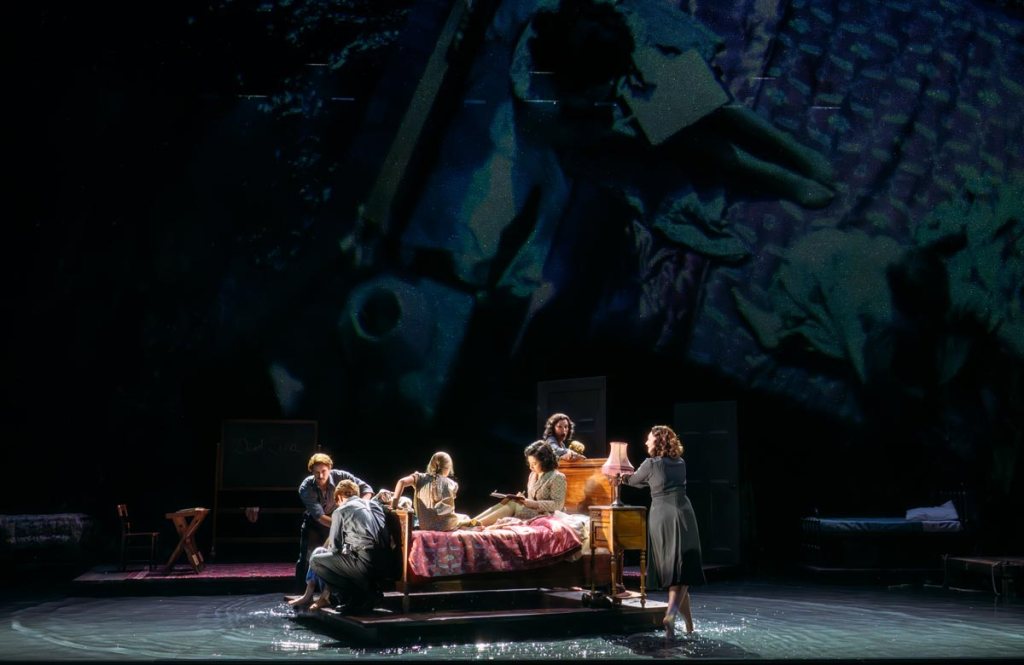
At first, it almost appeared to overplay its hand, stacking up the apparent genre homages: spooky siblings, doppelgangers, a roving camera showing the evil entity’s point of view. Misinformation overload! And in a truly startling visual coup, the drowning imagery that, well, saturates the story was realised through a flooded stage.
But I realised, as the story grew in intensity, that I’d fallen prey to the trap laid by co-creators Natalie Abrahami (direction) and Michael Levine (set design). The more certain I felt the production was telling me something, the more assuredly the rug was pulled from beneath me. Sometimes the projections reflected what one saw being performed, but chillingly, at other times they did not – and they weren’t about to reveal the joins. Out of potential confusion, the roles of the doppelgängers (silent actors doubling the two ‘ghosts’) coalesced so they almost became humanoid agents of claustrophobia, carrying out physical manoeuvres as pairs that wouldn’t work for individuals, and shifting props as though part of the house’s bricks and mortar.
Overall, the stagecraft honoured the tale’s ambiguity by blurring this world and the next: reality mixed with reflection; the house and lake merged; costumes morphed one character into another.
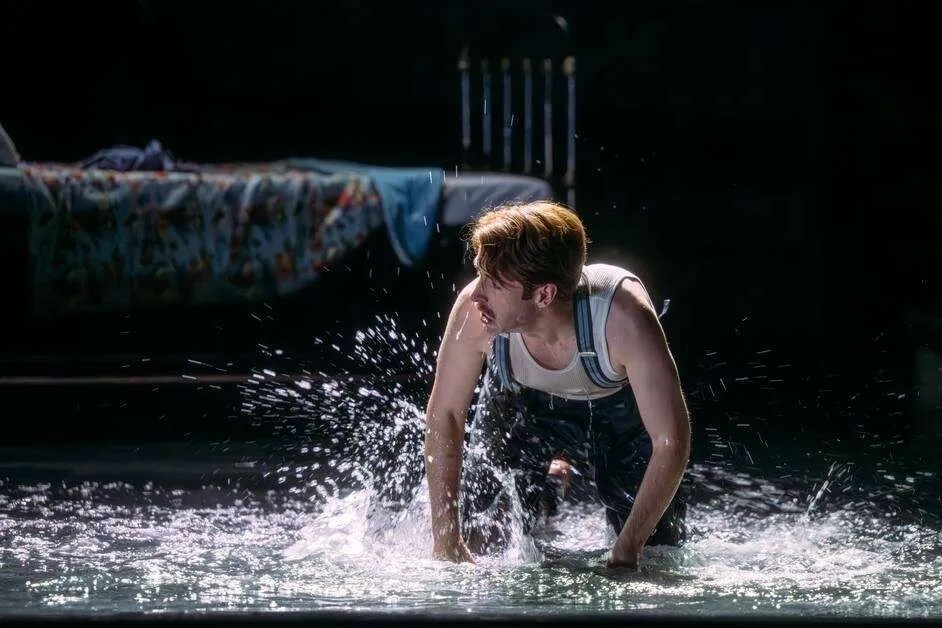
The stunning cast absorbed this fluidity into their performances. Isabelle Peters gave a perfectly-judged Governess, charting with precision and pathos her gradual descent from joy and anticipation to a near-fanatical terror. Claire Barnett-Jones as Mrs Grose moved from bustling protectiveness to baffled panic as her loyalties shifted and her denial fractured. Kate Royal and Elgan Lŷr Thomas were beautifully three-dimensional spirits, suffering and scheming, tender and terrifying, their own untold story bleeding through into the present. The two children – on the night I went, Fleur Maxion as Flora and Glenn Tong as Miles – were superb, seasoning their fear and vulnerability with something more sinister, and carrying their respective climactic scenes with convincing maturity. And it would be wrong to omit actors Clare Kate O’Brien and Peter Willoughby, mirroring Royal and Thomas with an eerie elegance, saying with movement what couldn’t be sung.
I accept that this is far better suited to the Linbury than the main stage (where, so far, the other operas in RBO’s Britten series have played). The orchestra is chamber-size, and the intimacy suits the story’s dark psychology and this version’s technical demands. But I do hope, after what I believe was a sell-out run, that a revival beckons and this production survives its current demise to haunt many more audiences.
AA
RBO production photo credits: Monika Rittershaus (‘Siegfried’) and Mihaela Bodlovic (‘The Turn of the Screw’).
Discover more from ARTMUSELONDON
Subscribe to get the latest posts sent to your email.
 ARTMUSELONDON