This Sunday afternoon recital promised to be a true rarity. In all the time I’ve been going to Wigmore Hall – in fact, attending art song concerts anywhere – I’ve never knowingly seen Messiaen’s ‘Harawi’ programmed. Recordings also seem relatively scarce, with a handful of mentions on the esteemed Presto Music website, and some of those incomplete as part-performances on discs with wider-ranging track listings.
After witnessing this spectacular rendition by mezzo Simone McIntosh and pianist Nathaniel LaNasa, I could both see why this might be the case, and lament the situation at the same time. (I would certainly encourage this duo to document their interpretation.)
I found the work itself quite brilliant. For both performers and audience, it’s a definite commitment: twelve connected songs, played through with no interval or applause breaks, over roughly an hour. Reaching for the most obvious comparison – just like ‘Winterreise’, you are drawn into a specific sonic universe as the narrative unfurls across the music and lyrics. However, for Messiaen, the ideas of ‘universe’, ‘narrative’ and possibly even ‘music’ take effect somewhat differently than for Schubert.
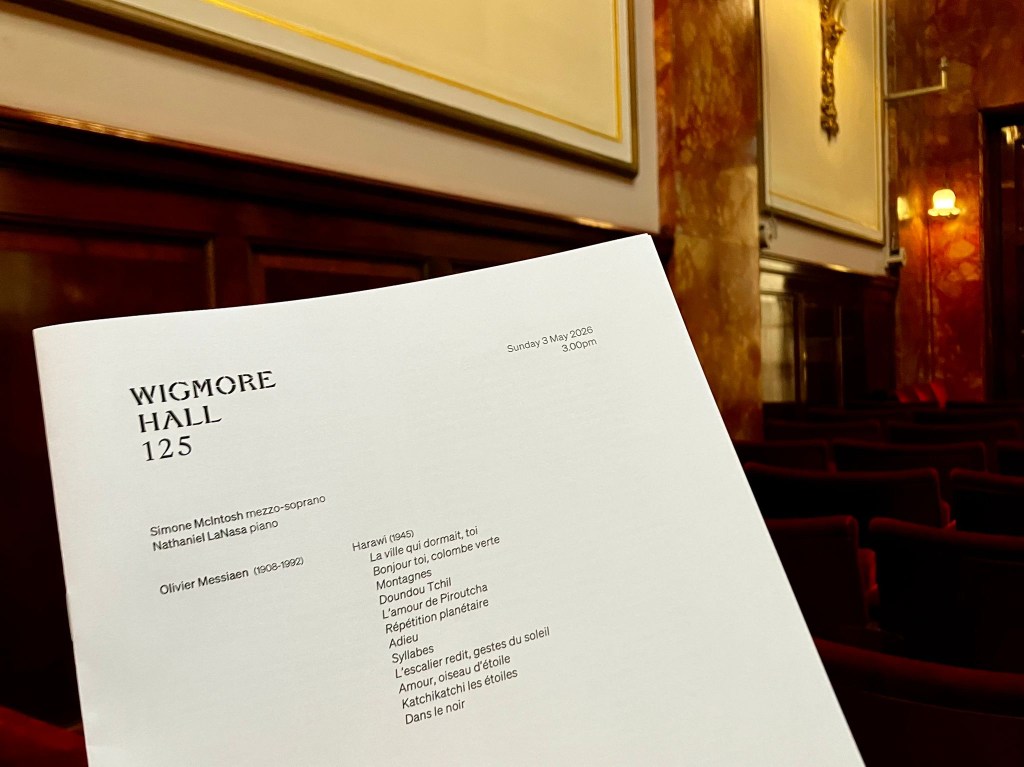
Perhaps it’s worth starting with the words, written by Messiaen himself. In pop, rock or folk, of course, the singer-songwriter figure handling both music and lyrics is a constant (even though the practice of songwriting teams writing for popular performers is equally storied: Motown, Brill Building, Xenomania). But classical song – more or less as a defining feature – has traditionally involved the composer finding existing poetry they want to set to music. At the keyboard, off the top of my head, I can think of very few prominent exceptions: Debussy setting his own words for the ‘Proses lyriques’; Errollyn Wallen as a fine contemporary example of a composer-lyricist; and the Schubert / Mayrhofer collaboration, which seems to have resembled a relatively modern songwriting partnership, the latter crafting verse deliberately for the former to use as lyrics.
So – along with the Debussy – this is a vanishingly rare opportunity to hear an art song cycle with a single brain behind the words and music, and – again, like the Debussy – I think it makes an audible difference. As the piano part darts around, making a conquest of the whole keyboard, and the melody demands similar shifts in pitch and dynamics from the voice – so, too, the words explode in short, vivid images and phrases. French often gives way to expressions in the Peruvian Quechuan dialect (some real, some imitation) – more on this shortly. They give the impression of spontaneous thoughts and ideas, at times eliding into wordless sounds of anguish and release (green-)dovetailing around each other – it’s almost impossible to imagine these elements existing separately. The integrity of the work is such that it feels like one long song, with recurring motifs tightening its vice-like grip on the listener.
Messiaen’s sky-dwelling aesthetic is in full effect – sun, stars and birdsong abound – but various influences pour into ‘Harawi’. As Nigel Simeone’s informative programme notes explained, the Quechan word ‘harawi’ itself, means a song of tragic lovers, and the cycle is partly inspired by the Tristan & Isolde legend (which went on to preoccupy Messiaen through two other works, the ‘Turangalîla-Symphonie’ and ‘Cinq rechants’).
However, the love/death motif has a real-world focus in Messiaen’s first wife Claire Delbos, already stricken with the early stages of dementia. Her condition seems to burst into the lyrics, with their references to blackness, darkness, silence, emptiness and – disturbingly – some of their breathless, meaningless repetition. Simeone suggests that Messiaen’s gifted student and champion Yvonne Loriod, whom he would go on to marry after Delbos’s death, may also feature. It is tempting to see this where there is fire, light and living nature in the lyric. However, this is all couched in deeply allusive, elusive text which also draws explicitly from Surrealist themes and symbols, and makes the most of the wrenching clash of beauty and horror.
The music is a matching melting pot, drawing on Peruvian folk music in line with the Quechan lyrical inspiration, but fragmented and reshaped into Messiaen’s richly onomatopoeic soundworld. After one hearing, it’s difficult to itemise these precisely, but because the words and music track so closely, the entire cycle felt completely expressive, from swirling chaos to dance rhythms, from flowing water to, inevitably, bird cries.
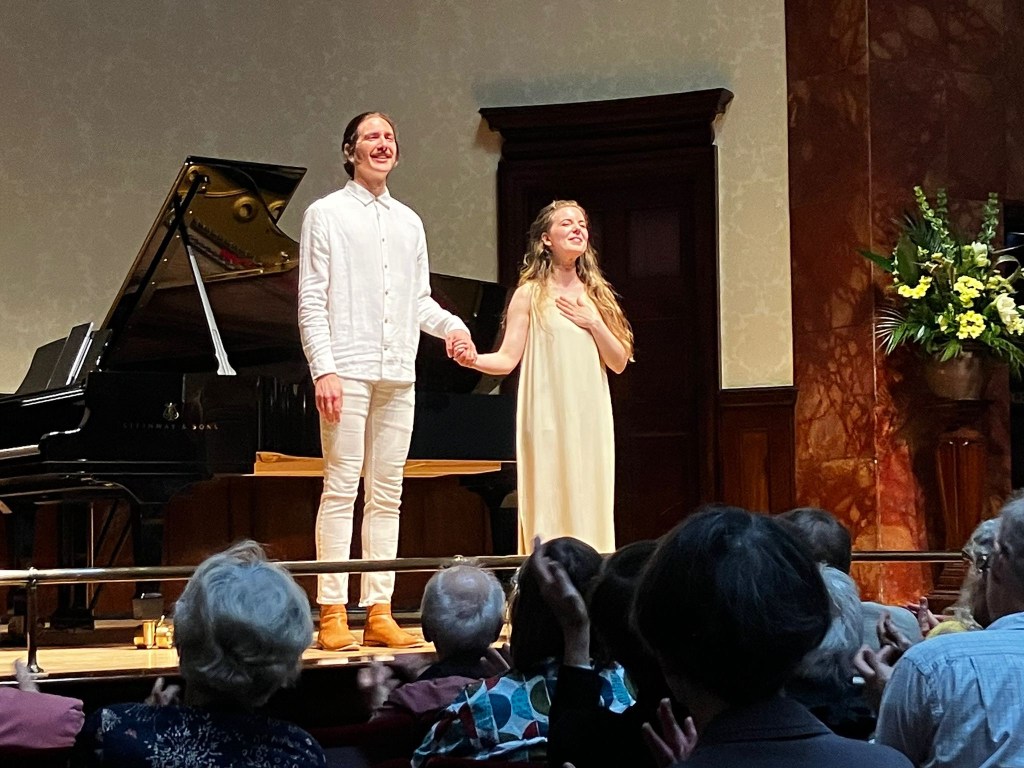
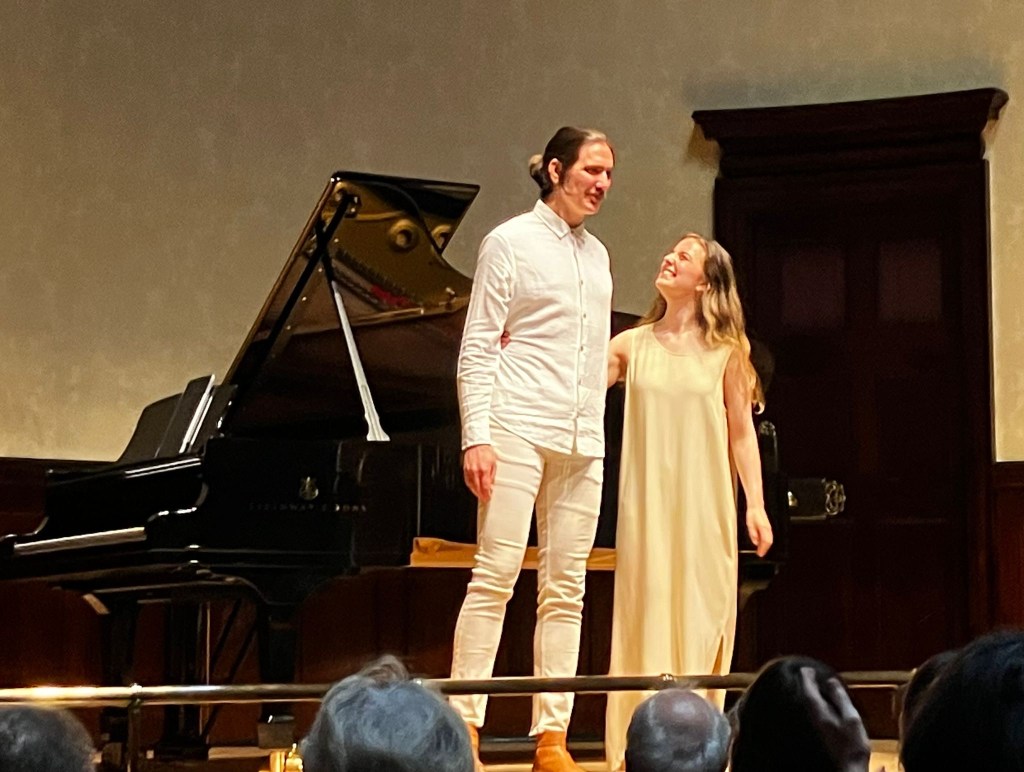
McIntosh and LaNasa had clearly thought deeply about the kind of performance ‘Harawi’ might require, and their stagecraft played a crucial part in making a potentially tricky piece immediately engaging for the audience. To begin with, they walked on in toning outfits, off-white, McIntosh barefoot: initially, the effect was slightly eerie – transcendence or the tomb? – but of course this proved to be a perfect fit for the work’s tragic spirituality. McIntosh had also choreographed her role, introducing dance movement and gestures through the longer instrumental passages, circling the piano ritualistically, even collapsing to the floor for certain verses. This was an elegant and understated device, never overdone, and never at the expense of her singing, but – given the unpredictable nature of the cycle – created an extra layer of tension through not knowing exactly what she might do next.
Most importantly of all, though, the duo simply sounded fantastic. McIntosh sang with a warm and sensual tone that could, at will, leap into a strident nerve-shredding cry or fracture into an insular near-breath, all coalescing into a heartfelt emotional depth. LaNasa was a consummate foil, watching her closely to mirror any extremes and convey the ‘single mind’ behind ‘Harawi’ as authentically as possible.
A superb performance of a challenging and rewarding work. Hoping for its return – and to hear much more from this team.
AA
(Press photo of Simone McIntosh: Seraphlia Photography. Other photos by AA.)
Discover more from ARTMUSELONDON
Subscribe to get the latest posts sent to your email.

