‘Opera that does not look away’ is the theme of English National Opera’s 2026/27 season – and in the case of ‘Angel’s Bone’, one might wonder ‘where to look?’
This one-act lightning bolt of a piece by composer Du Yun and librettist Royce Vavrek feels like an alchemical conversion of adrenaline to music. Hardly pausing for breath throughout its 80-minute running time, it careers relentlessly through a wide range of genres: there are dissonant orchestral passages, for sure, but they smash, transition-free, into metal, noise, jazz and soul. Now, in the hands of director Kip Williams, it becomes a full-on assault on the senses, filling video screens with images as ferocious and harrowing as the sound. It works.
It’s a contemporary opera, but it isn’t new: the full-length version dates back to 2016 and, in the following year, won a Pulitzer Prize. As its first production to play in both Manchester and London, this new staging of ‘Angel’s Bone’ now occupies a key place in ENO’s history. Sadly, I wasn’t able to make the UK première in Manchester – where I understand the presentation in the round created its own claustrophobic intensity – but in ENO’s London home, the Coliseum, Williams could ‘go large’, depicting the work’s abrasive horrors on the grandest of scales.

A brief summary of the plot. Two angels make a return visit to Earth and, in their weakened state, are found in the garden by Mr and Mrs X.E. Down on their luck and with their marriage on extremely thin ice, the couple see a chance to exploit their celestial visitors. Once the angels show signs of recovery, the X.E.s rip the feathers from their wings, forcing them into captivity, and delivering them up to an endless stream of paying customers.
As a polemic against sex trafficking and modern slavery, the ‘angels as innocent victims’ message is not subtle. (Taking this together with Benjamin and Crimp’s ‘Written on Skin’, it seems that being an angel in opera is almost as hazardous as, well, being a woman.) But then the subject matter doesn’t warrant or deserve subtlety: no depiction can be too horrendous if the point is to land. We are not given the luxury, or mercy, of separation, distance or even metaphor. Once those wings are clipped, the angels are a boy, a girl, children.
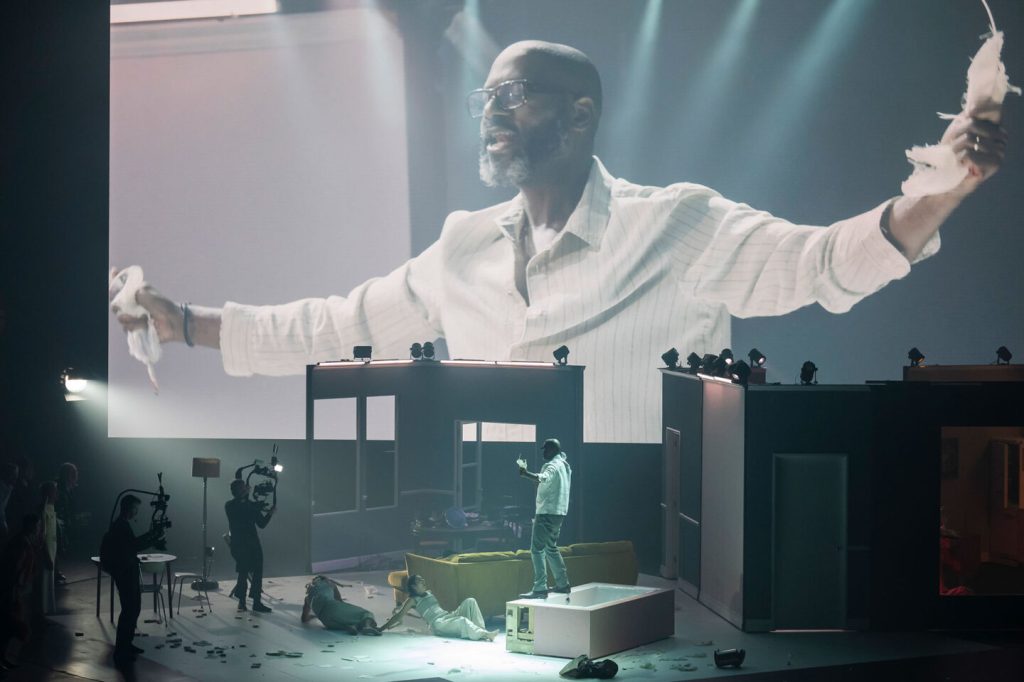
ENO’s content warning reads like a trigger checklist, and what we are asked to witness should be unbearable: and yet it is tolerable. This is where the technical brilliance of the production is so vital. On stage, the X.E.s’ house comes together gradually as mobile partitions start to form suggestions of rooms and corridors. However, gaps in the fabric allow three camera operators to roam through and around the action. What they film is projected live, in real time, on vast screens which at various stages hover above, or partially obscure the set.
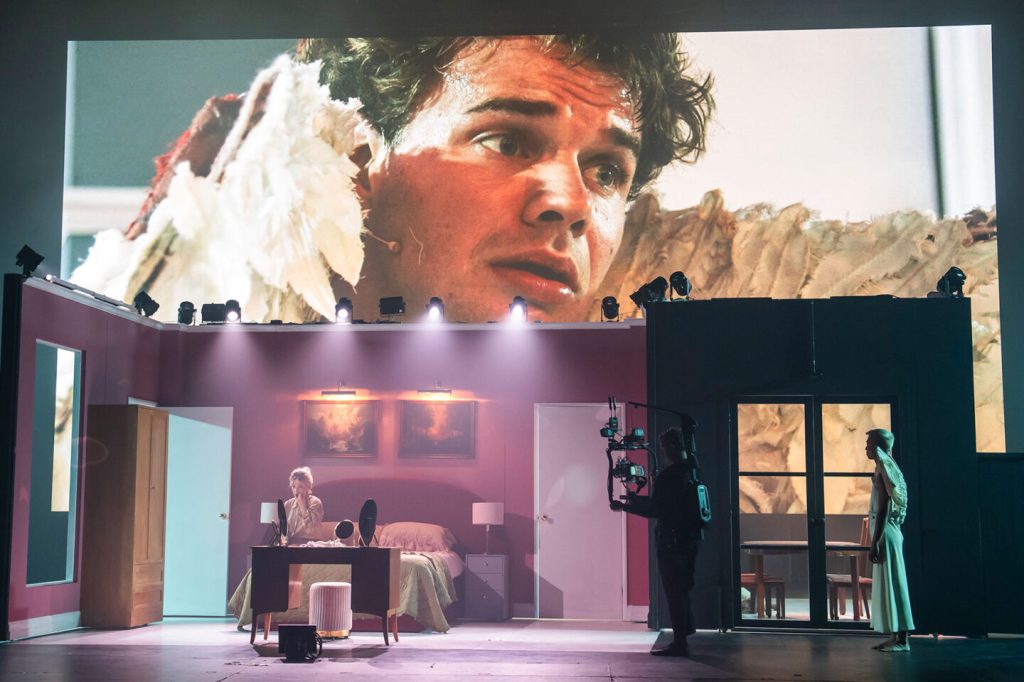
The blocking is extraordinary – one can only wonder at the imaginative prowess and ambitious planning involved in shooting what is essentially a live movie in a single take. The camera trio – Michael Barnes, Matthew Coulton and Rachel Laird – achieve the feat of making the visuals feel spontaneous, freewheeling, barely one step ahead of the chaos and corruption, yet hit their marks with frightening precision time after time. (An interview in the programme explains that they are also movement experts.)
Some of the frozen, snapshot moments could almost be framed, as voyeuristic or concerned observers hover, perfectly placed in the background, or lined up to show certain characters through windows or even reflected in mirrors. Impressively, they are in complete control of what we can and cannot see, finding ways to make us watch the unwatchable.
The cast do a spectacular job of matching the kinetic energy of the sound and visuals. There is nowhere for them to hide. Leading the charge is Allison Cook as Mrs X.E., fixing the character at the exact point before malignant madness tips over into hysteria, her fearsome range travelling from fever-pitch highs to guttural, base lows. Rodney Earl Clarke conveys the weak, broken-spirited Mr X.E. without sacrificing his baritone’s soulful strength.
Matthew McKinney and Mariam Wallentin were impressive as the captive angels, forced to convey their agonies as much through constrained physical movements as singing – although an unleashed Wallentin in particular provides one of the most unnaturally cathartic moments in the opera with the grinding punk set piece ‘Brick J’.
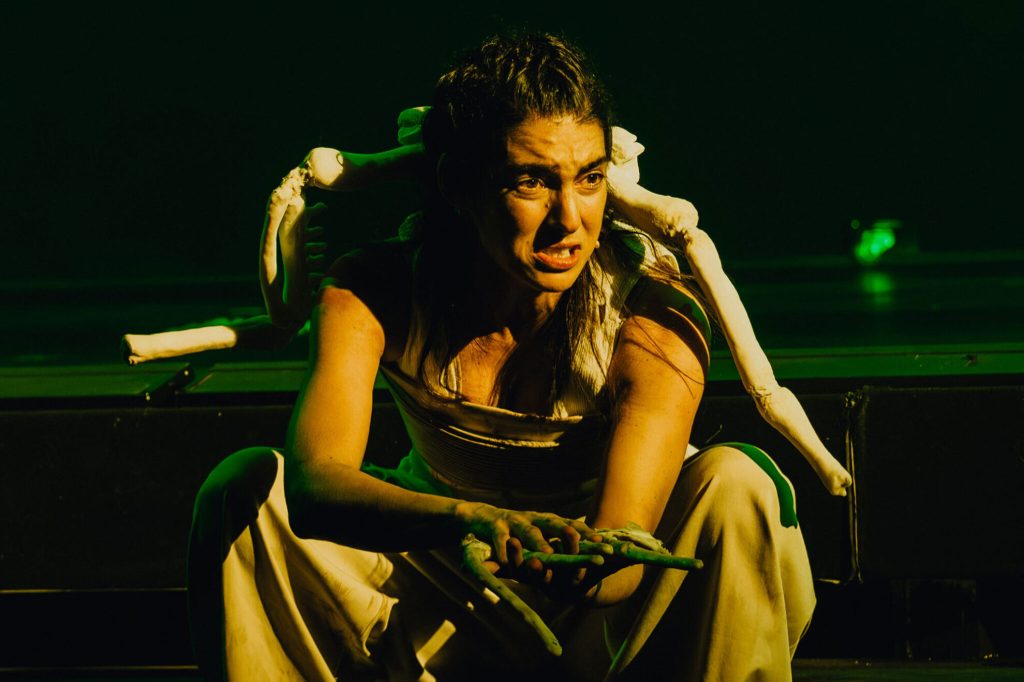
Keith Pun also cuts a haunting figure as a third, watchful angel, seemingly powerless to intervene, his male soprano register underlining his unspoiled, intact state. The Kantos Chamber Choir give an unforgettable group performance as the X.E.’s clients, collectively chilling as apparent socialites and revellers sliding all too readily into decadence, then degradation.
Something stops ‘Angel’s Bone’ from being simplistic exploitation, taboo-busting for the sake of it, a ‘shabby little shocker’. It could so easily collapse into simplistic vitriol, but in fact delivers one theatrical or musical coup after another. I think this virtuosity what makes it so brilliantly uncomfortable: in the audience, one feels a kind of queasy exhilaration – the tension between enjoying the bravura way the opera is staged and performed, and enduring its constant, terrifying events.
I have one misgiving: as brilliant as Kantos were, I would like to have seen the ENO Chorus tackle this piece, the demands of which play to their particular strengths of individual characterisation and movement. If the ENO Orchestra can take over from the BBC Philharmonic in the pit, I don’t see the need to stand the Chorus down from local duties in their home venue. While I understand that ENO is now expected to operate in London and Manchester, to me that means both cities should benefit from the artistry of the existing ensemble. I’d also hope that any north-south collaborations would be just that, projects bringing forces together (like ENO’s multi-chorus War Requiem a few years back) – not discarding one of the company’s greatest assets.
Maybe they will get the opportunity in a future revival – ‘Angel’s Bone’ deserves to stick around, railing against the repertoire.
AA
Discover more from ARTMUSELONDON
Subscribe to get the latest posts sent to your email.

