2026 marks Wigmore Hall’s 125th anniversary, and the venue has been celebrating its birth year in style, with a fortnight-long festival of over 20 concerts. This jewel among them took us back to when the Hall opened its doors, with every song featured dating back to 1901.
Followers of this duo will already be familiar with their enthusiasm and flair for engaging, fascinating programming, so this was a perfect match between theme and team.
As so often, their selections featured some ‘all-timers’ (Debussy’s ‘Chansons de Bilitis’ and three of Mahler’s ‘Rückert Lieder’), but with more focus, if anything, on lifting up lesser known or performed works and composers deserving more attention. Here, for example, they included early cabaret songs by Schoenberg alongside mélodies from Bonis, Bordes and Massenet.
The concert worked on multiple levels. To begin with, framing it as a lunchtime recital – hour-long running time with no interval – meant there was no break in the mood, and the illusion that this could almost be like attending a concert of contemporary music some hundred years ago was sustained. (With – ahem – the performers using extremely primitive iPads.)
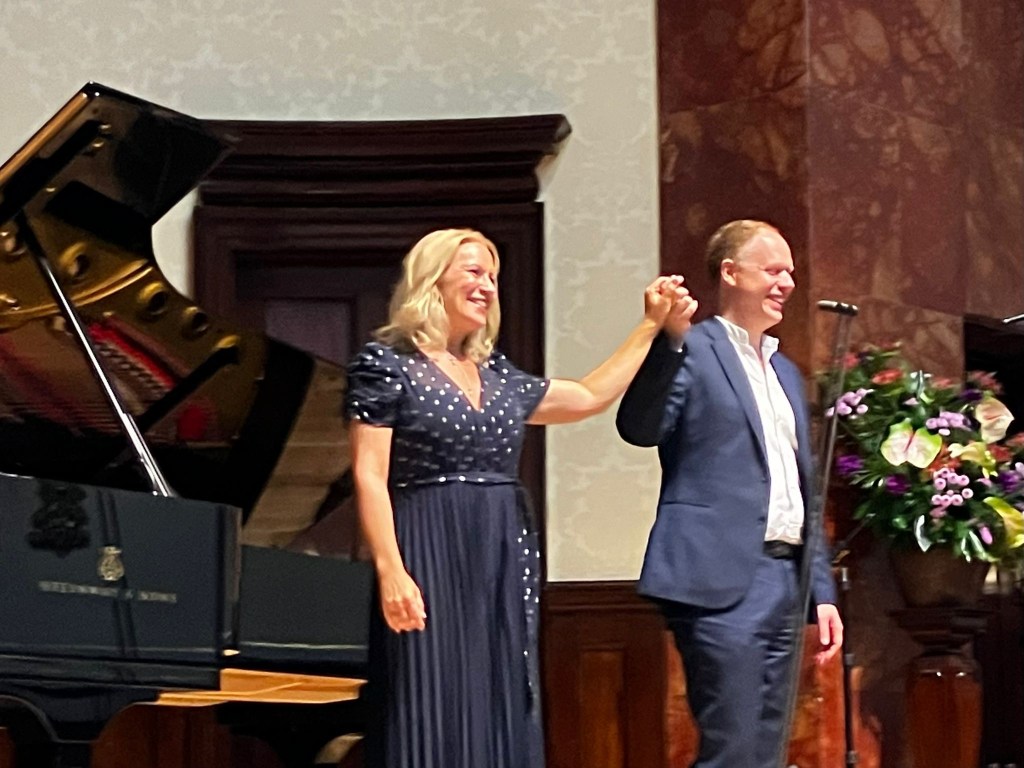
The slightly more informal vibe also enhanced the careful sequencing of the songs, which gently, gradually built up a kind of intimate abandon, moving through art song to that gorgeous hinterland where mélodie and chanson seem to blur, culminating in Schoenberg’s bravura entertainments.
These delicate shifts in character and intensity brought home to me more strongly than ever Sampson’s versatility as an actor-singer. One highlight for me from the whole concert was Debussy’s ‘La chevelure’ (‘The tresses of hair’), the second of the three ‘Bilitis’ songs. I sometimes feel that the first, ‘La flûte de Pan’ (‘The flute of Pan’), can overshadow the set due to its distinctive piano figure and vivid vocal story and melody… but not this time. Here, I heard ‘La chevelure’ as if I’d never heard it before: Sampson judged its heady eroticism perfectly, conveying its sensuality with such subtle changes of timbre and the slightest glances and movements: a masterclass in sensitivity.
Then, towards the end of the recital, the three Schoenberg songs place the soprano in a ‘gender-swap’ lusty-male scenario, allowing Sampson to broaden the characterisation out with brio – even the merest hint of good-natured swagger – into an energising, literally heart-racing finale. Middleton’s ability to calibrate these shifts in mood in complete sympathy with Sampson is testament to the rapport they’ve been building for over a decade now, since the release of their debut disc, ‘Fleurs’.
Sampson seems to have a special affinity and love for French song, and the two most powerful revelations for me were both mélodies. First, there was Mel Bonis’s ‘Reproche tendre’ (‘Tender reproach’), where Middleton’s steady, yet pulsing piano part runs like blood through the veins beneath Sampson’s elegant, gliding vocal… this tension gives a restraint, an ardent delicacy so suited to the lyric’s controlled passion.
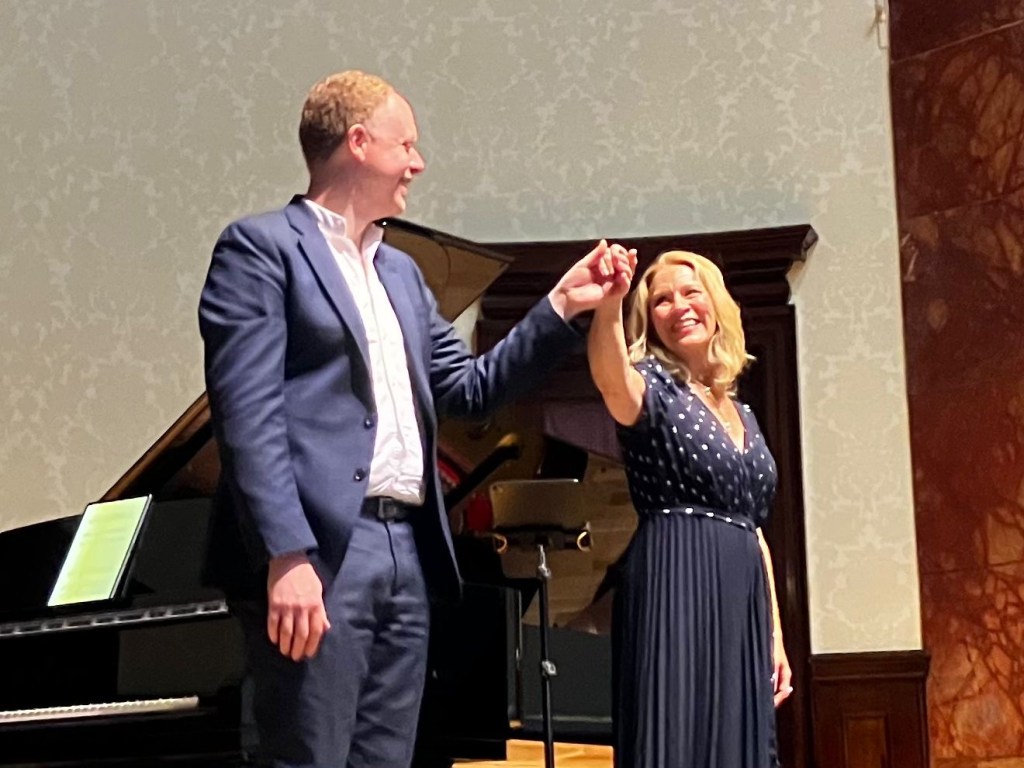
And I’m not ashamed to write that I was moved to tears by the duo’s performance of a Hahn song I was unfamiliar with: ‘La barcheta’ (‘The little boat’) from a set called ‘Venezia’. The lyric tells of a romantic gondola ride, sweetened by refreshing breezes. These take the form of a beautiful wordless refrain, which Sampson invested with a kind of wistful joy, prompting a contented sigh from the captivated Wigmore audience.
Even the encore was in tandem with the concept: in a brilliantly unexpected move, the duo hit reverse on the time-travel switch and performed a startling, newly-commissioned piece from Roderick Williams. In an instant, the recital covered the 125-year time span, with the piece uniting the accessible and the avant-garde, emphasising the place Wigmore Hall holds at the heart of art song’s ongoing tradition. I also felt it was a true reflection of the duo’s support of contemporary song and determination to include living composers in their programmes. (For just one example, listen to ‘but I like to sing…’, their 2023 disc celebrating Sampson’s 100th release, featuring work from Cheryl Frances-Hoad, Deborah Pritchard, Kaija Saariaho – still with us at the time of recording – and Errollyn Wallen.)
As a bespoke recital, the 1901 programme isn’t linked to any particular album release – however, you do have a chance to hear it. Like a number of other concerts from the festival, it was broadcast live on BBC Radio 3 and is now available on-demand on BBC Sounds. It is part of the Classical Live programme from Thursday 4 June, so should be on the site until around 3 July.
*
Coincidence corner: When I first saw this programme advertised, I thought – given the occasion – how fitting a concert it would have been for the defunct ‘Wigmore Hall Live’ label, which released a celebrated series of performances from the Hall on CD. Then, an email arrived this week announcing the revival of Wigmore Hall Live as a digital label through Apple Music Classical. It will be interesting to see how this initiative develops, but I hope they consider this recital for inclusion. It was one for the archives – and the ages.
AA
Main photo of Carolyn Sampson: Matthew Johnson. Applause photos: AA.
Discover more from ARTMUSELONDON
Subscribe to get the latest posts sent to your email.

